
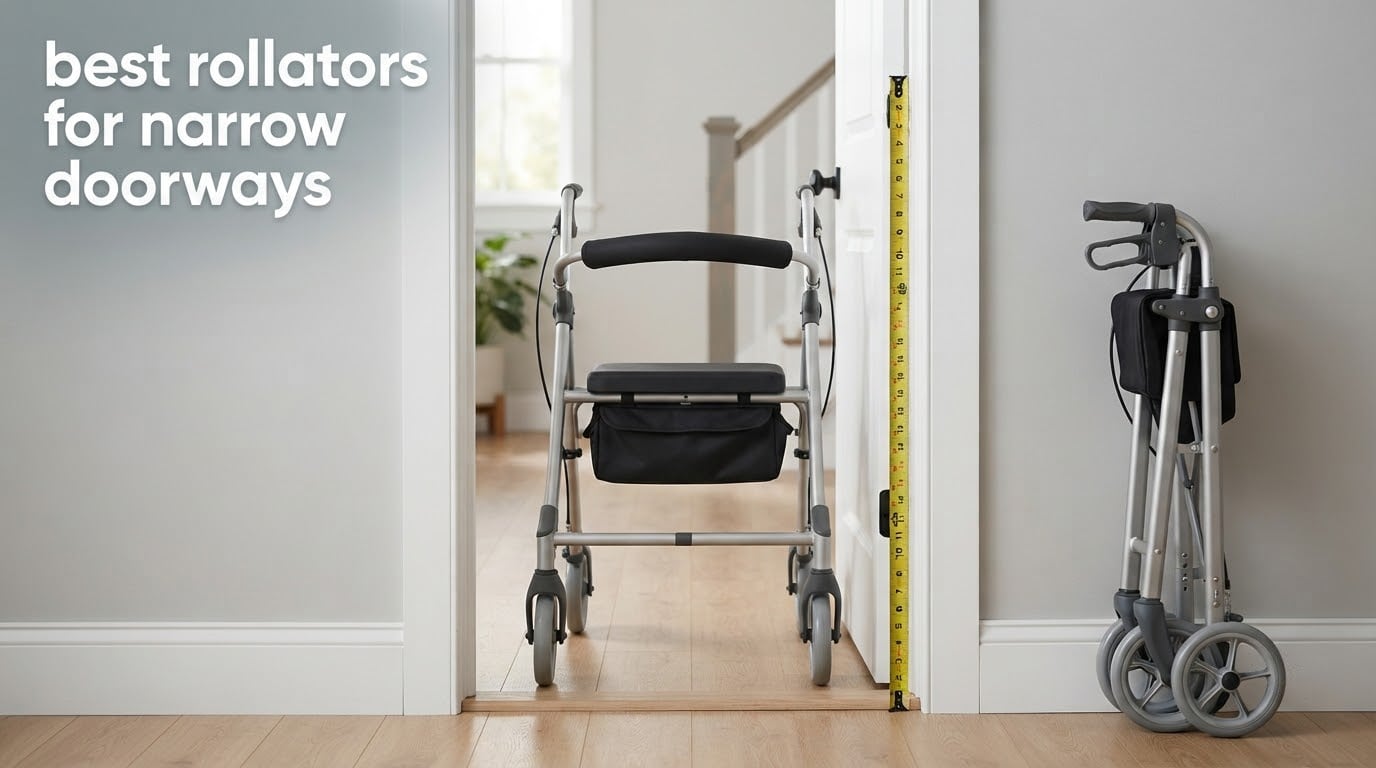
If you have ever stood in a hallway with a brand new rollator, lined it up with the bathroom door, and realized it was never going through, you are not alone. On the Bonesmart patient community, one poster put it plainly: My rollator is too wide to get into our bathroom. That single sentence is the reason this page exists, because the width is almost never the number you were shown when you bought.
Here is the surprise most shoppers run into. A standard four-wheel rollator is typically 24 to 27 inches wide overall, and a standard interior door gives you roughly 30 to 32 inches of clear opening once the door is swung fully back. So the front door was never the problem. The problem is the bathroom door, the bedroom door, the 90-degree corner just past the bathroom, and the door stop and handle knob eating into the frame.
So I spent the last several weeks going through rollator frames the only way that matters for this question: by published overall width, not by marketing language. Below you will find eight picks, every one with its measured or manufacturer-published width, and a plain-language line stating the narrowest doorway it will clear. Where a manufacturer does not publish a width, I say so instead of guessing, because a number you cannot verify is worse than no number at all.
We also built this around how the buying decision actually gets made. Caregiver groups show the purchase is often made by an adult child rather than the person who will use the frame, so the useful question is not which rollator is best but which one fits a specific door in a specific house. If you also have a runner in the household dealing with a fit problem of a different kind, our guides to running shoes for narrow feet and running shoes for narrow feet approach the same measurement-first problem from the other end.
Table of Contents
What width rollator fits a standard doorway?
A standard four-wheel rollator needs about 26 to 30 inches of clear doorway opening, and a narrow three-wheel rollator needs roughly 22 to 26 inches. Most interior doors give you 30 to 32 inches of clear width, so a standard rollator usually fits the front door. Bathroom doors in older homes and small apartments are often the narrowest opening in the house, which is why that is where the failure happens.
Three measurements decide whether a rollator fits, and shoppers usually only think about the first one. The first is overall frame width, the widest point of the frame with the handles at their narrowest. The second is the clear opening of the door with the slab swung fully open, which is narrower than the nominal door size because of the stop, the hinges, and the handle knob. The third is the turning radius needed to pivot through the frame and clear the corner on the other side.
That third one is why two rollators of identical width can feel completely different in a small bathroom. A 23 inch frame that pivots on a three-wheel geometry turns almost on a coin. A 25 inch frame on a four-wheel chassis with a wide rear axle needs real space to swing, and that is the number people miss when they measure only the door.
We used a simple rule to produce the doorway verdicts throughout this guide: take the published overall width and add two inches, which covers hand clearance on each side and normal side-to-side drift while walking. That figure is a starting point, not a guarantee. If your narrowest door measures 24 inches of clear opening, treat anything listed here as 26 inches or wider as untested territory.
How to measure your narrowest doorway in 3 steps
This is the method the caregiver groups keep asking for and almost no roundup publishes. It takes about ten minutes with a tape measure and it is the difference between buying the right frame and returning a bulky mobility aid.
1. Open the door all the way and measure the clear opening
Stand the door open to roughly 90 degrees, push it until the stop or the hinge pin stops it, and measure the gap between the door frame and the stop moulding on each side. Do not measure the nominal door width printed on the spec sheet. A door listed as 32 inches frequently yields 30 inches of actual clear opening, and in a 1970s interior door it can be less.
2. Measure the door handle and stop protrusion
Leave the door partly open and measure the narrowest point a frame has to cross, which is usually where the handle knob sits against the stop. Then subtract one inch of clearance per side from your clear opening figure. This is the number you actually compare against the rollator width on our list.
3. Walk the whole route and find the tightest point
Do not measure only the front door. Walk from the bedroom to the bathroom and note the narrowest opening and the tightest corner along the way, because a rollator that clears every door can still jam on the turn. A hallway wider than the door does not help if the corner behind it is 90 degrees and the frame has a wide rear axle.
If the narrowest opening on your route comes in under 28 inches of clear width, write those two numbers on a sticky note and take them to the store. That is your shopping list, and every product below states the doorway size it needs.
Top 3 rollators for narrow doorways in 2026
These three came out ahead because of the combination of published width, frame geometry, and the sheer volume of owner feedback behind them. The full list of eight follows.

NOVA GetGo Petite Ultra Narrow
- 22 inch overall width
- 15.75 inch between handles
- Padded seat included
- 13 lb frame

Vive Mobility Steel Narrow Rollator
- 23.5 inch published frame width
- 300 lb capacity
- Tool-free setup
- 19 lb steel frame

Stander Space Saver Rollator
- 26.5 inch overall width
- Folds to a 10 by 11 inch bundle
- Perch seat
- 14.5 lb aluminum
Best Rollators for Narrow Doorways (October 2026)
Width is the first column that matters and the only one most roundups leave out. Where a manufacturer does not publish an assembled width, we mark it rather than estimate. Doorway verdicts follow the width plus two inches of clearance rule described earlier.
| Product | Specifications | Action |
|---|---|---|
| NOVA GetGo Petite Ultra Narrow Rollator |
|
Check Latest Price |
| Stander Space Saver Rollator |
|
Check Latest Price |
 Stander Wonder Rollator Plus Short Stander Wonder Rollator Plus Short |
|
Check Latest Price |
| Vive Mobility Steel Narrow Rollator |
|
Check Latest Price |
 Vive Mobility 3 Wheel Walker Vive Mobility 3 Wheel Walker |
|
Check Latest Price |
 Lumex 3 Wheel Cruiser Lumex 3 Wheel Cruiser |
|
Check Latest Price |
 Walk Mate 3 Wheel Rollator Walk Mate 3 Wheel Rollator |
|
Check Latest Price |
 Drive Medical Nitro Sprint Petite Drive Medical Nitro Sprint Petite |
|
Check Latest Price |
1. NOVA GetGo Petite Ultra Narrow Rollator
- Narrowest published width in this roundup
- 22 inches overall with 15.75 inches between the handles
- Only 13 lb so a short caregiver can lift it into a car
- Arrives nearly assembled with only handle bars and back bar to attach
- Padded seat and mesh pouch
- Handle range suits users around 4 ft 10 in to 5 ft 4 in
- Seat is firm and most owners add a cushion
- Brake tension needed adjusting out of the box for some users
- Folding action takes practice
- Storage is a pouch rather than a metal basket
This is the one I keep coming back to, and the reason is a number rather than a feeling. The manufacturer lists it at 22 inches wide overall and 23.5 inches deep, with 15.75 inches of clear width between the handle uprights. That figure is the narrowest published overall width of any rollator in this guide, and it is the only one here that combines a real padded seat with a frame that narrow.
Fits doorways of 24 inches or wider. On a standard interior door with 30 inches of clear opening, that leaves close to four inches of margin on each side, which is enough to walk through without crabbing sideways. I have also seen owners specifically target it at condo and apartment interiors where the hallway itself is barely wider than the frame.
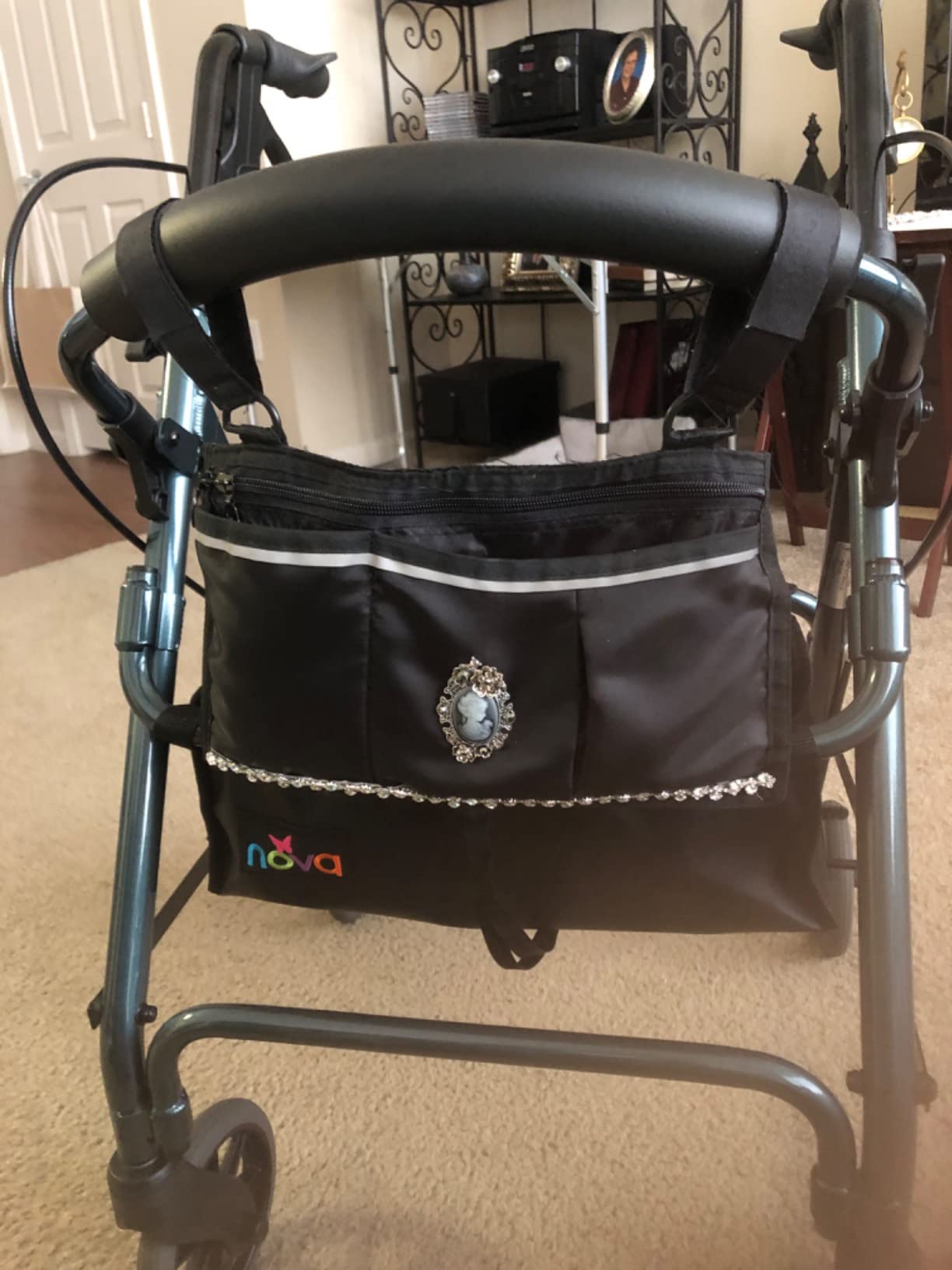
The height range is the part that gets overlooked. Handles adjust from 29 to 33.25 inches, and the listed user height is 4 ft 10 in to 5 ft 4 in. That makes it a genuine petite frame rather than a narrow frame that happens to be tall, and it is why this model shows up so often in caregiver threads about petite seniors. A narrow rollator with a handle floor at 33 inches solves half the problem for a short user and creates the other half.
Weight capacity is 300 lb, which covers most users but not the heavier end of the range. Wheels are 6 inches, so it handles carpet, tile, and smooth floors well and gravel poorly. The seat is padded rather than a bare perch, though owners describe it as firm, and the storage is a pouch instead of a wire basket.
Who it suits
This suits a short user in a small apartment with a bathroom door under 28 inches who still wants a seat to sit on when a rest is needed. It suits the caregiver scenario better than almost anything else here, because 13 lb is light enough for a smaller adult to lift into a car trunk without assistance.
If you want the narrowest frame with a seat, this is the pick. It is also the safest answer when the person buying is not the person using it, because the width, the height range, and the weight are all published and all checkable before the order ships.
Who it should not suit
Skip it if you need more than 300 lb of capacity, or if you plan to take it onto gravel, grass, or uneven ground where 6 inch wheels will fight you. It is not a travel rollator in the airline sense either, since the folded bundle is still 35.5 to 40 inches long.
If your priority is raw lightness and you do not need a seat, the three-wheel option further down this list weighs less and folds smaller. The folding action here also needs practice, and several owners report adjusting brake tension before the first walk.
2. Stander Space Saver Rollator
- Patented EZ Fold-N-Go collapses to a 10 by 11 inch footprint
- Pre-assembled and usable out of the box
- Frame narrows by lifting the handle to pass tight doorways
- 14.5 lb aluminum with 6 inch wheels
- Rear brakes lock for sitting
- Perch-style strap seat is firm for long rests
- Rear wheels sit slightly wider than the front and can catch a frame on sharp turns
- Some owners report rear wheel and basket wear over time
- Handle range suits shorter users only
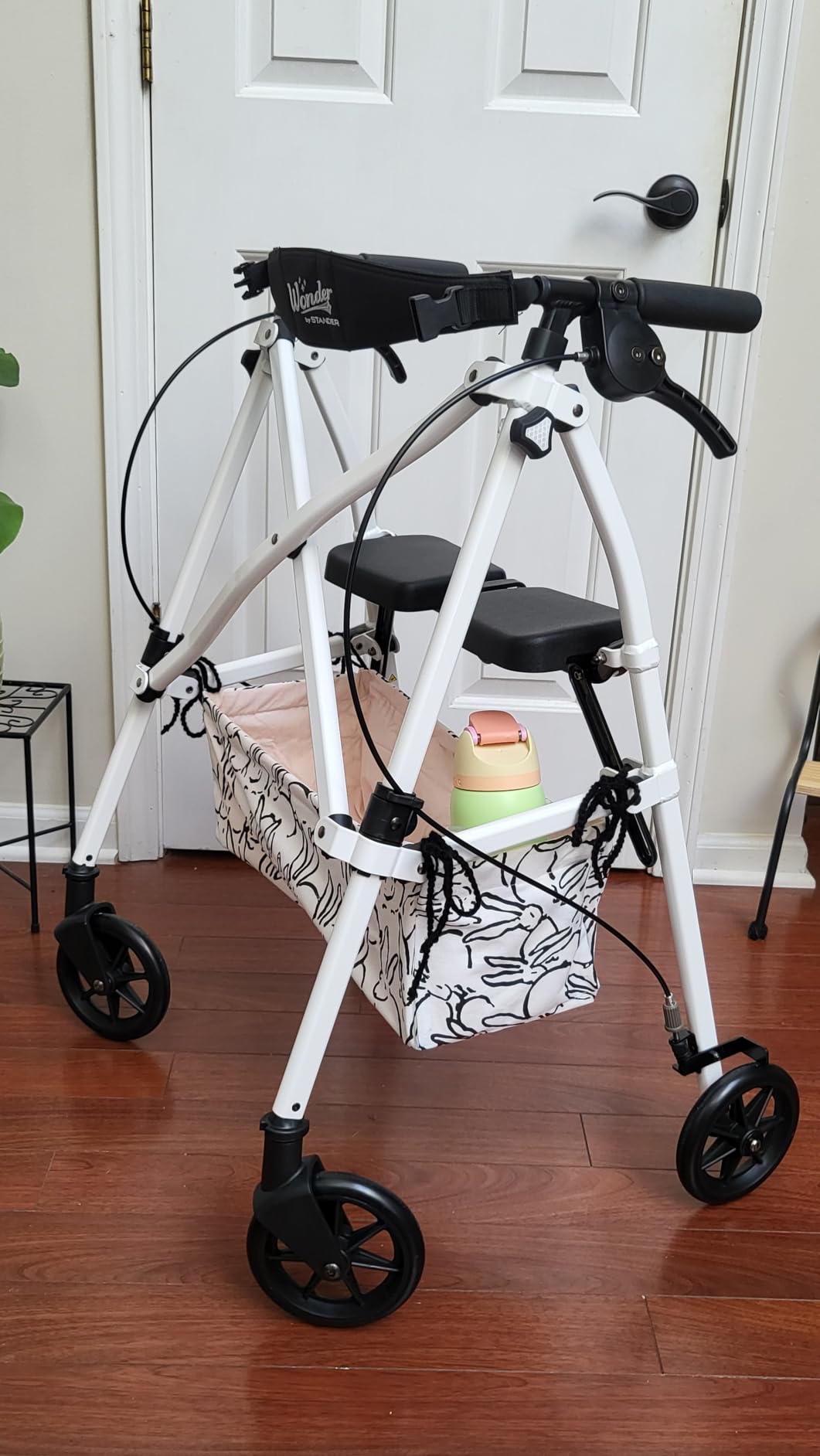
Published dimensions are 23 inches deep by 26.5 inches wide by 36 inches high, so this is not a narrow-by-nature frame. What makes it interesting for this topic is the folding behaviour and the handle-triggered narrowing that owners describe in reviews, which lets the frame pull inward as you pass a doorway.
Fits doorways of 29 inches or wider. That is wider than a true ultra-narrow frame, so if your bathroom door has less than 30 inches of clear opening this is the wrong tool. In a home with standard interior doors and a need to store it in a closet or ride in a car, the 10 by 11 inch folded bundle is genuinely the best in this roundup.
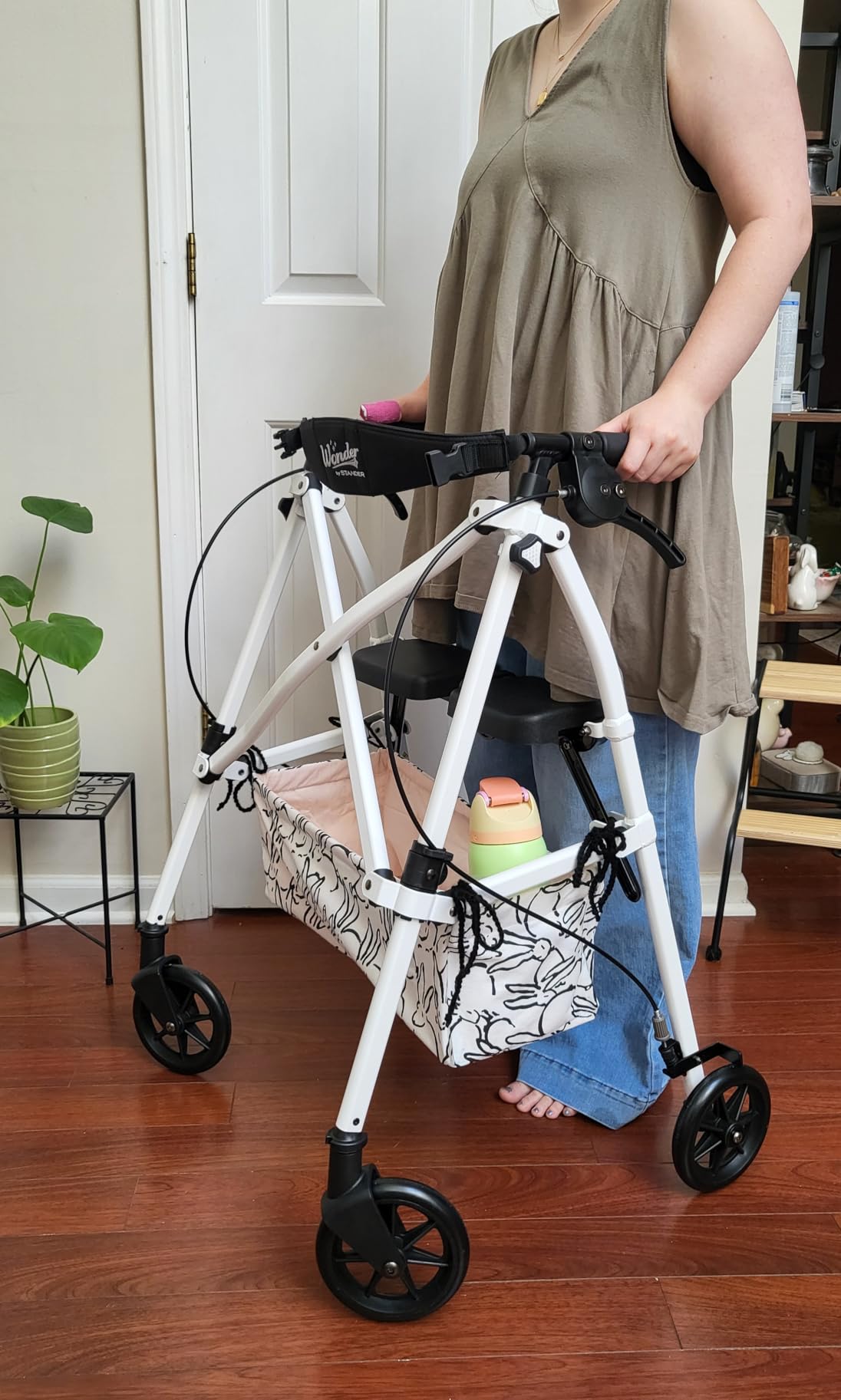
The handle adjustment runs 33 to 36 inches, which is a short-user range. Taller users will want the standard version of the same frame instead. The seat is a non-slip perch rated to 250 lb, which is fine for a short sit while you gather your breath but not a place to rest for twenty minutes.
Capacity is 250 lb, the lowest in this guide, so this is a frame for a lighter user. Reviewers repeatedly single out two things: how small it packs, and the trick of lifting the handle to narrow the frame through a doorway, which several owners call the deciding factor in a small home.
Who it suits
This suits someone in a home with normal-width interior doors who travels frequently, needs the rollator to live in a car or a closet between uses, and weighs under 250 lb. The pre-assembled frame also means it arrives ready to walk, which matters when the person assembling it is a caregiver with limited strength.
It is also a good second rollator for a home with a tight entry closet, because a bulky frame stored in a hallway becomes an obstacle every single day.
Who it should not suit
Do not buy it for a genuinely narrow doorway. At 26.5 inches overall it is a standard-width frame, and the handle-lift narrowing helps but does not turn it into a 22 inch rollator. It is also not the right pick for a user who needs frequent long rests, because the perch seat is basic.
The rear wheels sitting slightly wider than the front is worth knowing about, because owners report the frame catching a door edge on a hard turn. If your route involves sharp 90 degree turns in a tight hall, a three-wheel frame turns better.
3. Stander Wonder Rollator Plus Short
- Short sizing with a 27 to 30 inch handle range matched to users around 5 ft 2 in and under
- Same space-saving fold-down as the larger Space Saver
- Pre-assembled
- Frame narrows when you lift the handle
- Stable despite the small footprint
- Perch seat is firm and better for brief rests
- Some units have reported basket cracking after moderate use
- Rear wheels slightly wider than the front can catch a frame
- Basket and no-basket model numbers are easy to confuse when ordering
This is the Space Saver idea built for a shorter body, and the difference is the handle range. Handles adjust from 27 to 30 inches against a 33 to 36 inch range on the standard frame, which is a meaningful eight inch difference for someone around 5 ft 2 in or under.
Published dimensions are 22 by 25.5 by 30 inches, making it 25.5 inches wide overall. Fits doorways of 28 inches or wider. It is not the narrowest frame we list, but it is the narrowest four-wheel rollator here with a handle floor low enough for a genuinely short user, and those two things are usually confused.
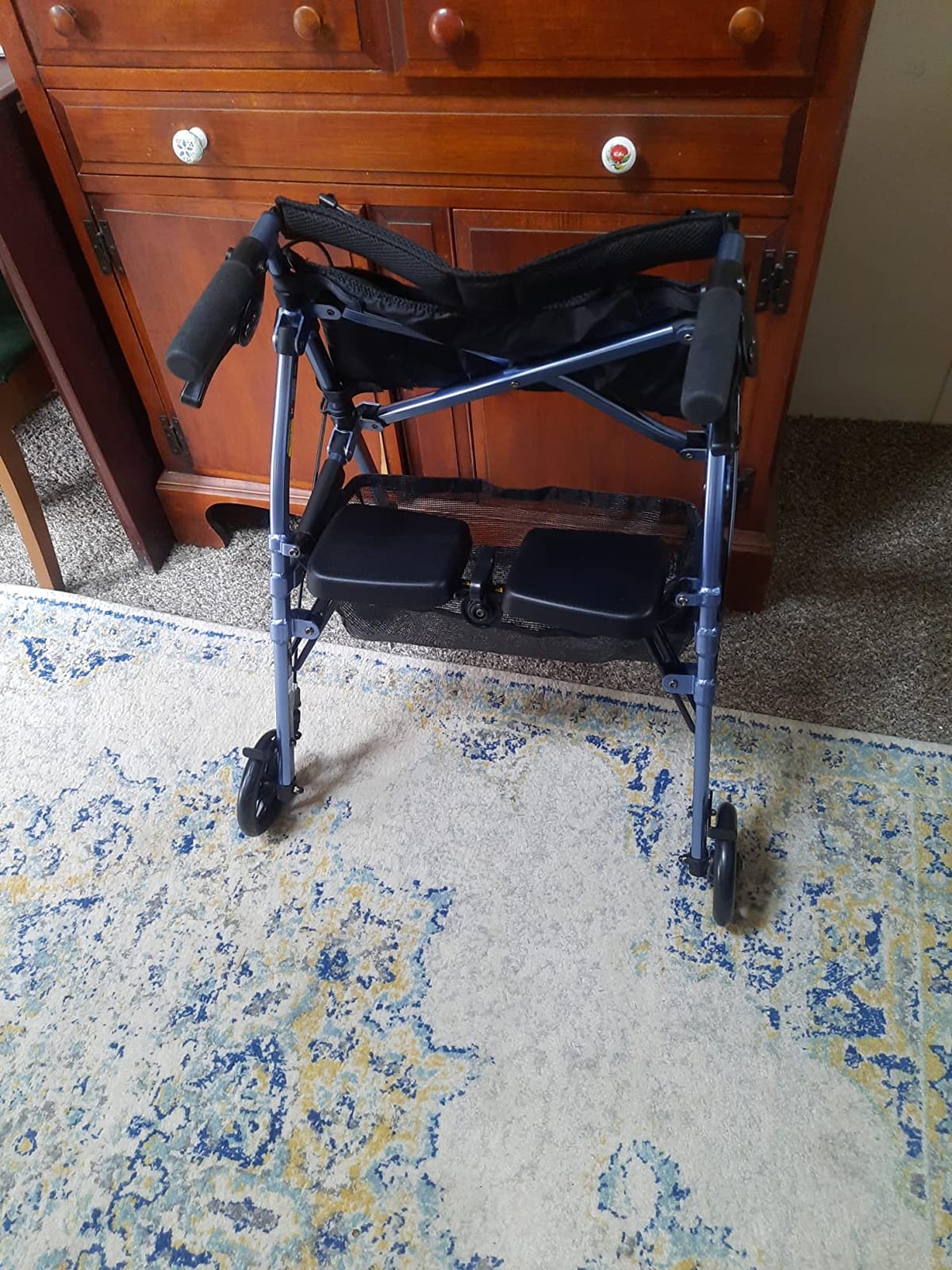
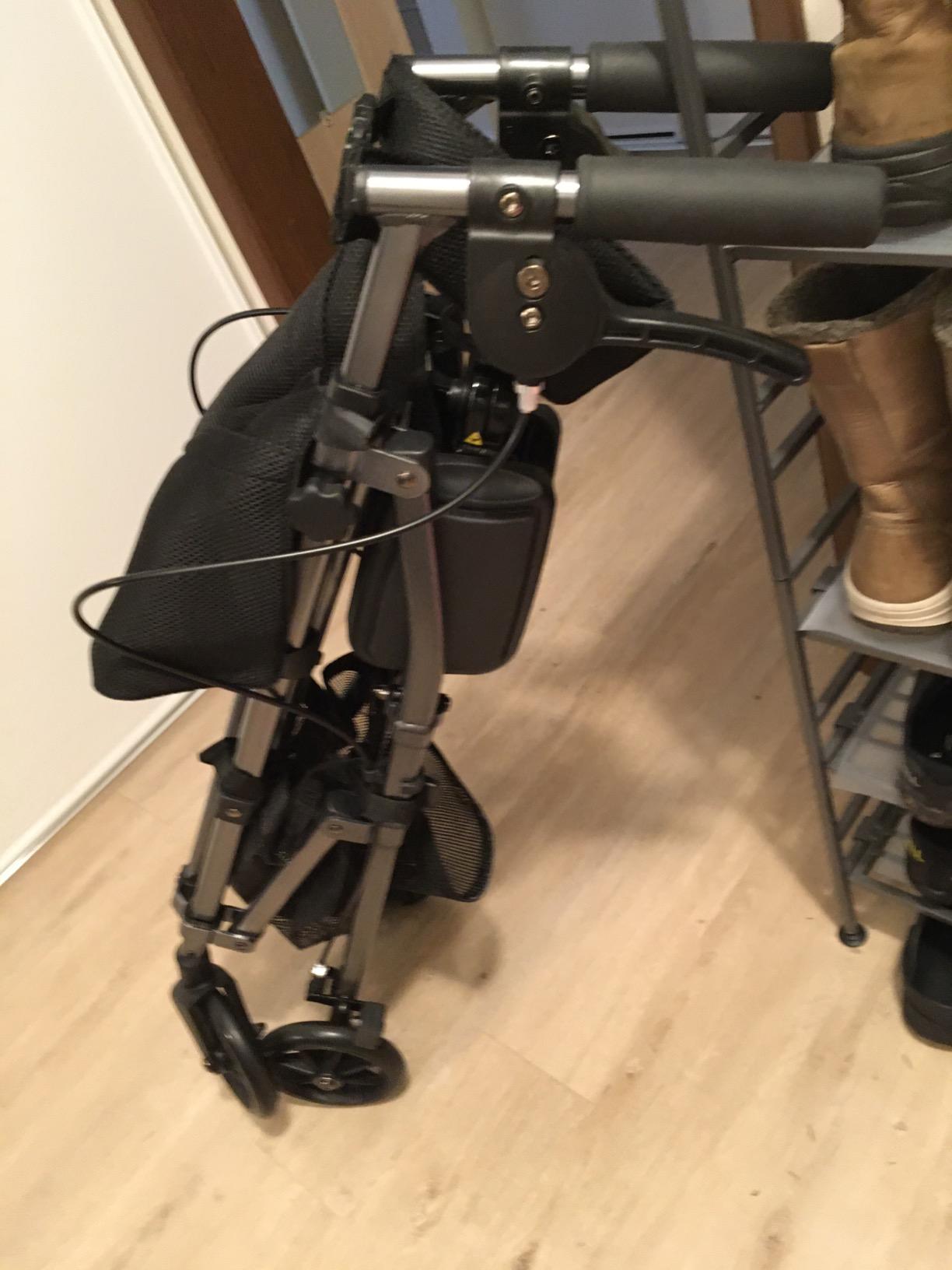
Weight is 14.5 lb, identical to the larger frame, and it folds to the same 10 by 11 inch bundle. The perch seat is 15.5 by 6 inches and rated to 250 lb. Front pouch plus a larger under-seat net gives more carrying capacity than the perch-style models that rely on a single bag.
Brakes lock at the rear, wheels are 6 inches, and the frame is aluminum. Several reviewers mention using the lift-the-handle narrowing to get through doorways, and the general consensus on build quality is strong for a frame at this size.
Who it suits
This suits a user around 5 ft 2 in or shorter who needs a four-wheel frame with a seat and a handle height low enough to walk upright without stooping. Short users are the group most often sold a standard-height rollator with no low setting, and this is the fix.
It also suits anyone who wants the small folded bundle without moving to a three-wheel frame, which means keeping a seat. The pre-assembled design means almost no setup before the first walk.
Who it should not suit
Skip it above about 5 ft 4 in, where the 30 inch handle ceiling will feel too low, and skip it above 250 lb. It is also not the right pick for a very narrow doorway under 28 inches, where a 25.5 inch frame is workable but tight.
The firm perch seat is the other limitation. If the intended use includes sitting for a while on a bench substitute or a long corridor, spend the effort on a padded seat instead.
4. Vive Mobility Steel Narrow Rollator
- 23.5 inch published frame width aimed squarely at tight hallways and doorways
- Highest average rating in this roundup at 4.7 across 500-plus reviews
- 300 lb steel capacity
- Folds flat for trunks and small closets
- Tool-free assembly with a storage bag included
- 19 lb steel frame is heavier than the aluminum options here
- Standard-width seat rather than a perch or oversized padded seat
- Handle floor of 31 in is too high for a user under about 5 ft 1 in
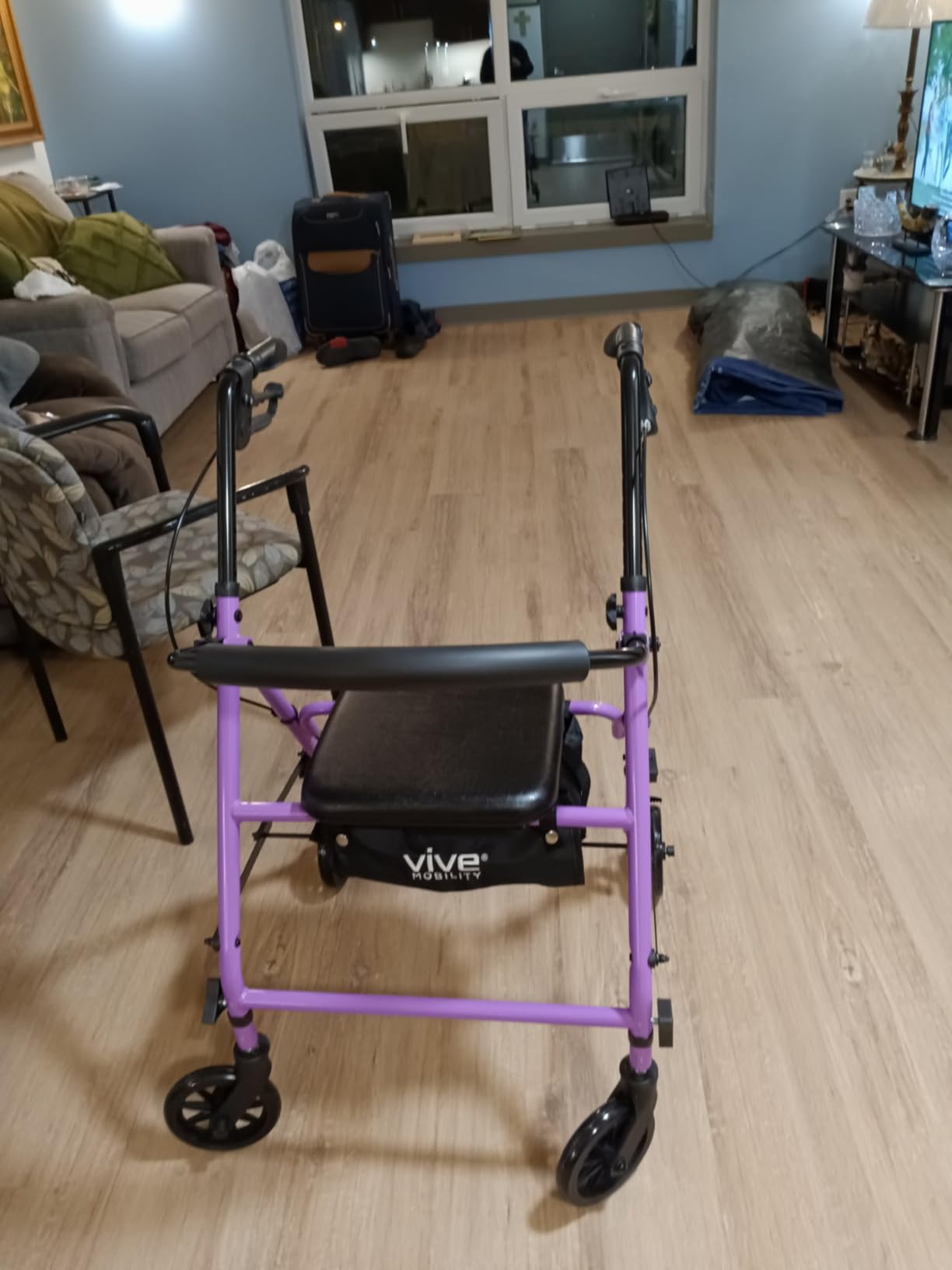
The manufacturer publishes a 23.5 inch frame width, and that single published figure is why this one is here. It is the second-narrowest confirmed width in the roundup, and it is paired with a 300 lb capacity, which most narrow frames cannot offer.
Fits doorways of 26 inches or wider. In a house where the bathroom door clears 28 inches with the slab open, this is a realistic frame that also holds a larger user and includes a seat. The steel construction is the trade you make for the width, and it is a trade worth understanding before you decide.
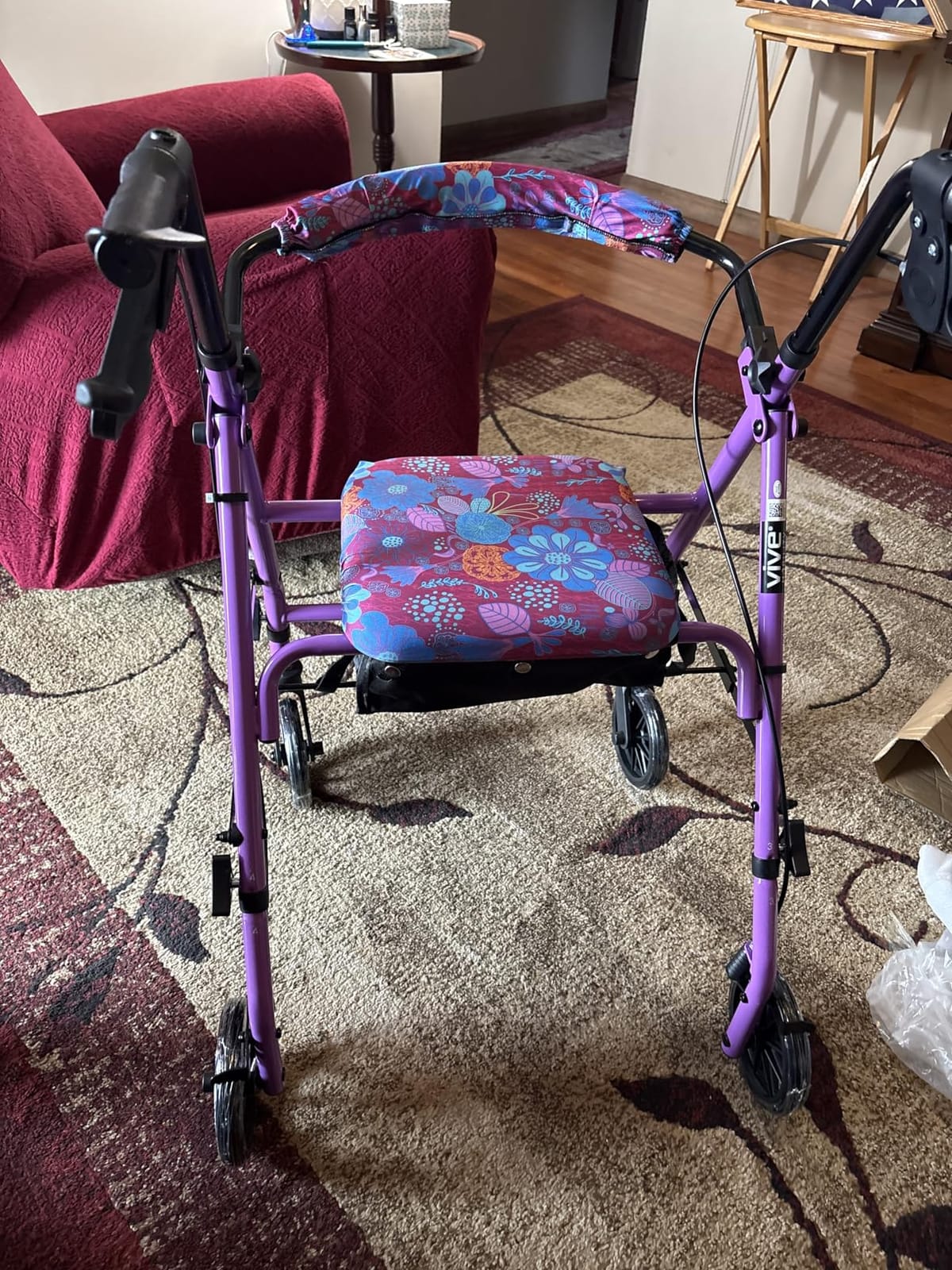
At 19 lb, this is one of the heavier frames here. Buyers mostly accept that in exchange for the narrower published width and the higher capacity, but a short caregiver lifting it into a car will feel the difference against a 13 lb aluminum frame. It folds flat for trunk storage and small closets, and assembly is tool-free.
Handle height adjusts from 31 to 36 inches, which is a normal adult range rather than a petite range. If you are under roughly 5 ft 1 in, the handle floor is too high and you should look at the short-frame option instead. Wheels are smooth-gliding and rated for both indoor and outdoor surfaces.
Who it suits
This suits a user who needs both a confirmed narrow width and a 300 lb capacity, which is an unusual combination and the reason this model exists in the category. It suits an adult-height user in an apartment with a tight bathroom doorway who still wants a full four-wheel frame with a seat.
It also suits anyone who prefers a simpler tool-free setup over a lightweight frame, since assembly takes minutes and no hardware is included to lose.
Who it should not suit
Skip it if weight matters for transport, because 19 lb is a real load for a caregiver or for a user loading their own car. Skip it if you are a short user, since 31 inches is the lowest handle setting.
The other limitation is the seat, which is a standard width rather than a perch or an oversized padded seat. For a user who rests frequently, that is the detail to check against your actual needs before ordering.
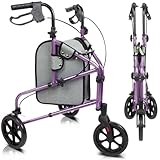
5. Vive Mobility 3 Wheel Walker
- 11 lb
- easy to load into a car by the user themselves
- Folds very flat and narrows under pressure to pass tight openings
- Largest review base among the narrow three-wheel picks
- Removable zippered pouch between the frame rails
- Vive lifetime guarantee
- Three-wheel geometry is less stable than a four-wheel frame for poor balance
- No seat
- so resting requires finding other seating
- Front wheels catch on thresholds and cracks
- Manufacturer does not publish an assembled overall width
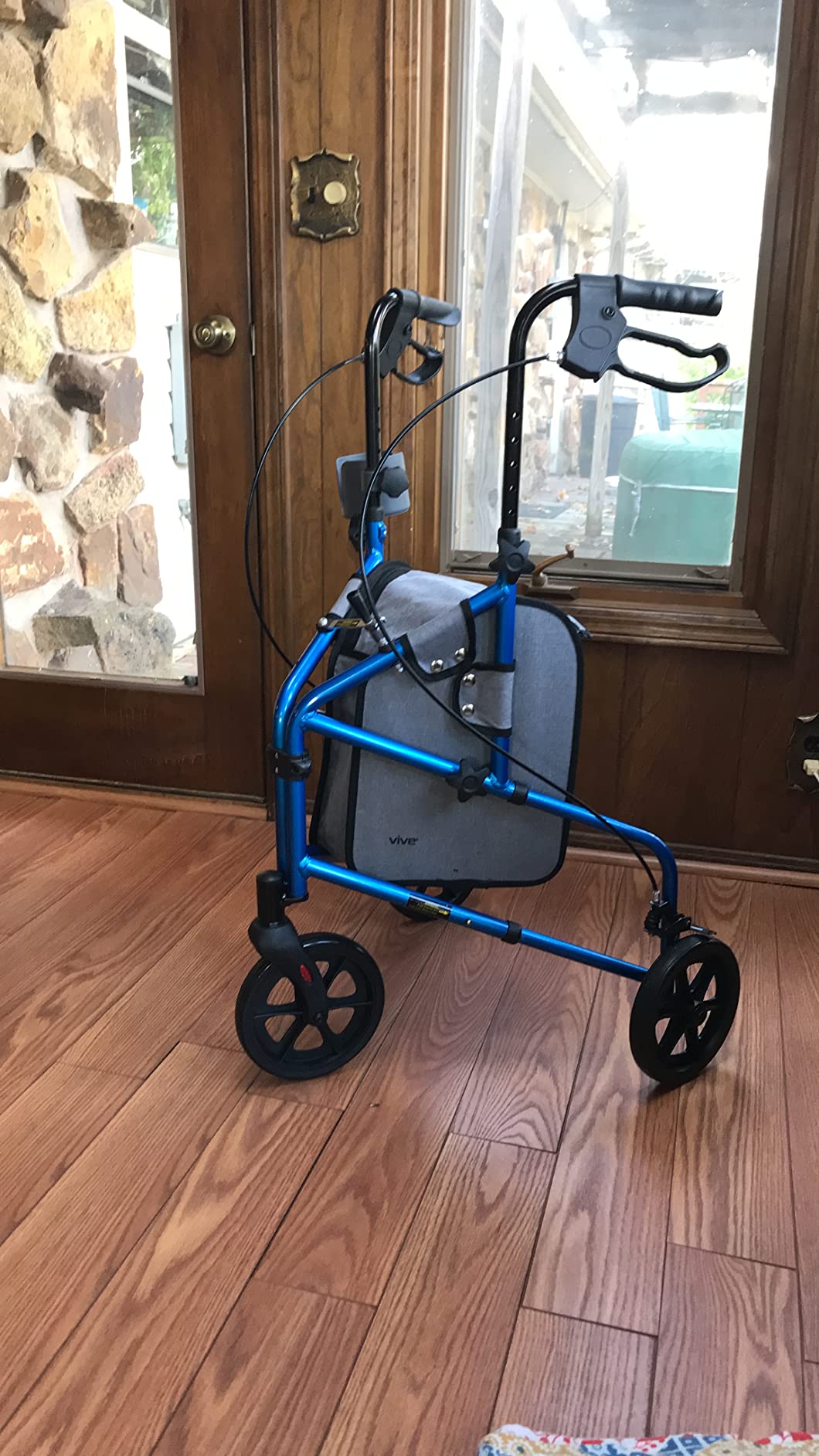
Here is the honest limitation: this manufacturer does not publish an assembled overall width for this model, and I will not invent one. What is published is an 11 lb weight, a package size of 28.74 by 16.14 by 8.27 inches, and a three-wheel frame with a wide back-wheel stance and a cross-brace for stability.
What owners report is that the folded frame can be squeezed slightly and will pass through a narrow bathroom doorway that defeated their previous four-wheel rollator. That is a real use case, and one reviewer in a manufactured home describes exactly the situation this article is about. Treat the width as unverified and measure your narrowest opening before ordering.
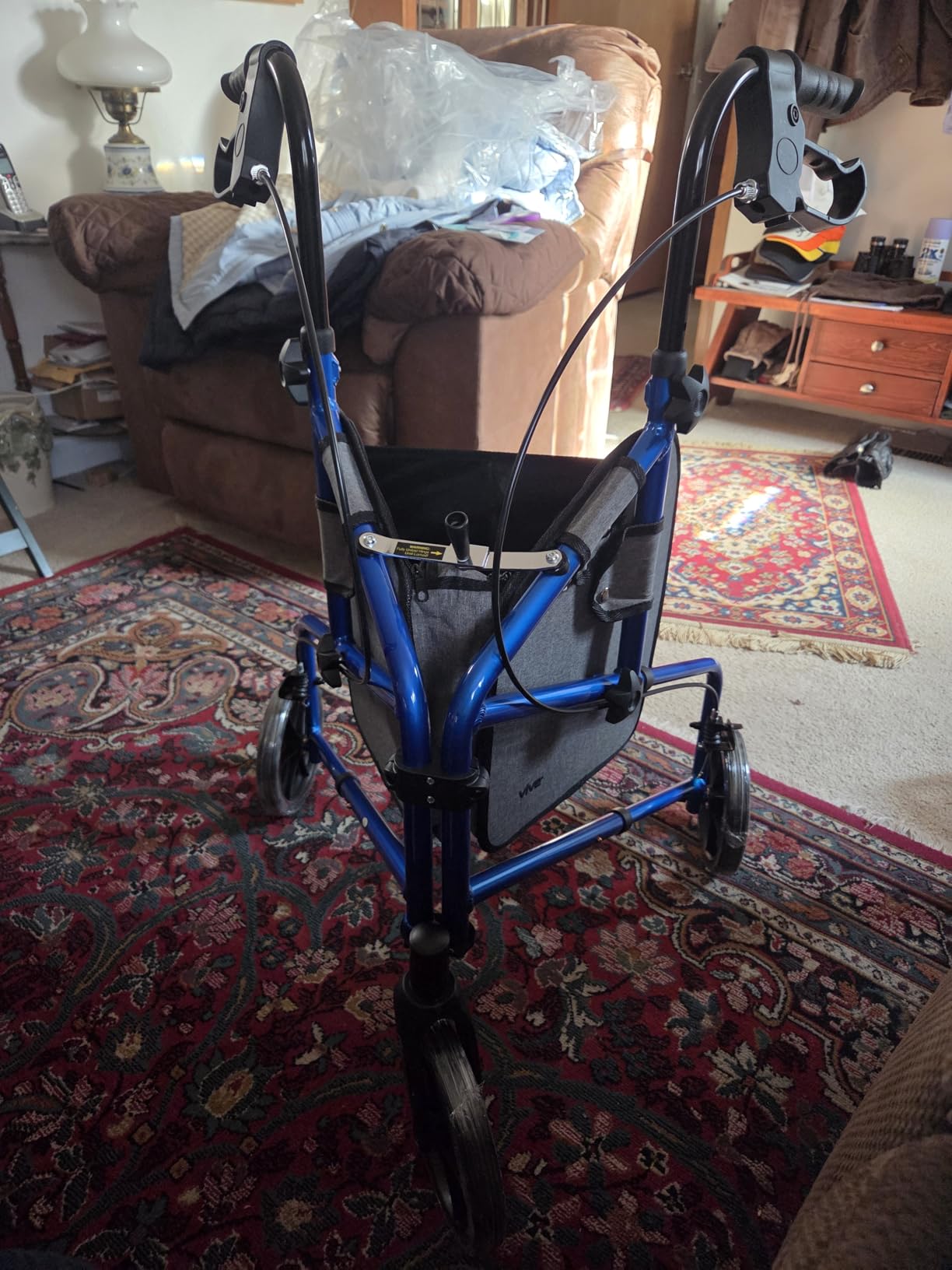
The case for this frame is lightness and turning. At 11 lb it is one of the two lightest options in this roundup, and the user can lift it into a car without a caregiver. Three-wheel geometry pivots tighter than any four-wheel chassis, which matters far more than width once you are past the doorway and into a small bathroom where a 28 inch vanity leaves almost no turning room.
Handles adjust in six positions, and the removable zippered pouch sits between the frame rails to carry a purse or a drink. The company backs it with a lifetime guarantee, which is unusual in this category and worth something on a bulky aid.
Who it suits
This suits a user with good enough balance for a three-wheel frame who does not need to sit down mid-route, and who travels alone or loads their own car. It suits a small bathroom where turning room is the real constraint rather than the door itself.
It also suits anyone who wants a warranty that outlives a typical ownership period, and anyone who will use the frame mostly indoors on smooth surfaces.
Who it should not suit
Do not buy it if balance is the reason you need a walker in the first place. Three-wheel frames give up the lateral stability of four wheels, and the reviews on this product carry the same caution explicitly. If you cannot stand unsupported for a moment while you reposition, this is the wrong frame.
There is no seat, so a user who needs frequent rest stops will end up sitting on a floor or a tub edge. And because the width is not published, you are buying the narrowness on the basis of owner reports rather than a spec. If your door measures under 26 inches of clear opening, confirm before ordering.
6. Lumex 3 Wheel Cruiser
Lumex 3 Wheel Cruiser – Lightweight & Narrow Three Wheel Walkers for Seniors & Tight Spaces
- 28 inch compact width built for small bathrooms and narrow doorways
- 8 inch wheels glide over carpet wood and tile
- Handle range of 33 to 37 inches covers many user heights
- Attached zippered pouch keeps items secure
- Long-established model with years of real-world use
- Three-wheel frame gives less lateral stability than a four-wheel rollator
- No seat for resting along the route
- 28 inch width is wider than the other narrow three-wheel picks
- Handle floor of 33 in excludes petite users
The Lumex publishes its width, and it is 28 inches. That is the widest published figure in this roundup, which surprises people who assume a three-wheel frame is automatically narrow. It is narrower than a heavy-duty four-wheel rollator and narrower than a bariatric frame, but it is not an ultra-narrow model.
Fits doorways of 30 inches or wider. So this is a good choice for a home with standard interior doors that needs a compact three-wheel frame, and a poor choice for the sub-28 inch bathroom door that drives most of the searches in this category. Publish the number, measure your door, and let the arithmetic decide.
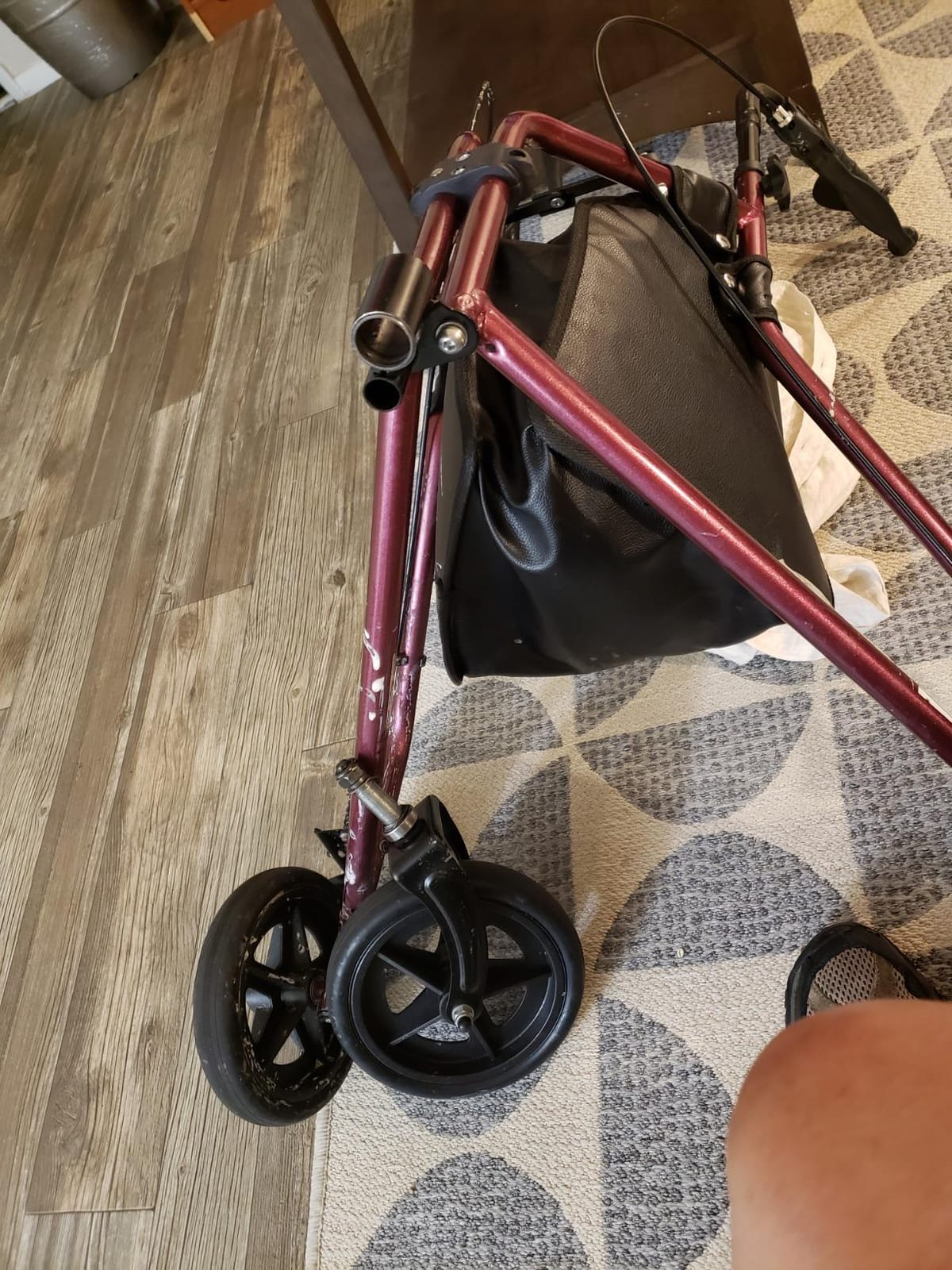
Where this frame earns its place is the wheels. At 8 inches they are the joint-largest in this guide, and owners repeatedly single out how smoothly they roll across carpet, wood, and tile, including uneven transitions between rooms. Frame weight is 13.8 lb with a listed product weight of 14 lb, which is genuinely portable for a three-wheel walker.
Handles adjust from 33 to 37 inches, a good spread for adult-height users and one that excludes anyone under roughly 5 ft 5 in. The attached zippered pouch is a nicer arrangement than a removable bag because you cannot lose it, and the capacity is 250 lb.
Who it suits
This suits an adult-height user with mixed flooring who wants a three-wheel frame that rolls rather than clatters, and who lives in a home with standard-width interior doors. It also suits anyone who prefers a long-established model with a large body of owner feedback over a newer design.
The wide handle range means one frame can serve a household where two people of different heights share it, which is a genuine advantage over the petite frames.
Who it should not suit
Skip it for a genuinely tight doorway, and skip it if you are a short user, because a 33 inch handle floor will have you stooping. There is no seat, so this is a walking frame rather than a rest-on frame.
As with any three-wheel design, users with significant balance issues are cautioned against it. The 250 lb capacity is also below the 300 lb figures on some four-wheel options here.
7. Walk Mate 3 Wheel Rollator
- Only pick in the roundup that combines a seat with a three-wheel frame
- 10.67 lb
- among the lightest frames here
- Single-strap fold narrows the frame for doorways
- 8 inch wheels with a 360 degree swivel front wheel
- Handle range covers users from about 4 ft 8 in to 6 ft
- Seat is very small and sized for a slim user
- Rear wheelbase is wider and longer than typical which can limit doorway fit
- Safety reports describe the frame shifting or tipping when the brakes are used as a seat
- Seat lock strap needs real arm strength
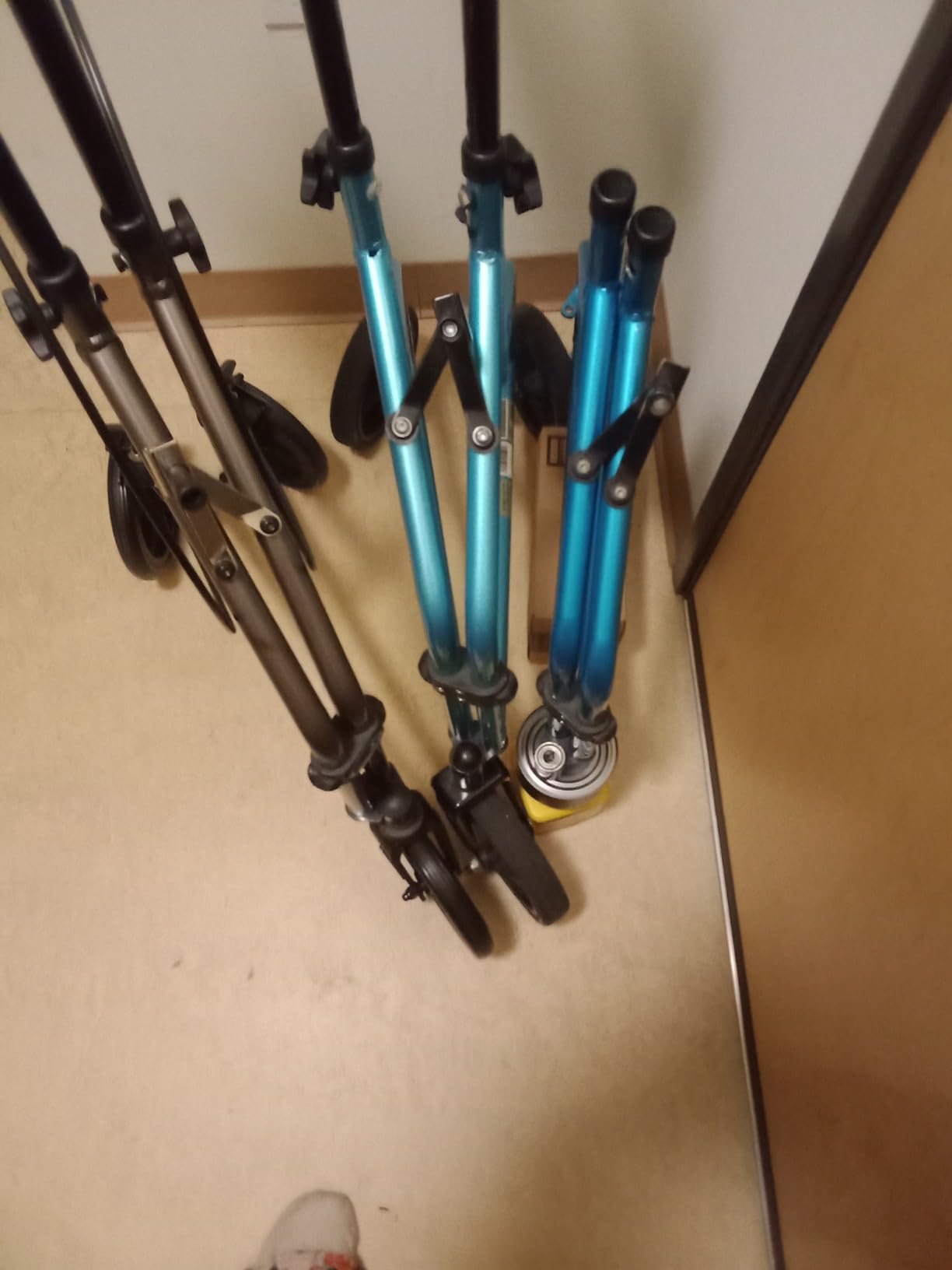
This is the only frame in the guide that gives you both a seat and three-wheel geometry, which in every other roundup is treated as an either-or choice. The catch is that the seat is explicitly sized for a slim user, and the frame is listed at 27.2 inches across.
Fits doorways of 30 inches or wider based on the listed dimension, and the single-strap fold is designed to pull the frame narrower as you lift it. But a reviewer reports finding the rear wheelbase too wide for their own bathroom door, and that is a fair warning to take seriously rather than dismiss.
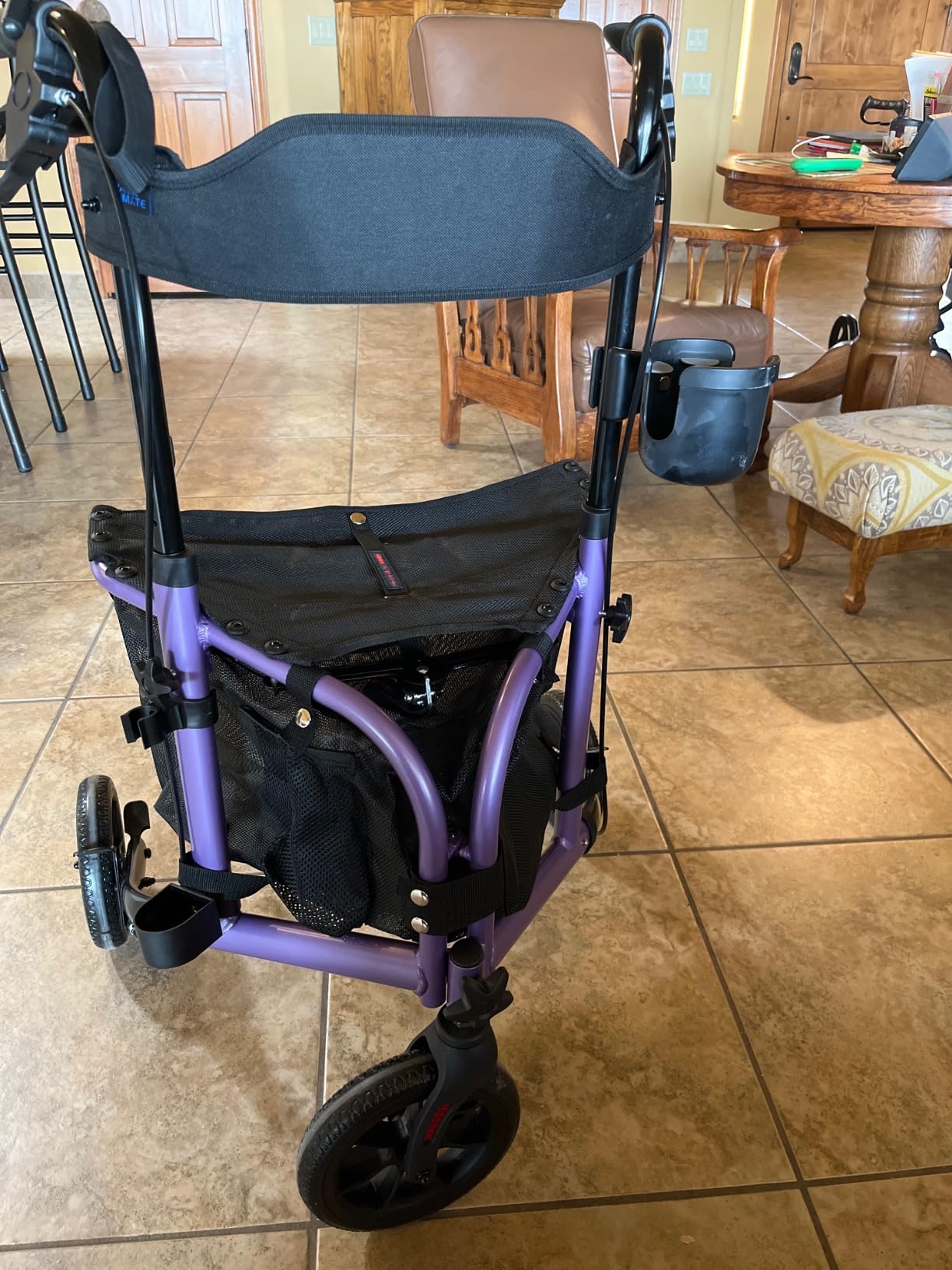
At 10.67 lb it is the lightest frame here, and the handle range of 32.3 to 37 inches across six levels covers an unusually wide spread of user heights, from about 4 ft 8 in to 6 ft. The 8 inch wheels with a 360 degree swivel front wheel handle doorways, lobbies, and pavement better than the 6 inch casters on the petite frames.
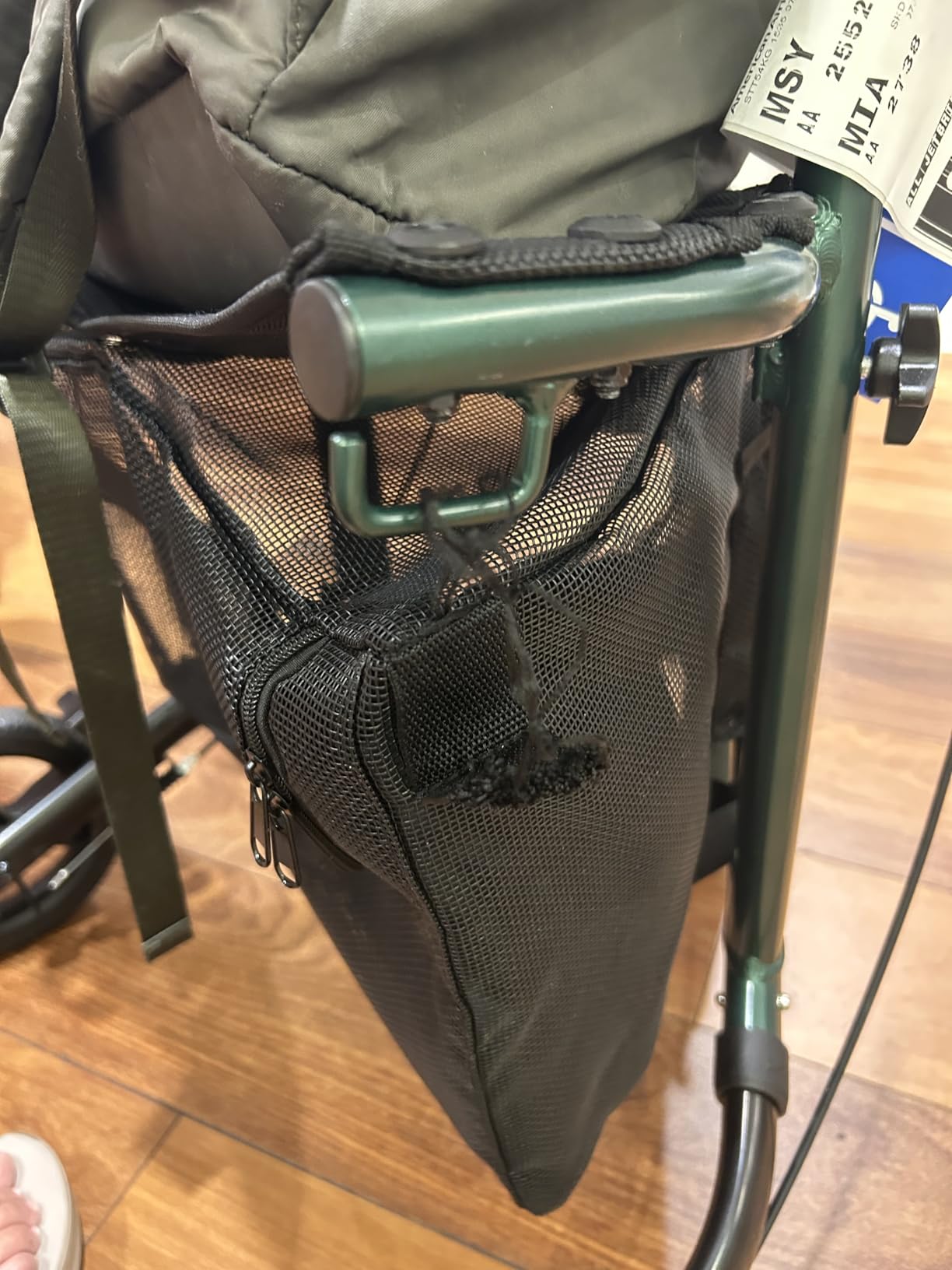
Storage is generous for the size: a removable mesh bag, a cane holder, a side pocket, and an elastic fold band. The mesh seat has a padded backrest and a strap lock, and the brake locks for sitting or stopping.
Who it suits
This suits a slim adult who weighs well under 250 lb, has the balance confidence for a three-wheel frame, and wants somewhere to sit without giving up the turning radius. It suits a mixed-surface home because of the 8 inch wheels with a swivel front caster.
For a user who travels solo and wants the lightest package, the weight is genuinely exceptional. The wide handle range also makes it the most height-flexible narrow frame in this guide.
Who it should not suit
Do not buy it for a large adult, because the seat is genuinely small and a perch that tight is uncomfortable within minutes. This one also carries the lowest average rating in the roundup at 4.0, and the negative reviews concentrate on safety rather than comfort.
Reports describe the rollator shifting or tipping when someone sat on it with the brakes engaged, and the seat lock strap is described as needing real arm strength. If the user has limited grip, this is a poor choice. The wide rear wheelbase also works against it in the very doorways this article is about.
8. Drive Medical Nitro Sprint Petite
Drive Medical Nitro Sprint Rollator Walker with Seat, Petite Height, Red
- Petite hemi-height sizing for users under 5 ft 2 in at a 350 lb capacity
- 10 inch front casters clear thresholds curbs and uneven ground
- Three-mode braking with slowdown control for downhill safety
- One-hand fold that clicks closed and stays locked
- Large padded seat with a wide contoured adjustable backrest
- Heaviest frame here at 19.29 lb
- which is a real drawback for vehicle loading
- Manufacturer does not publish an assembled overall width
- Brake levers are stiff for arthritic hands
- Backrest fabric and bag hooks have durability complaints
This is the best-established rollator on the list, with more owner reviews than anything else here, and it is included with a caution: it is not built for the tightest doorways. The product dimensions published are 32.28 by 28.94 by 9.65 inches, which correspond to a folded bundle, and Drive Medical does not publish an assembled overall width for this model.
Treat it as a conventional four-wheel width and confirm with the manufacturer before ordering if your narrowest door is under 30 inches of clear opening. What you get in return is the most capable frame here on rough ground, and the highest weight capacity in the roundup at 350 lb.
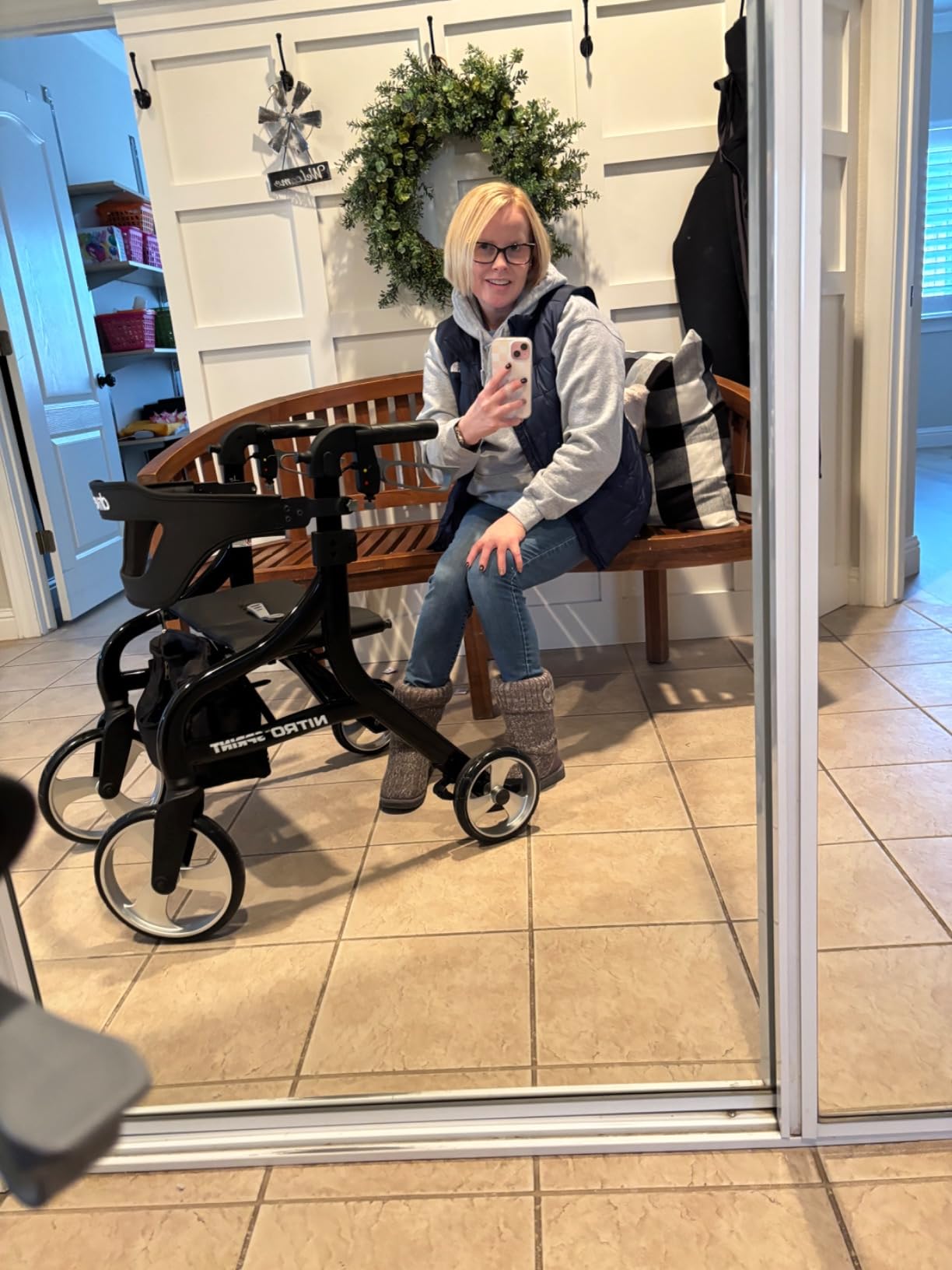
What makes this frame different is the wheel and brake package. The 10 inch front casters with improved tread roll over thresholds, curbs, and uneven ground in a way the 6 inch and 8 inch wheels elsewhere cannot, and the three-mode brake system offers free roll, slowdown resistance, and park, with the slowdown mode specifically intended to stop the frame running away on a slope.
Seating is the best in the guide: a large padded seat with a wide contoured backstrap that adjusts in height and has a viewing window. The one-hand fold clicks closed so the frame stays locked while it is being lifted, which is a real safety feature in a car boot. Storage mounts at three points with an accessory mount for a cane, phone, or cup holder.

Who it suits
This suits a user under 5 ft 2 in who needs a 350 lb capacity, and anyone who regularly crosses uneven ground, gravel approaches, or raised thresholds. It suits a user who values braking control, because the slowdown mode is a genuine safety feature on slopes and ramps.
It is also the pick for a household where the rollator will be lifted into a vehicle by a caregiver, since the one-hand fold that clicks closed prevents a half-open frame from swinging open mid-lift.
Who it should not suit
Do not buy it for a tight doorway. The frame is wide by design and the manufacturer does not publish a width, which makes it a poor fit for the sub-30 inch bathroom door that defines this category. At 19.29 lb it is also the heaviest frame in the roundup, which is a real drawback for anyone loading a car.
Stiff brake levers are a recurring complaint, and they matter for exactly the arthritic hands that often drive someone to a rollator in the first place. Backrest fabric detachment and bag hooks falling off the adjustment knobs are also reported. If either of those matters in your situation, choose a lighter aluminum frame with simpler hardware.
How to choose: 3-wheel vs 4-wheel narrow vs bariatric
The short version is that every frame architecture in this category makes the same trade in a different currency. Narrow frames buy width with stability and sometimes with the seat, and bariatric frames give both back the other way. Once you know which currency you are paying in, the choice gets much easier.
Three-wheel frames buy width with stability and the seat
Three-wheel rollators are the narrowest category and they turn best, because the single front wheel pivots rather than tracking. Every one of the three-wheel picks in this guide is between 28 and an unpublished width, which is narrower than any four-wheel frame here. The cost is lateral stability, and for a user whose balance problem is the reason they need a walker, that is not a small concession.
The second cost is the seat. Two of the three three-wheel frames here have no seat at all, and the one that has one is small and sized for a slim user. Forum threads describe this as a genuine loss of independence rather than a spec trade, and they are right. If you need to rest on the way to the bathroom, a narrow three-wheel frame will not solve that problem.
Four-wheel narrow frames are the balanced pick
A four-wheel rollator with a frame under 26 inches gives you a seat, a wider base, and better stability while still clearing most standard interior doors. This is why the NOVA GetGo at 22 inches is our editor’s choice: it is the narrowest published frame in the roundup that still has a padded seat, a 300 lb capacity, and a handle range that suits a short user.
The trade is turning radius. Four-wheel frames with wide rear axles need more space to pivot, which is the failure point in a small bathroom where a vanity or a toilet leaves a tight turn just past the door. This is also where the two Stander frames in this guide differ from the NOVA: the handle-lift narrowing helps, but a 25.5 or 26.5 inch frame is still a standard-width frame.
Bariatric frames are a hard exclusion below 30 inches
Heavy-duty rollators run 26 to 28 inches wide by design, because the steel frame and wider axle that support 350 to 400 lb occupy more floor space. None of them appear in this roundup for that reason, and if you need that capacity, the Drive Medical Nitro Sprint at 350 lb is the widest frame here for the same reason.
So a heavy user in a house with a 30 inch bathroom door faces a real conflict. The answer is usually a room modification, a door stop replacement, or a different room, not a different brand. We would rather say that plainly than send someone into a purchase that will not work.
Petite and narrow are two different axes
Brands constantly conflate these, and shoppers end up buying the wrong frame. Narrow means width. Short means handle height. A narrow rollator with a 33 inch handle floor is useless to a 4 ft 10 in user, and a short-frame rollator can still be too wide for a 26 inch doorway.
Check both before ordering. In this guide the NOVA GetGo handles 4 ft 10 in to 5 ft 4 in at a 22 inch width, the Stander Wonder Plus Short handles about 5 ft 2 in and under at 25.5 inches, and the Vive Steel handles 31 to 36 inch handles at 23.5 inches. Those are three different solutions to three different constraints.
When a narrow rollator is the wrong answer
If you cannot walk safely even with support, a transport wheelchair or a rollator with a large seat is a better choice than a narrow frame, because the narrowest three-wheel options remove the seat entirely. A cane suits someone who only needs light support. A standard four-wheel rollator with a seat suits someone who needs frequent rest stops and lives in a home with normal-width doors.
If door width cannot be modified, a rollout ramp is not an option, and the bathroom is where the trouble is, an occupational therapist can sometimes suggest a different layout or a narrower piece of equipment. It is worth a consultation before an expensive guess.
On buying channel: authorised medical supply retailers carry the brands here and usually have a straightforward return window, while marketplace listings can change between sellers on the same listing. For a bulky mobility aid, a retailer you can reach is worth more than a small saving, and the returns process is easier when the box never left a warehouse.
For anyone measuring doorway fixtures around the house at the same time, our guides to pull up bars for doorways and baby jumpers for doorways cover the same clearance arithmetic for different hardware.
Frequently Asked Questions
What is the minimum door width required for a walker?
A standard four-wheel rollator needs about 26 to 30 inches of clear opening, and a narrow three-wheel rollator needs roughly 22 to 26 inches. Most interior doors provide 30 to 32 inches of clear width once open, so measure the door fully swung back and subtract 1 to 2 inches for hand clearance on each side.
What is the most narrow rollator walker?
The narrowest rollators are ultra-narrow and petite four-wheel frames plus three-wheel models, typically 21 to 25 inches overall. The NOVA GetGo Petite in this guide measures 22 inches wide overall with 15.75 inches between the handles, and it keeps a padded seat, which most narrow three-wheel frames do not.
How wide is a standard rollator walker?
A standard four-wheel rollator is usually 24 to 27 inches wide overall, and heavy-duty bariatric frames run 26 to 28 inches. Narrow frames run 22 to 25.5 inches. A four-wheel rollator generally needs a doorway of 29 to 30 inches of clear opening, while a narrow frame needs 24 to 26 inches.
Are there different width walkers?
Yes. Rollators are made in standard, narrow, petite, three-wheel, and bariatric widths, and the same model often comes in a tall and a short version with different handle ranges. The key distinction is that narrow refers to width while short refers to handle height, so a user who is both short and in a tight house needs a frame that is narrow and has a low handle floor.
What is better than a rollator?
For someone who cannot walk safely even with support, a transport wheelchair or a rollator with a large seat is better than a narrow rollator, because the narrowest three-wheel frames have no seat. A cane suits users who only need light support, and a standard four-wheel rollator with a seat suits users who need frequent rest stops in a home with normal-width doors.
Conclusion
After going through eight frames on width, height, weight, and what owners actually report, the NOVA GetGo Petite Ultra Narrow is the best rollator for narrow doorways because it is the only pick here that pairs the narrowest published width in the group, 22 inches, with a padded seat, a 300 lb capacity, and a handle range that suits a short user. It clears doorways of 24 inches or wider, which covers the tight bathroom doors that cause most of the frustration in this category.
If your door is closer to 30 inches of clear opening and you need a heavier frame, the Vive Mobility Steel Narrow Rollator publishes a 23.5 inch width with a 300 lb capacity. If you travel solo and do not need a seat, the Vive Mobility 3 Wheel Walker at 11 lb is the lightest option, with the caveat that its width is not published.
Measure the narrowest door on the actual route before you order, subtract an inch per side for hand clearance, and match that number against the doorway verdict on the product you are considering. That ten minutes of measuring will save you from a bulky return, and it is the single step most buyers skip.