

Most garage workshops have the same problem: the car has to fit, the tools have to run, and the dust keeps coming back. Fine airborne wood dust settles on everything you own, dulls blades faster than it should, and adds a combustible load to a room with a car parked in it. That is where the best dust collectors for garage workshops come in, and where most buying guides get the sizing wrong.
We spent weeks putting twelve collectors, extractors and separators through their paces in a one-car and a two-car bay, timing emptying cycles, watching CFM fall as hose length grew, and checking which ones actually fit against a wall without stealing the parking space. This guide covers everything from a bucket-mounted cyclone that bolts onto a shop vac you may already own to a wall-mounted unit that frees the whole bay floor.
Before the picks, here is the short version. If you only read one thing, read this.
Table of Contents
Key Takeaways
A shop vac plus a cyclone separator is the fastest real upgrade and it covers most hobbyist garage work. It collects chips before they reach the filter, so the vac stops clogging.
For one machine at a time on short hose runs, 500 to 700 CFM is plenty. Blowing past 1,000 CFM in a garage wastes floor space and money.
Filtration rating matters more than horsepower. A 5-micron bag will let sub-micron dust into your lungs; 1-micron bags and canister filters hold it.
Wall-mounted and benchtop collectors solve the car-still-has-to-fit problem better than bigger floor units.
A collector alone does not clean the air. Add a hanging air filtration unit as the second half of the system.
Never run ductwork made from PVC plumbing pipe. It is a fire and static hazard around sawdust.
If you are still working out how much air you need, our small shop dust collector guide covers the sizing math in more depth, and our cyclone dust collector roundup goes deeper on two-stage separation.
Top 3 Best Dust Collection Picks for a Garage Workshop

Dustopper PRO Cyclone Separator
- Mounts on a 5-gallon pail
- Preinstalled EPDM gasket
- Two high-flow sweep elbows
- Needs no power

Bosch VAC090AH 9 Gal Extractor
- 150 CFM and 97 in static lift
- HEPA 99.97% at 0.3 microns
- Auto filter cleaning every 15 sec
- Tool-activated auto start
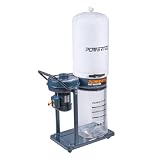
POWERTEC 1 HP 800 CFM Collector
- 800 CFM from a 1 HP motor
- 1 micron collection bag
- Quick-release bag clamps
- Mobile caster base
Best Dust Collectors for Garage Workshops in 2026
Here is the full lineup at a glance. Every unit below is rated against the same question: will it earn its floor space in a bay where the car also has to park?
| Product | Specifications | Action |
|---|---|---|
| Dustopper PRO Cyclone Separator |
|
Check Latest Price |
| Bosch VAC090AH 9 Gal Extractor |
|
Check Latest Price |
| POWERTEC 1 HP 800 CFM Collector |
|
Check Latest Price |
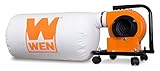 WEN DC3401 660 CFM Collector WEN DC3401 660 CFM Collector |
|
Check Latest Price |
 Mullet Cyclone Separator Mullet Cyclone Separator |
|
Check Latest Price |
 Shop Fox W1826 Wall Collector Shop Fox W1826 Wall Collector |
|
Check Latest Price |
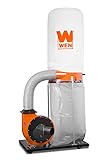 WEN DC1300 1300 CFM Collector WEN DC1300 1300 CFM Collector |
|
Check Latest Price |
 JET DC-1100VX-CK Collector JET DC-1100VX-CK Collector |
|
Check Latest Price |
 BUCKTOOL DC50 750 CFM BUCKTOOL DC50 750 CFM |
|
Check Latest Price |
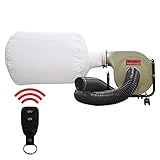 BUCKTOOL DC30A-1 550 CFM BUCKTOOL DC30A-1 550 CFM |
|
Check Latest Price |
 PSI DC725 Tabletop Collector PSI DC725 Tabletop Collector |
|
Check Latest Price |
 DEWALT DWXAF101 Air Filtration DEWALT DWXAF101 Air Filtration |
|
Check Latest Price |
1. Dustopper PRO Cyclone Separator for Bucket-Mounted Collection
Dustopper PRO Dust Collector – 99.9% Efficiency Cyclone Dust Separator
- Substantially extends shop vac filter and bag life
- Easy way to add real separation to an existing shop vac
- Quick assembly with everything needed for a 2-inch connection
- Buckets empty easily with a blast of air
- Clear body lets you see fill level
- Needs a 5 HP shop vac for full separation
- Lighter buckets can collapse under suction
- Heavy static buildup
This is the first thing I put in a new garage, before any powered collector. It is a low-profile cyclone that clamps onto the rim of a standard 5-gallon pail, and it bolts directly into a shop vac inlet. Over roughly 1200 owner reviews it holds a 4.6 average, one of the most proven scores in this group.
What it does is simple. Heavy chips and coarse sawdust hit the cone, drop into the bucket, and never reach your shop vac filter. That single change is why filter and bag replacement frequency drops so much. Workshop users report going from a filter change every few sessions to far fewer changes once the separator is in the line.
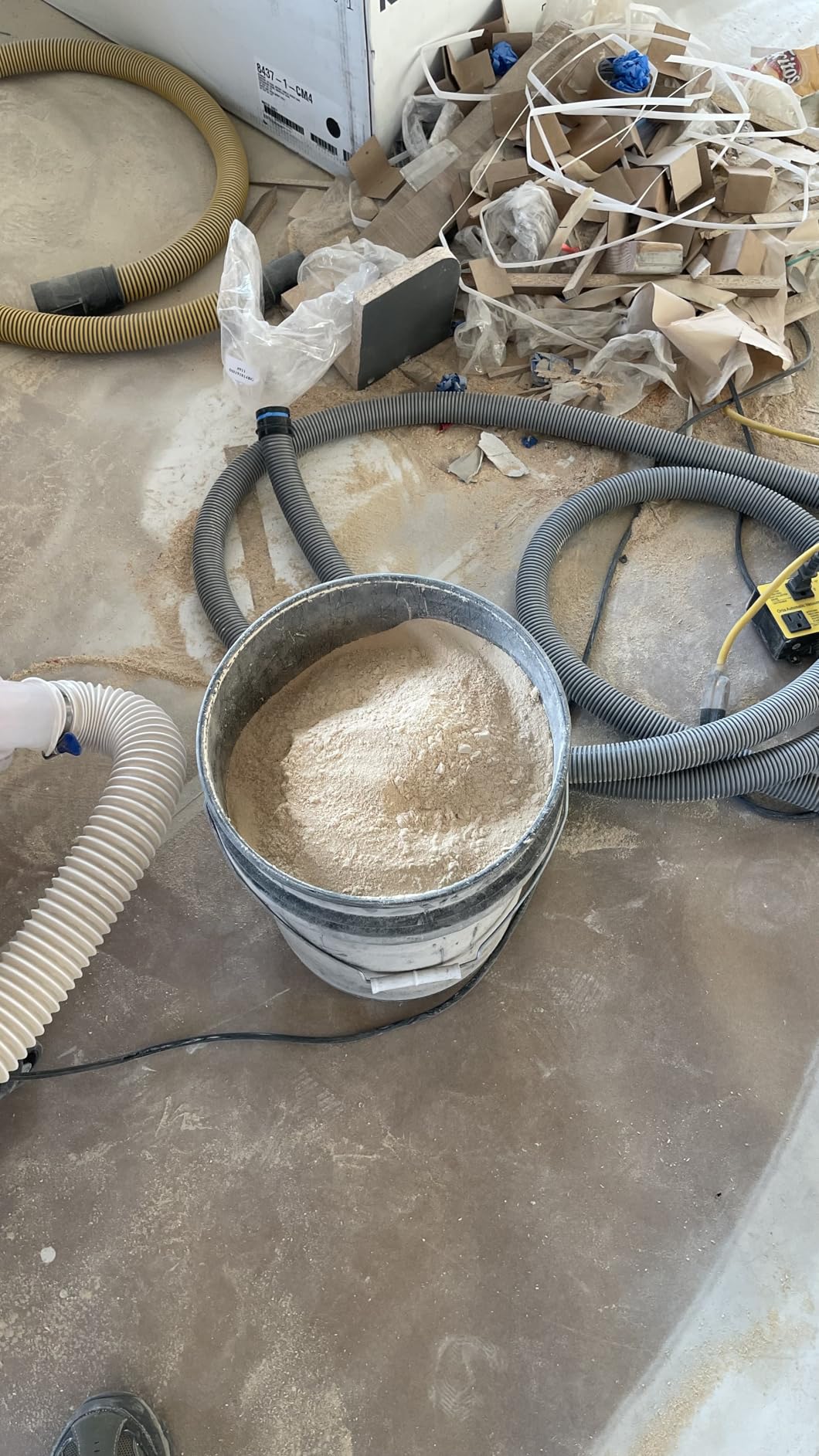
The engineering is more considered than the packaging suggests. Aerodyne Environmental independently tested it against fine sawdust, coarse sawdust and drywall powder, and found higher collection efficiency than other low-profile separators. Two patented high-flow sweep elbows come included, and they remove turbulence that would otherwise spin past the cone wall.
It also ships with a hollow-core EPDM gasket preinstalled, so the seal is a factory fit rather than something you jury-rig with duct tape. Made in the USA, and it took a Most Innovative Concept Award at the 2023 National Hardware Show.
Will a regular 5-gallon bucket hold up?
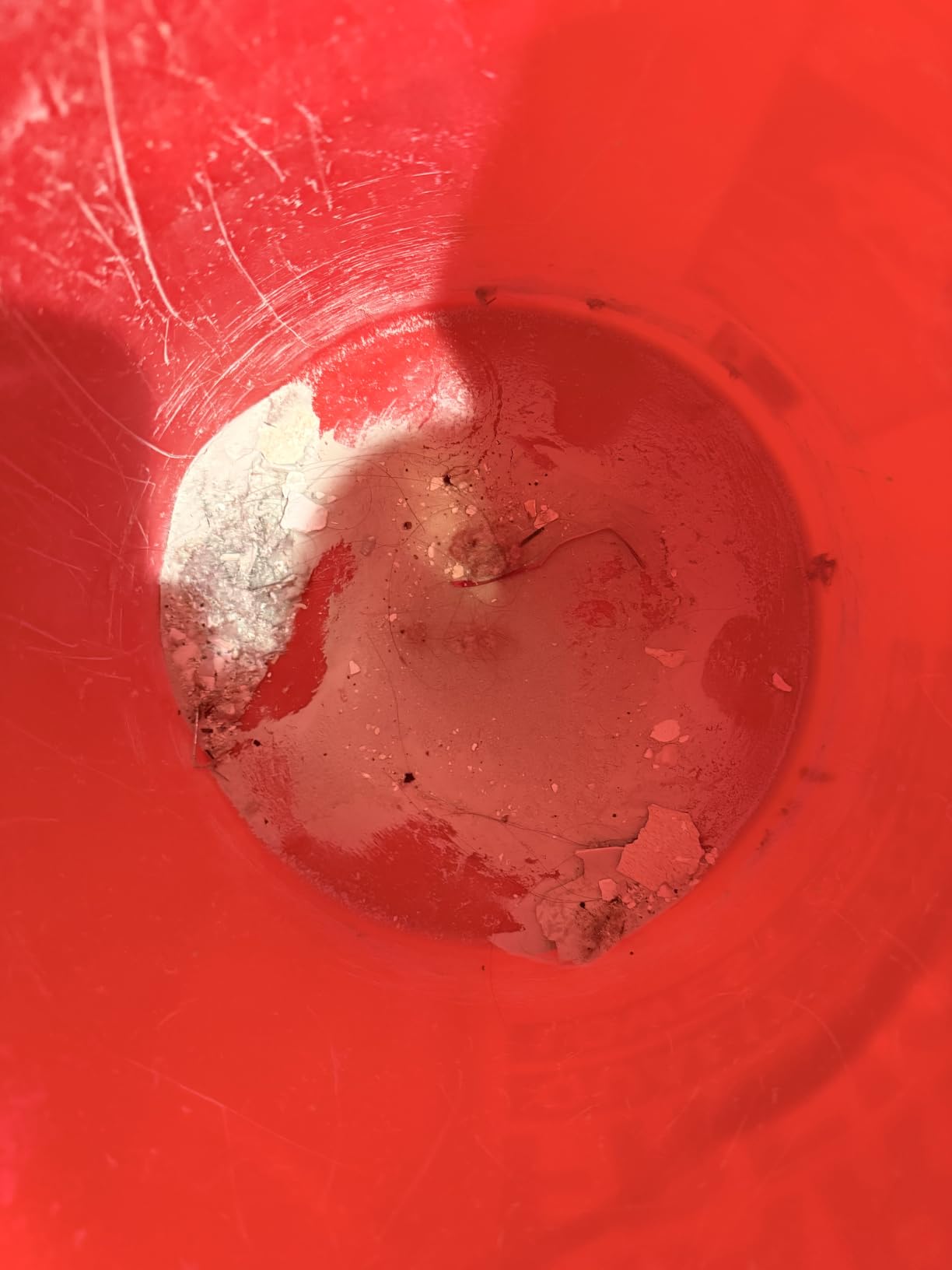
Only the heavy-duty ones, out of the box. Lightweight big-box pails can flex and collapse under full suction, which breaks the seal and ruins separation. Doubling up a cheap pail with a clamp works, but a stiff bucket is the cleaner answer. The included gasket can also pop out of its groove when you pull the bucket off, so seat it again each time.
Is it worth adding to a garage that already has a good vac?
Yes, if your vac has any filter trouble at all, and that includes most. It is the quickest way to turn a mediocre wet and dry vac into something that handles real woodworking dust. Skip it if you already run a two-stage unit or a canister-filter extractor, because then the heavy debris is already being handled upstream.
2. Bosch VAC090AH 9-Gallon HEPA Dust Extractor
Bosch VAC090AH 9 Gallon Dust Extractor with Auto Filter for Grinder 1773AK
- HEPA filtration rated at 99.97% of 0.3 micron particles
- Automatic filter cleaning every 15 seconds
- Tool-activated switching with a Power Broker dial
- Wet and dry capable with a 9-gallon capacity
- Heavy construction from an established tool maker
- Cost sits well above typical hobby-shop collectors
- Fleece filter bags are a recurring consumable
- 28 pound body needs real bench space
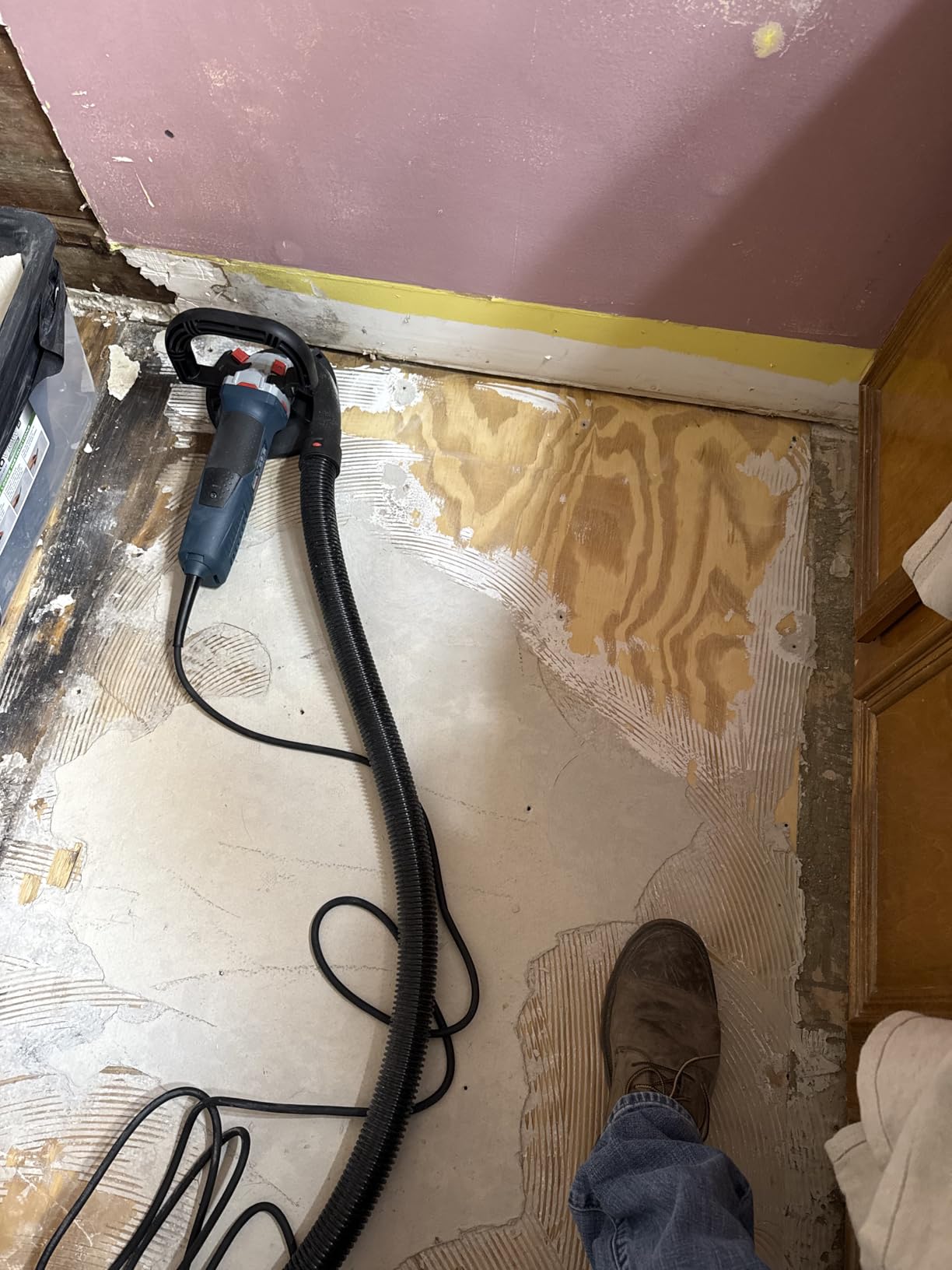
This is the one to buy if your garage dust is concrete, drywall or sanding dust rather than sawdust, because it is the only unit here with a genuine HEPA rating of 99.97 percent at 0.3 microns. It is a filtered vacuum with an onboard tool outlet and app and foot control, not a central collector, so think of it as the partner to a table saw rather than a replacement for one.
Suction is the standout number: 150 CFM with a sustainable maximum static water lift of 97 inches. Static lift is what separates a real extractor from a wet and dry vac, because it is the ability to pull through a clogged filter and a long hose. Most shop vacs quote a maximum suction figure that only exists on an empty filter with a short hose.
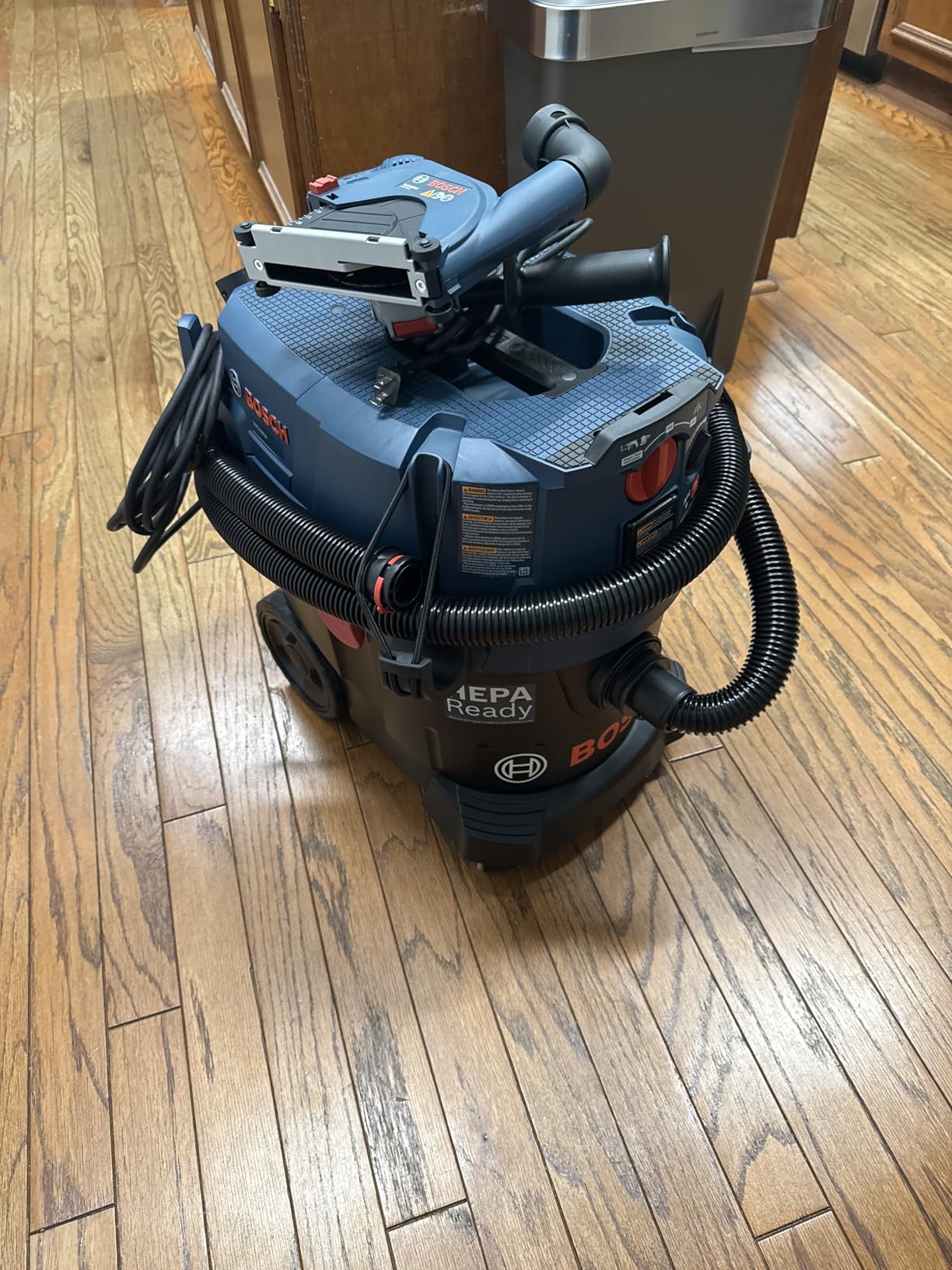
The filter cleaning cycle runs every 15 seconds, which is the feature that actually changes daily behaviour. Without it, a fine-dust job will load a cartridge within minutes and the airflow quietly drops. Owners working grinder and sander jobs report suction holding up through a whole session because of that cycle.
A fleece filter bag is included to protect the cartridge and hold dry debris. Bosch positions the whole system as a move toward OSHA silica Table 1 compliance, which is a useful framing if you plan to do demolition or concrete work in the same bay.
Is it too much for a wood-only garage?
If you only cut wood, yes, you are paying for filtration you will not use to its limit. A 1-micron bag collector for a fraction of the cost captures nearly everything a wood shop produces. The Bosch earns its place when drywall, concrete or auto body sanding is part of the job list, and when OSHA-minded compliance matters to you.
What does the total ownership cost look like?
Budget for fleece bags and cartridges as recurring consumables, because that is where the long-term cost lives. Owners also flag the 28-pound weight, which is stable but wants a real corner rather than a shelf you can barely load. Clear a 20.5 by 14.5 inch floor area before you order.
3. POWERTEC 1 HP 800 CFM Dust Collector
- 1 HP motor and 800 CFM handle typical garage woodworking machines
- 1 micron bag is finer than the common 5 micron bags
- Quick-release bag clamps make changes fast and tidy
- Caster base repositions easily under a machine
- Dual voltage motor allows 120V or 240V
- Bag filtration means frequent emptying and ongoing bag purchases
- 55 pounds is stable rather than hand-portable
- Assembly takes time with a lot of hardware
This is the unit that fits the most garages for the least fuss. A 1 HP single-phase motor running at 3450 RPM moves 800 CFM, which is enough headroom for a table saw on 4-inch hose without the system bogging down.
The filtration is the other reason it stands out at this level. The standard bag is 1 micron, not the 5 micron fabric you find on entry-level collectors. That single specification removes most of the fine airborne fraction that settles on your car, your bench and your ceiling joists. Owners consistently note that shop cleanup time drops noticeably once fine dust stops circulating.
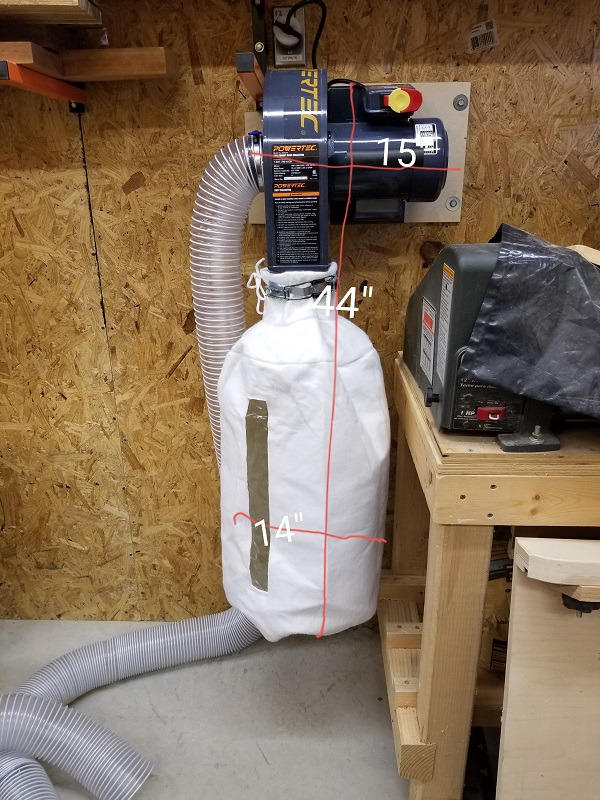
Quick-release bag clamps are an unglamorous feature that you will thank during week three. Most bag collectors use drawstrings or awkward clamps that take several minutes at the worst possible moment. These release and re-secure in seconds, and emptying happens where the unit sits instead of near the bin.
The motor is rated for both 120V and 240V, which matters more than it sounds. Plenty of garage outlets sit on a 15-amp circuit shared with an opener and a welder, and a dual-voltage motor gives you the option of a dedicated 240V run later without buying a new machine.
Does 800 CFM make it overkill for a small garage?
No, and this is the sizing trap most people fall into. In a garage, duct runs are short, so airflow at the machine stays high. The collector you regret is usually the one you undersized, not the one you oversized, because a starved collector pulls chips back onto the floor instead of into the bag.
What is it like to live with day to day?
Two things to plan for. The 55-pound weight means you roll it on its casters rather than lift it, so leave clearance beside it. And bag maintenance is real work, which is the honest trade-off against canister filtration. If you hate changing bags, look at the JET unit further down this list instead.
4. WEN DC3401 660 CFM Collector with Wall Mount Option
- Moves far more air than a comparable shop vac
- Compact enough to wall mount in a small shop
- Lockable swivel casters for moving between machines
- Handles a table saw
- bandsaw
- router table or sander
- Zippered 5 micron bag empties in place
- Clogs quickly on planer or jointer shavings unless the inlet screen is removed
- Brushed motor brushes need replacing around 250 hours
- 5 micron bag is coarse for fine dust work
This is the entry point that moves most people from a wet and dry vac to real collection. A 5.7-amp brushed motor with a 6-inch impeller moves up to 660 CFM through a 4-inch dust port, and that throughput is the reason hoses and duct runs stay clear instead of packing solid.
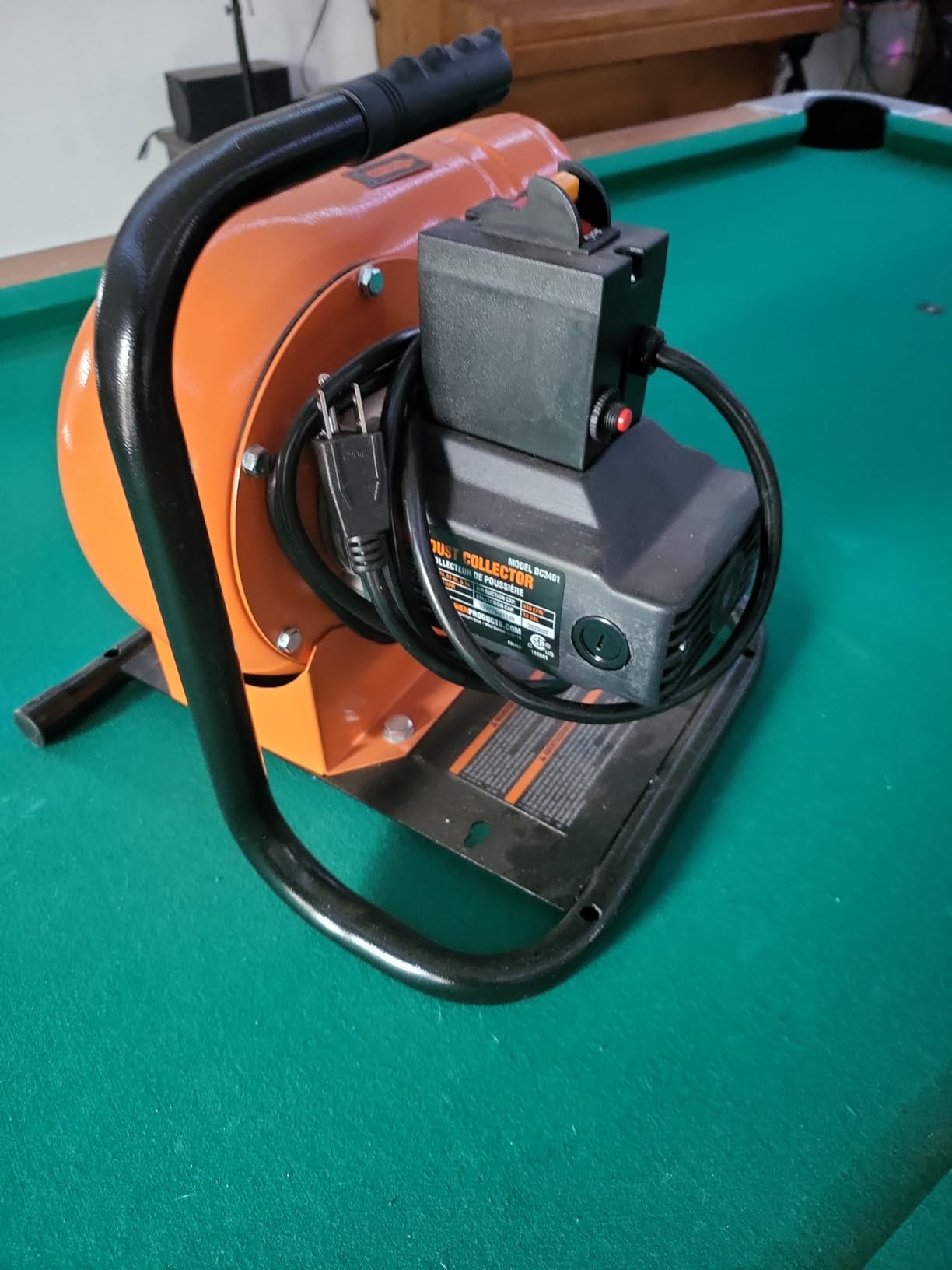
It comes in at 34.25 by 13 by 14.2 inches with an onboard carrying handle, which is small enough for a one-car bay. The optional wall mount is the feature that matters most in a garage: it puts the whole unit above bench height and gives the parking bay back entirely.
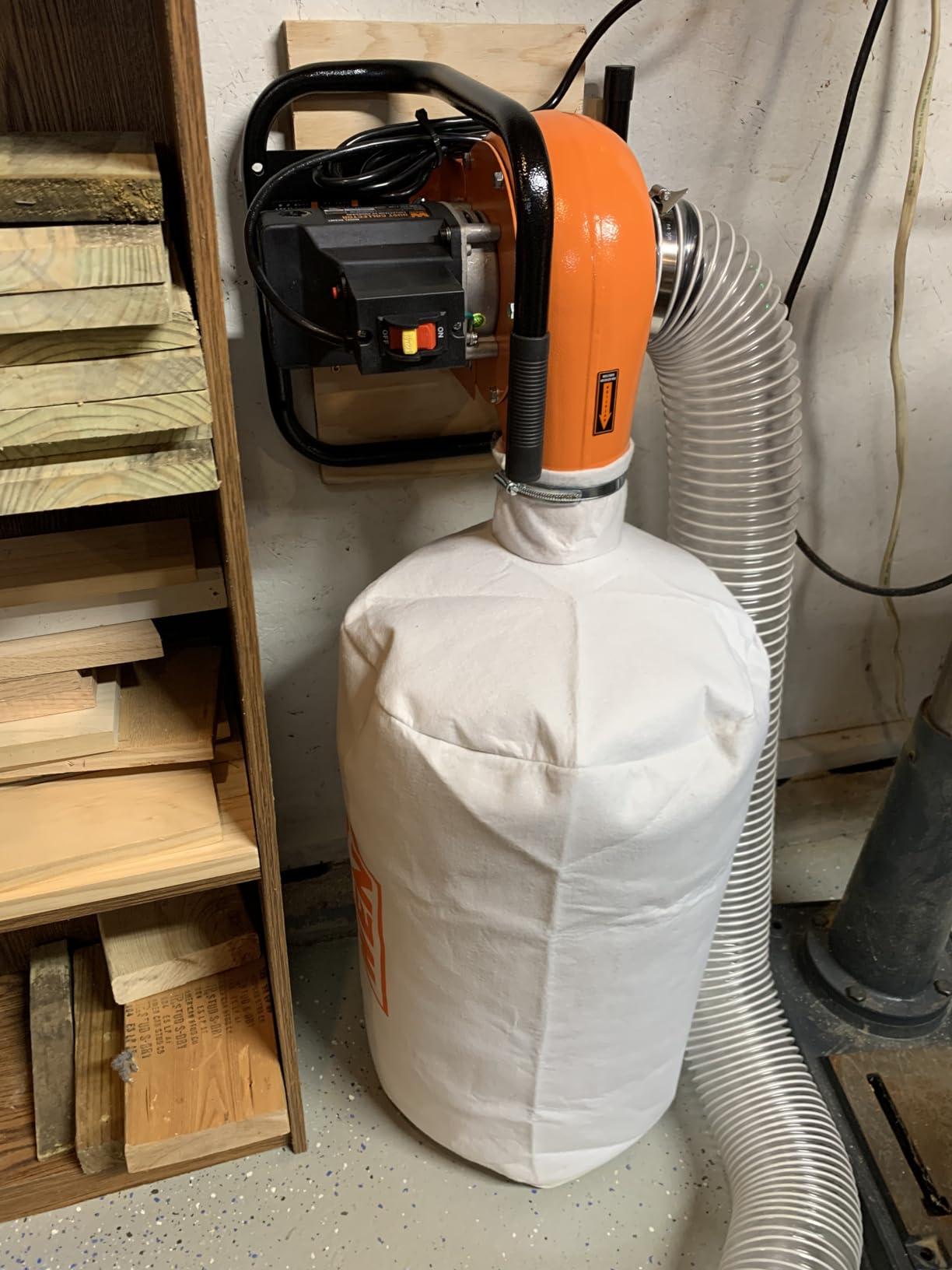
Storage details are genuinely useful. Lockable swivel casters let you park it out of the way when the car comes in, and the 12-gallon bag has a zippered bottom so you empty it where it stands. A two-year warranty is included, which covers longer than most single-stage collectors in this airflow band.
Its one real acoustic complaint shows up in reviews: it is louder than buyers expect at first start. If the garage shares a wall with living space, run it during daytime hours for the first few sessions and see how it sits. Where it earns its keep is single-machine duty: one table saw, one bandsaw, one router table, one sander at a time.
Will it take planer and jointer duty?
Not without a tweak. The inlet screen is designed as a safety guard, and on high-volume shavings it becomes the first thing to clog, which shows up as falling suction mid-cut. Plenty of owners snip it out. Do that deliberately, with the unit unplugged, and keep a replacement screen on hand.
Where does the 5-micron bag fall short?
It lets a meaningful fraction of fine dust through into the room, so it is a poor match for sanding-heavy work or anyone with a sensitivity. Add a pre-separator ahead of it, or step up to a 1-micron bag unit. For sawdust, chip and shavings, it is more than adequate.
5. Mullet Cyclone Dust Separator for Shop Vacs
Mullet Cyclone Dust Collector, High-Speed Separator for Shop Vac
- Highest average rating in the group
- Parabolic one-piece body separates better than straight-wall DIY builds
- Rigid cut-to-fit connection is airtight
- Included hose adapters fit a wide range of wet and dry vacs
- Lightweight at 7.5 pounds and easy to move
- Adds no suction of its own and depends entirely on the attached vac
- Cut-to-fit PVC connection is sized to your hose
- Owns no motor or collection bin
The Mullet holds the highest average rating of anything we tested at 4.8 across 289 reviews, with 88 percent of those ratings at five stars. It works on the same principle as the Dustopper, but the geometry is different in a way that matters for separation efficiency.
The body is parabolic and seamless rather than a straight-walled cone-and-bucket stack. Air enters, follows the curve, and spins faster than it would in a straight wall, so more debris falls out before the air continues to the vacuum. It pre-separates over 99 percent of what comes off a tool, which is the number that keeps filters breathing.
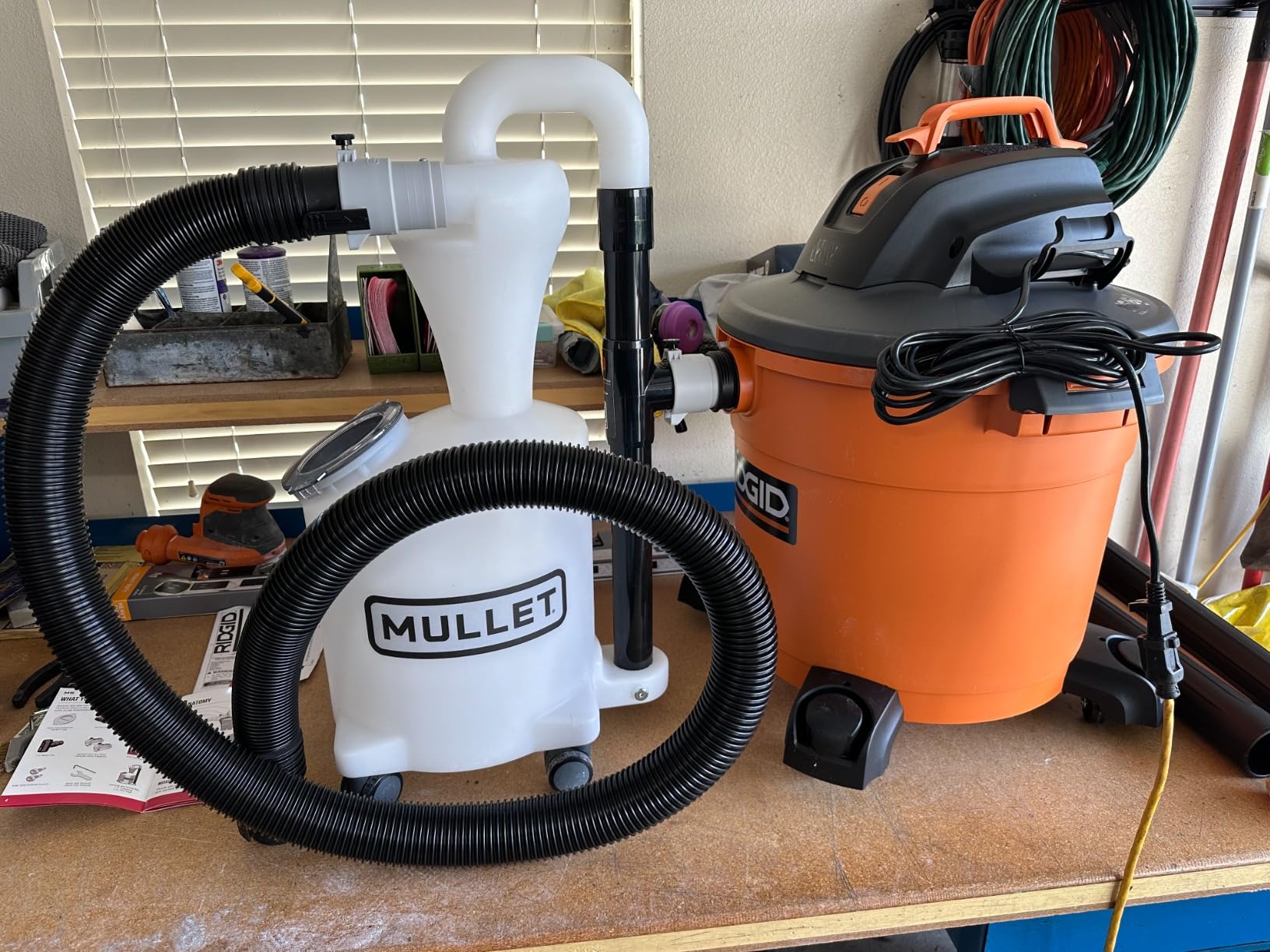
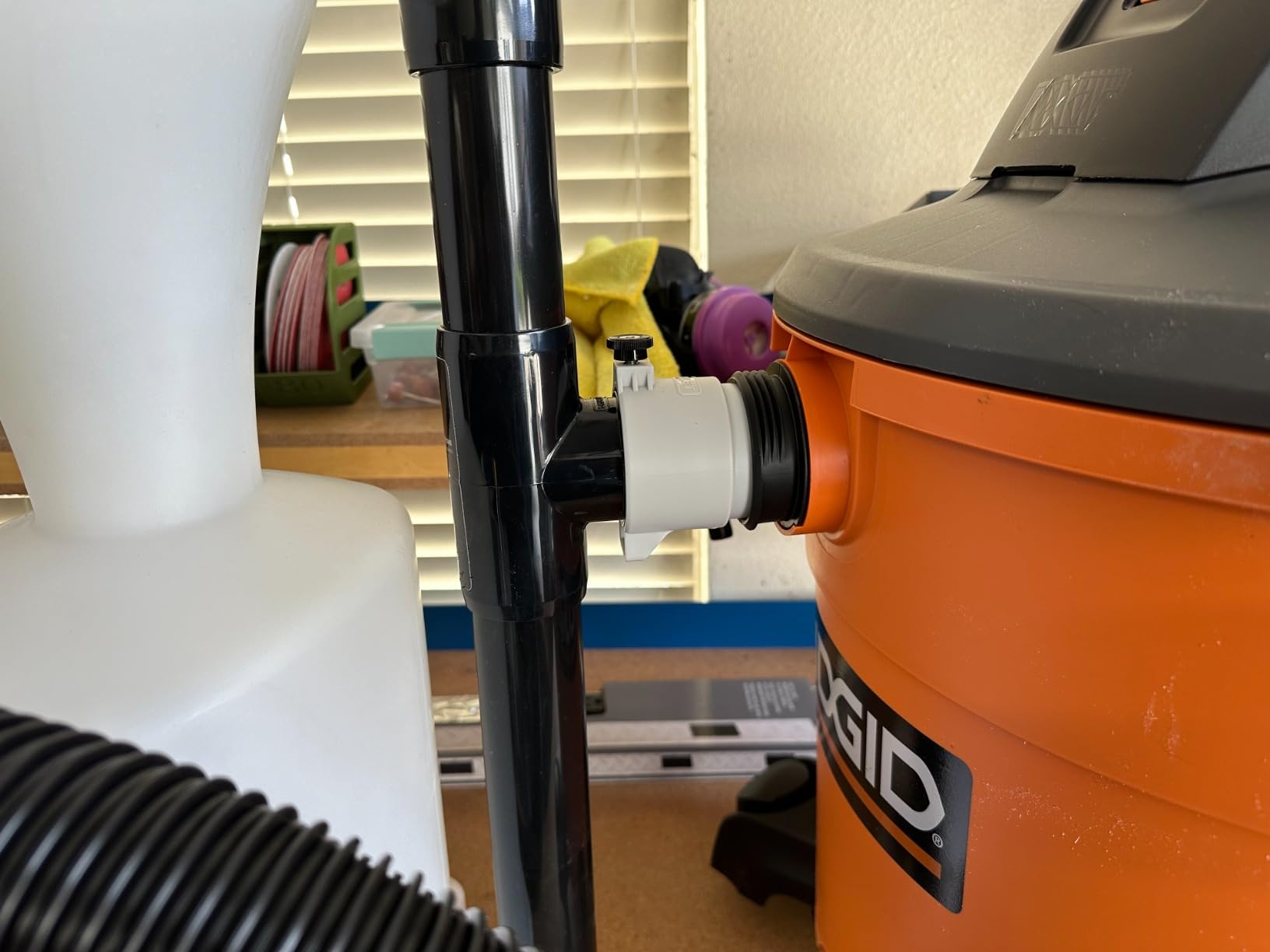
The connection is where DIY cyclone builds usually fail. Most bucket systems rely on a bolt, bungee cord and duct tape sandwich, which leaks and lets air escape before separation happens. The Mullet uses a rigid cut-to-fit PVC collar, so the seal is airtight once you trim it to your hose diameter. Two wet and dry vac hose adapters are included.
Owners consistently report cleaner vacuum filters and stronger sustained suction compared with their bucket builds. At 7.5 pounds it moves around a garage easily, and it handles wet or dry material without a filter change.
Does it need a special shop vac?
No, but the vac still sets the ceiling on performance. Like any suction-driven separator, it moves only as much air as the vacuum behind it can supply. Pair it with a strong wet and dry vac and you get real separation. Pair it with a small household vacuum and you get a tidy drum that fills slowly.
How is it different from a bucket separator?
Shape and seal. The parabolic one-piece body spins debris faster than a straight-wall cone, and the rigid connection removes the biggest leak point found in DIY builds. It is also lighter and more compact, which makes it easier to move between a table saw and a sanding station.
6. Shop Fox W1826 Wall-Mount Dust Collector
Shop Fox W1826 Wall Dust Collector, 2.5 Micron Filtration,White
- Wall mount frees the whole floor area in a small bay
- Much quieter than a shop vac for continuous runs
- All-steel construction is heavy and feels built to last
- Bag window shows fill level and the bottom zips open in place
- Rewirable from 110V to 240V for a dedicated circuit
- Inlet safety cage traps shavings and causes clogs
- Arrives with bent housings or missing hardware reported
- Unpublished exhaust port diameter means extra fitting work
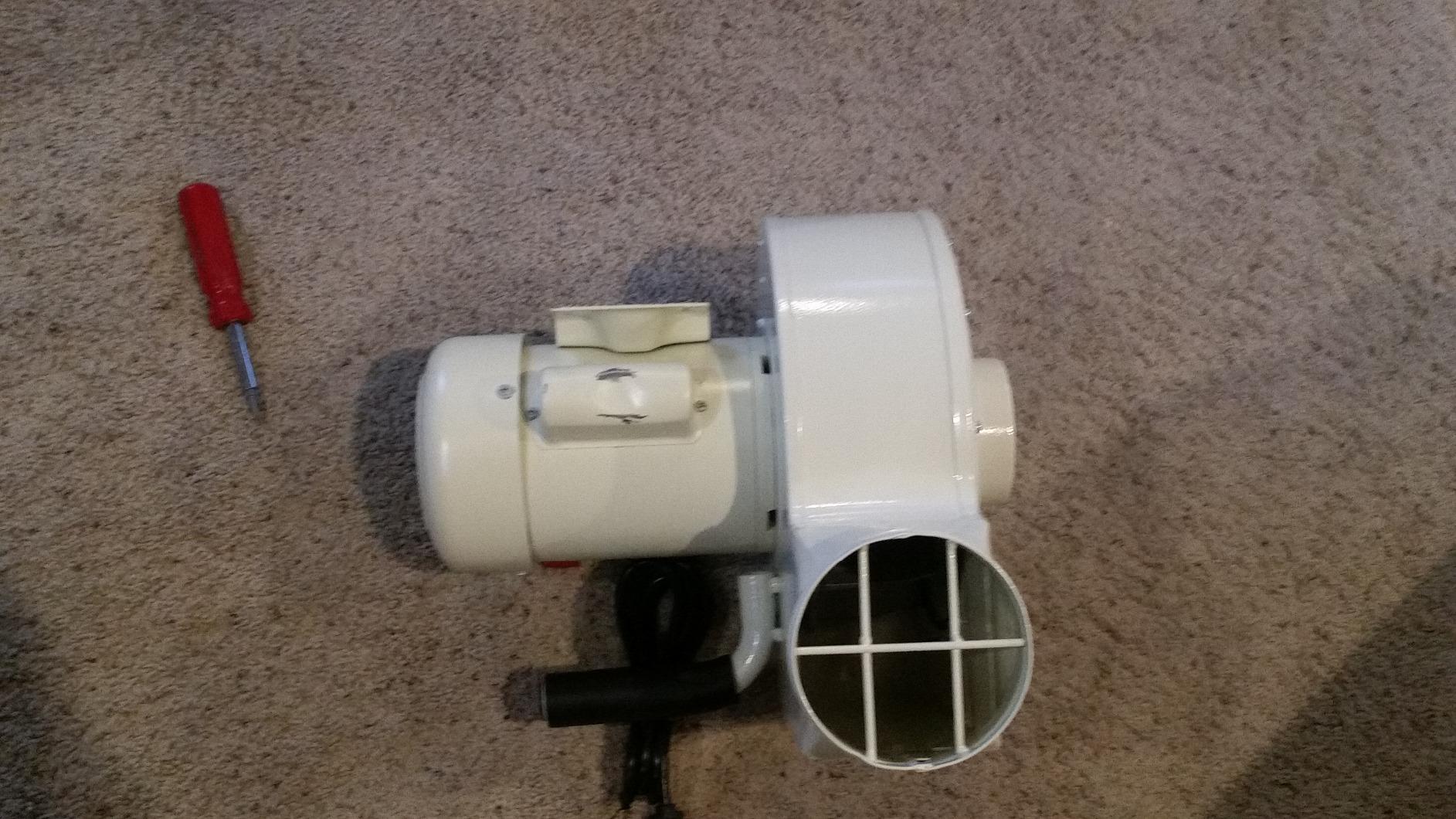
If the parking bay is the constraint, a wall-mounted collector solves it outright. This 1 HP unit mounts to studs with the included bracket and locking screw system, taking up wall space instead of floor space. The motor draws 7 amps at 110V, which sits comfortably on a standard 15-amp garage circuit with tools still able to share it.
Performance is a solid 537 CFM at 7.2 inches of static pressure. That is lower than the 800 CFM floor units here, and it shows on long or reduced-diameter hose runs. Plan on one machine at a time through 4-inch hose, which is the honest use case for a garage of this size.
Filtration is a 2.5 micron cloth bag, which sits between a 5-micron bag and a 1-micron bag. The bag has a viewing window for gauging fill level and a bottom zipper for emptying in place, so you never need to wrestle a full bag over a bin in a tight bay.
Owners also praise how quiet it is for continuous running compared with a shop vac doing the same job. If your garage shares a wall with living space, that is a genuine benefit rather than a spec-sheet detail.
Do you need to modify it before use?
The inlet safety cage is the almost universal first modification. On planer and jointer shavings it clogs and chokes airflow, so many owners cut it out. Unsure of the airflow drop on your machine, snip it, test, and keep the piece as a reference.
What goes wrong out of the box?
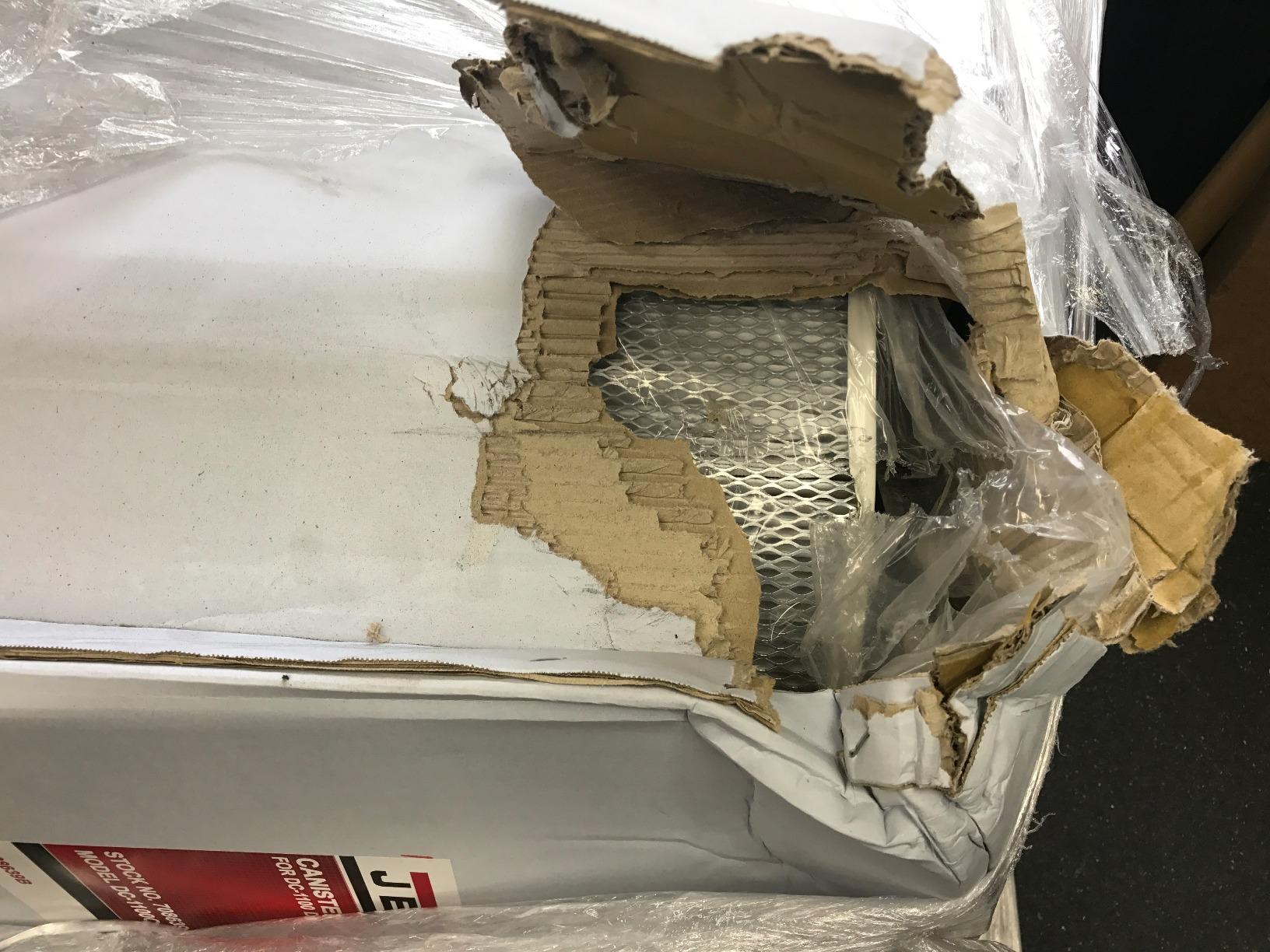
Shipping damage comes up more often than it should. Bent housings, bent mounting plates and missing hardware show up in a share of reviews, so inspect the cabinet and the bracket on arrival and photograph it. The exhaust port inside diameter is also not published, which means hose fitting takes a little fabrication.
7. WEN DC1300 1300 CFM Collector with 50-Gallon Bag
WEN DC1300 1,300 CFM 14-Amp 5-Micron Woodworking Dust Collector with 50-Gallon Collection Bag and Mobile Base , Black
- Moves 1300 CFM
- far above the 550 to 800 CFM band of the 1 HP units
- dual 4 inch inlets run two tools at once
- 50 gallon bag means emptying once a month or two instead of every few days
- Markedly quieter than running multiple shop vacs
- Effective dust capture from CNC work
- 14 amp draw wants a dedicated 15 or 20 amp circuit
- Metric hardware is awkward for imperial-only toolboxes
- Fixed height bag arm can conflict with overhead ductwork
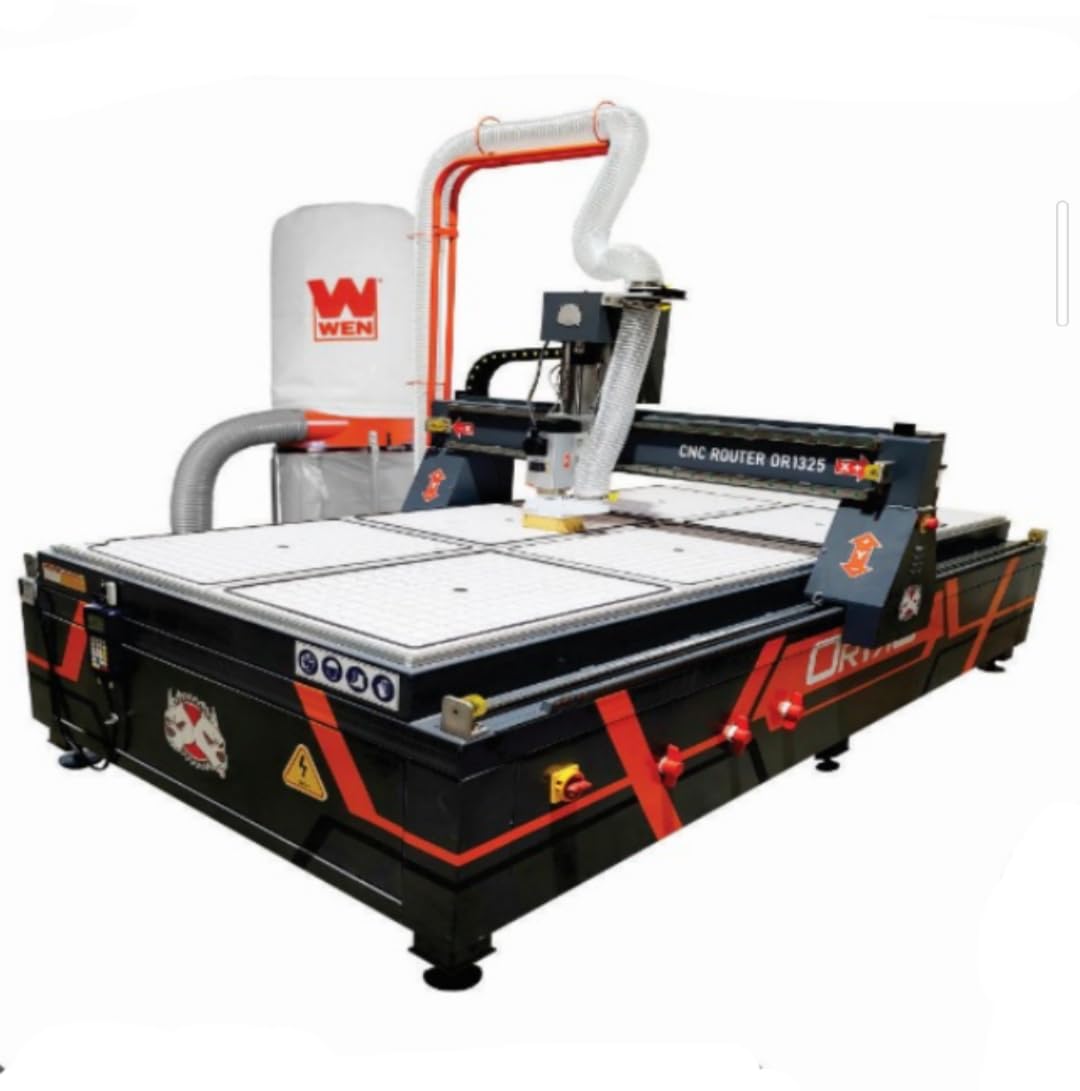
This is the high-airflow end of the garage range, and it exists because some bays have two machines and a CNC rather than one table saw. A 14-amp motor driving a 10-inch steel impeller up to 3450 RPM circulates up to 1,300 CFM, which is more than double what most single-machine setups need.
The dual 4-inch air inlets are the feature owners care about most. You can hook up two tools simultaneously, or feed one machine and a benchtop sanding box at the same time. That flexibility is what makes it useful in a two-car bay where you might be running a planer and a sander without stopping.
The 50-gallon vertical collection bag is the reason most owners stay with it. Owners report emptying roughly once a month or two instead of every few days, which sounds trivial until you count how many weekends go into bag changes across a year.
It sits on a mobile base with four swivel casters, so it can be rolled aside when the cars come in. Assembly is straightforward, and several owners specifically call out how much quieter it is than running two shop vacs at once.
Will it run on a normal garage outlet?
A 14-amp motor on a 15-amp circuit leaves almost nothing for a saw or a shop vac. Give it a dedicated 15-amp circuit, or better a 20-amp, and check your wiring before the first cut. That requirement is worth knowing before you plan where the unit goes.
What are the fitting and assembly snags?
Hardware is metric throughout, so an imperial-only toolbox leaves you stuck. The bag support arm is fixed height, which can collide with low overhead ductwork if you are running a central system. Some units also arrive missing hardware, and a handful of owners report dust puffing from the secondary opening when airflow overwhelms the 5-micron bag.
8. JET DC-1100VX-CK Vortex Cone Collector with Canister Filter
JET Vortex Cone Dust Collector with 2-Micron Canister Filter, 1-1/2 HP, 115/230V 1Ph (DC-1100VX-CK)
- Continuous-duty permanently lubricated motor built for long service
- 2 micron canister filtration is a real upgrade over cloth bags
- Vortex Cone packs the bag better and extends run time
- Quick-connect elastic bags change in seconds
- Five year residential warranty
- Canister filters and collection bags are ongoing costs
- 80 dB is not among the quietest options here
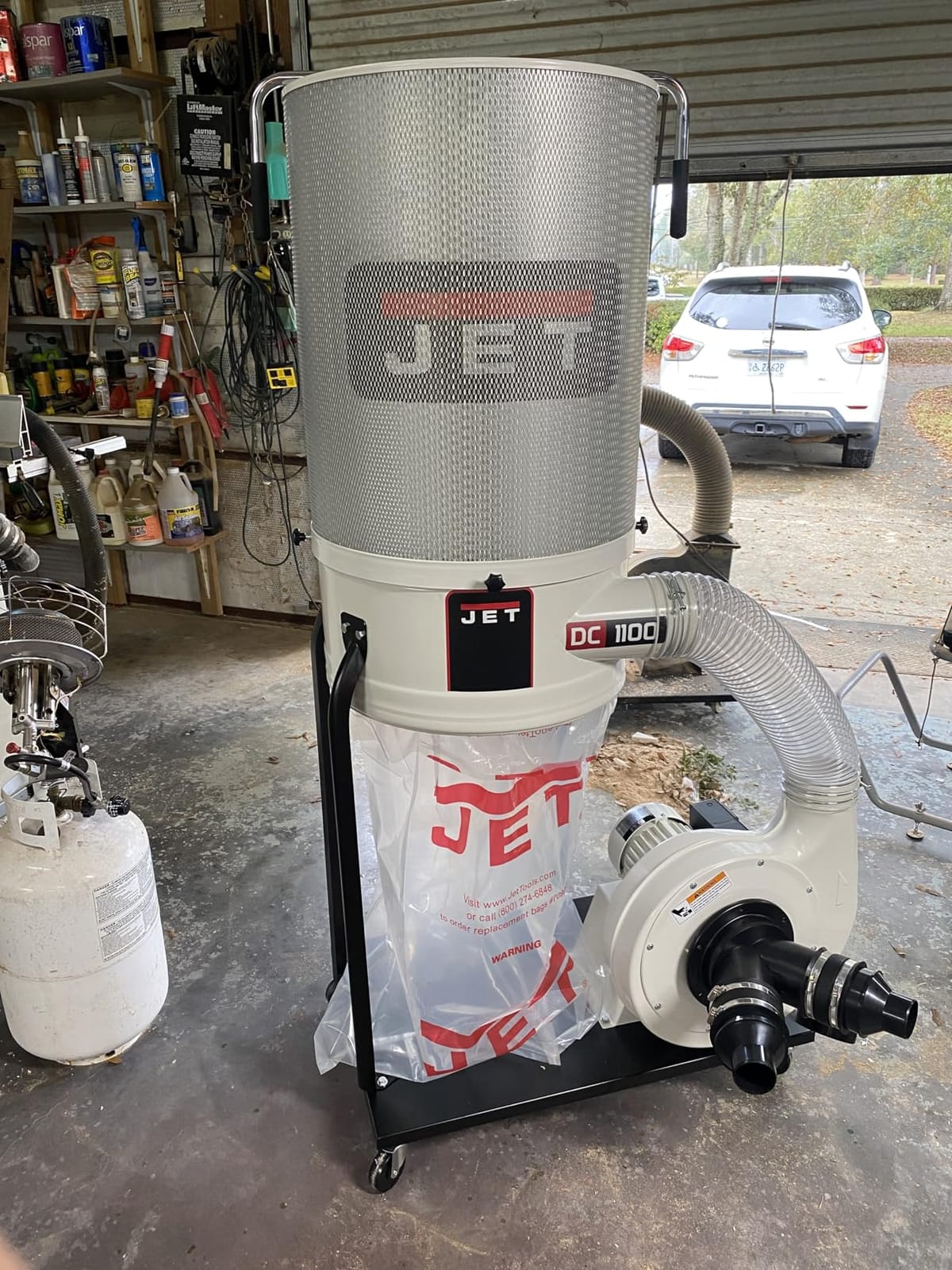
The JET is the filtration answer for a garage where fine sanding dust matters more than floor space. It uses a 2-micron canister filter rather than a cloth bag, and the included kit holds five collector bags plus the canister and a snap ring, so you can run for a long time before anything needs replacing.
The motor is a 1-1/2 HP unit on 115 or 230 volts, permanently lubricated, totally enclosed and fan-cooled, rated for continuous duty. That is a different motor spec from the brushed machines at the budget end of this list, and it is why owners describe it as something that will still be running years from now.
The Vortex Cone is a conical section inside the housing that improves chip separation and, more importantly, bag packing efficiency. A better-packed bag means more collected volume per empty, which quietly reduces both the emptying frequency and the replacement bag count over the life of the machine.
Quick-connect collection bags use an elastic band rather than drawstrings. Changes take seconds, the single-stage design keeps operation economical and relatively quiet, and four casters are included so a heavy machine can be repositioned.
Is the price difference justified?
It depends on how many hours you run. Over a year of heavy sanding and hardwood work, canister filtration and a five-year warranty recover much of the gap, because you are replacing consumables far less often. For a few hours of hobby cutting a year, a bag collector gives you most of the result for a lot less.
Where does it fit in a one-car garage?
Fine, on casters, but this is not a wall-mount unit and 1-1/2 HP pulls real power. It runs at 80 dB, louder than the extractor and the hanging filtration unit in this group, which is worth considering if the garage wall touches a bedroom. It is a machine for a committed wood shop rather than a weekend hobbyist.
9. BUCKTOOL DC50 750 CFM Auto-Start Dust Collector
BUCKTOOL 750 CFM Auto-Start Dust Collector,1.2HP 13-Gallon Capacity
- Auto-start outlet means the tool switch runs the collector
- 750 CFM from a 1.2 HP motor is competitive for the size
- Three bag setup with a 2 micron upper filter bag
- Accessory kit includes five reducers and a 5 ft flexible hose
- Compact base with casters suits small shops
- Lowest average rating here at 4.0 with a 10 percent one-star share
- Triple bag design means more parts to install and replace
- Soft PET bag clamp fit problems reported
The auto-start outlet is the reason to look at this one. It provides a powered outlet on the collector for tools up to 7 amps, so switching on a sander or router starts the dust collection with it. In practice that removes a habit, not just a step, and it is the same feature that separates a real dust extractor from a shop vac.
The motor is 1.2 HP at 120 volts running 3450 RPM, producing 750 CFM, and it is CSA listed with a 6.5-amp full load draw. That sits comfortably on a standard 15-amp garage circuit, which makes it easier to install than a 14-amp unit.
The filtration is a three-bag system: a plastic lower bag, a cloth lower bag and a 2-micron cloth upper filter bag. That layered arrangement captures more than a single-bag collector of the same size, and the 2-micron upper stage is the part that actually keeps fine dust out of the room.
The accessory bundle is unusually complete for this tier. You get five reducers, a 5-foot by 4-inch flexible hose and a PET bag clamp designed not to cut fingers during changes. That is most of what you would otherwise spend a separate afternoon sourcing and ordering.
How is the score split across reviews?
58 percent five-star against a 10 percent one-star share makes this the most polarised unit in the group. The praise clusters on the auto-start outlet and the accessory kit. The complaints cluster on the three-bag system, which is genuinely more to install, empty and replace than a single bag.
Is it a good first collector?
Yes for a garage with sanding and routing in the mix, because auto-start makes the habit automatic and the upper bag catches what a plain bag would let through. If you only run a table saw, the simpler single-bag units further up this list are less to manage for the same job.
10. BUCKTOOL DC30A-1 550 CFM Wall-Mount Collector with Remote
BUCKTOOL 1HP 6.5AMP Wall-mount Dust Collector with Remote Control and 2-micron Dust Filter Bag 550CFM Air Flow DC30A-1
- Induction motor is maintenance-free and runs quieter than brushed motors
- 49 foot remote starts the collector from across the garage
- Works wall-mounted or on braked wheels from one unit
- Suited to frequent heavy use
- 6.5 amp draw shares a standard 15 amp circuit
- 550 CFM is modest for a 1 HP motor
- 2 micron bag is a recommended add-on rather than included
- Wall mounting needs structure that carries 43 pounds
The motor is the story here. This is a totally enclosed, fan-cooled induction motor rather than a brushed universal motor, and owners consistently call out how much quieter and more durable it feels compared with brushed units at the same horsepower. There are no carbon brushes to wear or replace.
It delivers 550 CFM from a steel impeller at 1 HP and 6.5 amps on 120 volts, so it shares a 15-amp circuit with other bench tools without complaint. Airflow is adequate rather than impressive, which is why it fits best on one machine at a time through 4-inch hose.
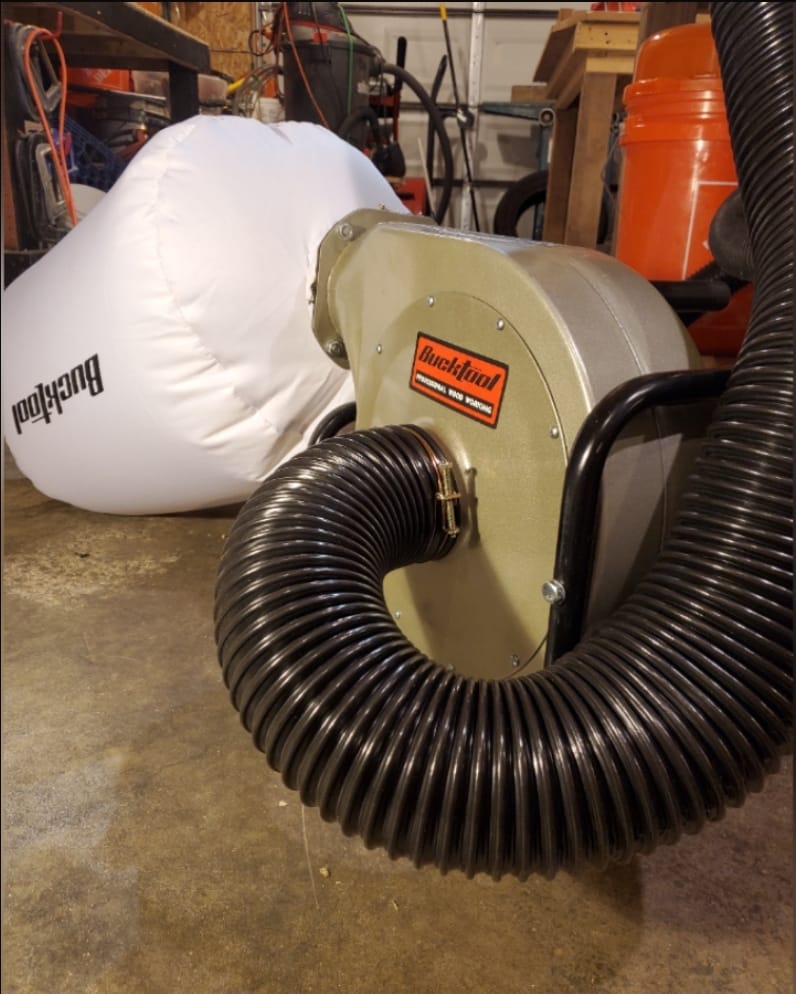
Two things make it convenient in a garage. The included remote runs 49 feet, so you can start the collector from the far end of a two-car bay without walking back to it. And the same unit mounts on a wall bracket or sits on braked caster wheels, which means one purchase covers both a fixed layout and a mobile one.
The recommendation to pair it with a 2-micron filter bag appears in nearly every review. The base unit ships with a coarser bag, and upgrading is where the real fine dust capture comes from. Budget for that bag as part of the system rather than an afterthought.
Is 550 CFM enough for a garage?
For one machine on a short run, yes. For a planer on a long hose run with the bag already loaded, you will notice the shortfall, because 550 CFM sits at the bottom of this group. Buy the 660 or 750 CFM class if you plan to grow the shop.
What does wall mounting actually require?
Solid structure that carries 43 pounds plus the loaded bag. Mount into studs, not drywall or a hollow door header, and check the bracket and locking hardware before you trust it with that weight. A remote start also cuts down on the walking back and forth that makes a garage setup annoying.
11. PSI DC725 Portable Tabletop Dust Collector
- Three independent fans give quiet operation
- Variable speed control suits carving and sanding
- Built-in grounded outlets for hand tools
- Small footprint fits on a bench
- Easy to carry around the shop
- Limited to small carving
- sanding and turning tasks
- Only one filter included and it is a consumable
- Not enough volume for table saw or planer duty
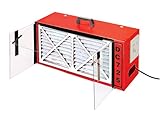
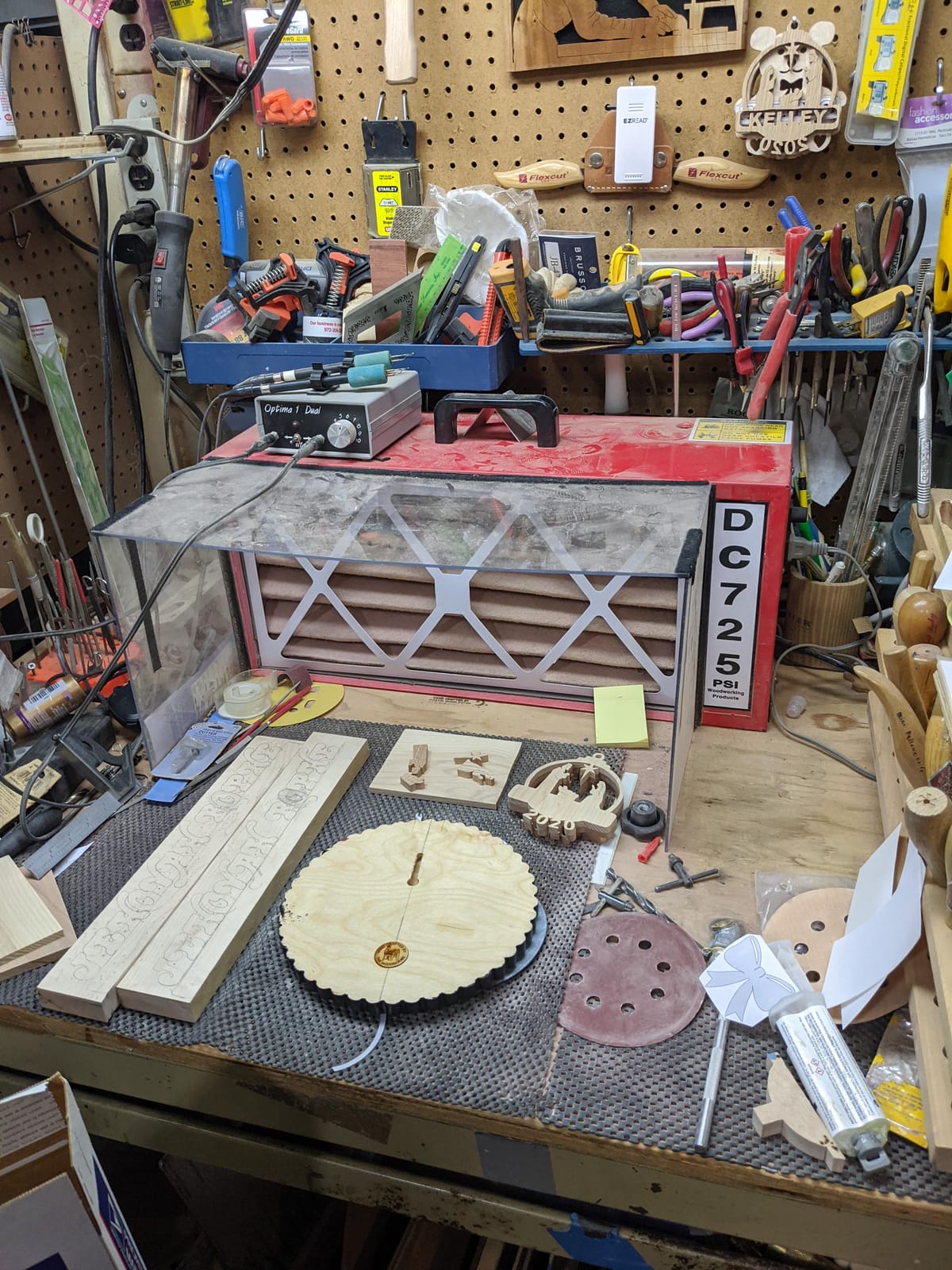
This is the odd one out, and it earns a place because garage work is not only table saw work. The PSI runs three computer-grade maintenance-free fans off a variable-speed control, topping out at 725 CFM, and it is built to sit on a bench during carving, sanding, grinding and small woodturning projects.
Noise is the reason it earns a place. Three smaller fans run noticeably softer than one large impeller, which is why owners keep it for carving and detail work in a garage next to living space. The variable speed knob lets you turn airflow down for carving, where a hard blast of air scatters the workpiece.
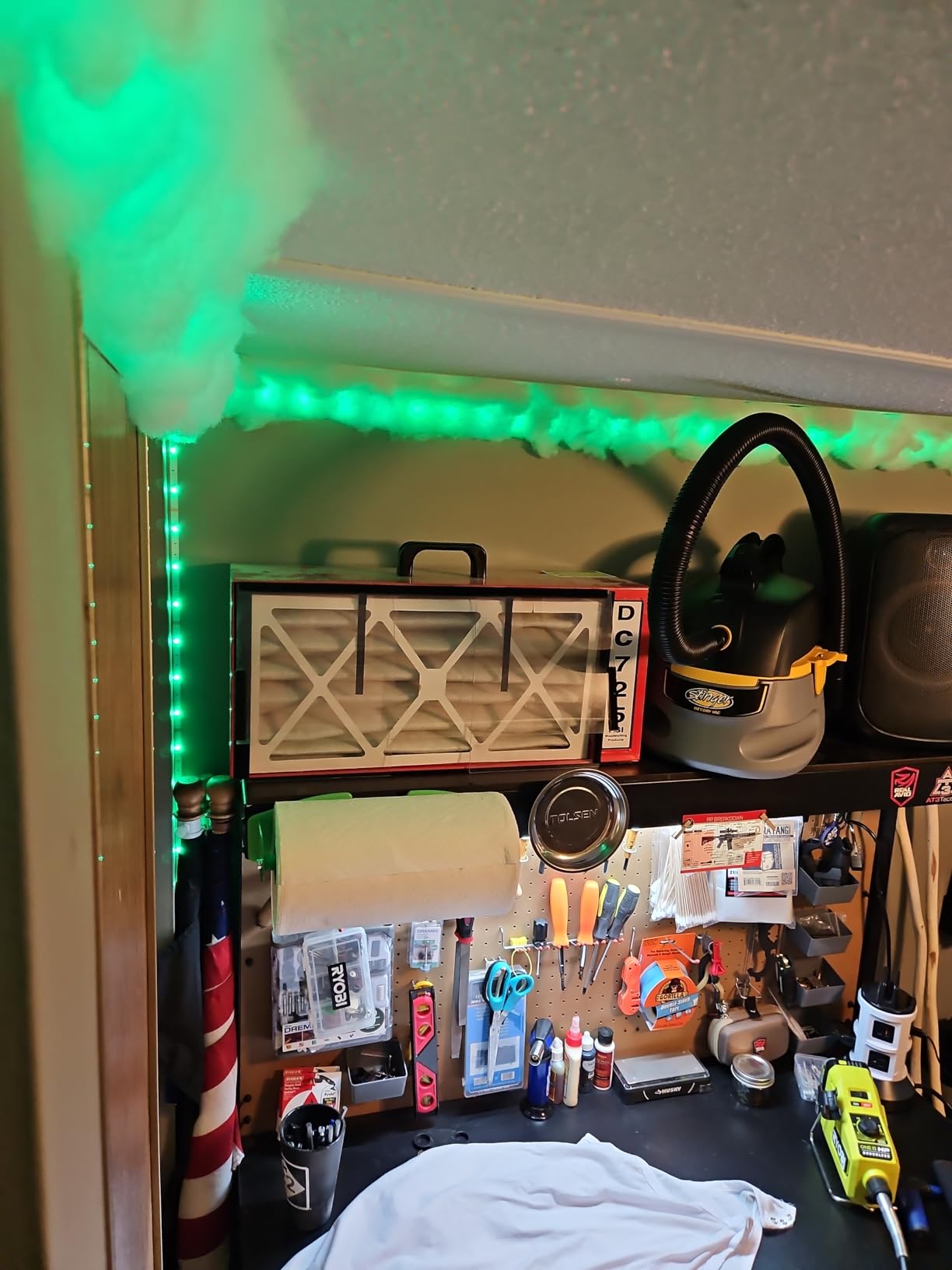
Two grounded 115V outlets sit on the side panel, so a random orbital sander or a small router can plug straight into the unit. Add an automatic vacuum switch or use the variable control and the extraction tracks the tool without you touching anything. The footprint is 23 by 8 inches at 10.5 inches tall.
Total running draw is only 1.29 amps across all three fans, which means it shares an outlet with almost anything else in the garage. Dust is captured by a 2 by 10 by 20 inch filter, one included, and it carries a two-year warranty under normal use.
Is it a replacement for a shop collector?
No. It is a benchtop supplement for detail work, and reviewers are consistent about that. It will not handle table saw or planer duty, and it will not bag 50 gallons. Pair it with a floor collector rather than choosing between them if you do both kinds of work.
Is the design dated?
Somewhat. The listed availability date goes back to 2007, and the plastic hood and side doors show it next to a modern steel collector. The fan-based approach still works at its intended scale, but expect a disposable filter as an ongoing cost and plan for the sound of moving air rather than raw suction power.
12. DEWALT DWXAF101 Hanging Air Filtration System
DEWALT Air Filtration System Dust Collector for Woodworking DWXAF101
- Hangs from the ceiling and takes up zero floor space
- Washable pre-filter keeps running costs down
- Timers up to 8 hours clean the air after you leave
- AUTO mode adjusts speed to measured air quality
- Quiet at 64 dB
- Filter replacement indicator
- Circulates ambient air rather than capturing dust at the machine
- Best used alongside a machine collector rather than instead of one
- Ceiling mounting needs solid joists
I want to be direct about this one: it is not a dust collector. It is an air filtration system, and it belongs in this roundup because a garage needs both halves. The DEWALT captures what has already become airborne, and a machine-mounted collector stops the dust from getting airborne in the first place.
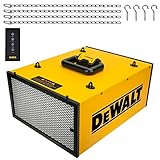
Filtration is two-stage, with a static cotton pre-filter in front of an H11 HEPA filter, capturing over 95 percent of 0.3 micron particles. The pre-filter is washable, which is what keeps the operating cost down and the replacement interval long.
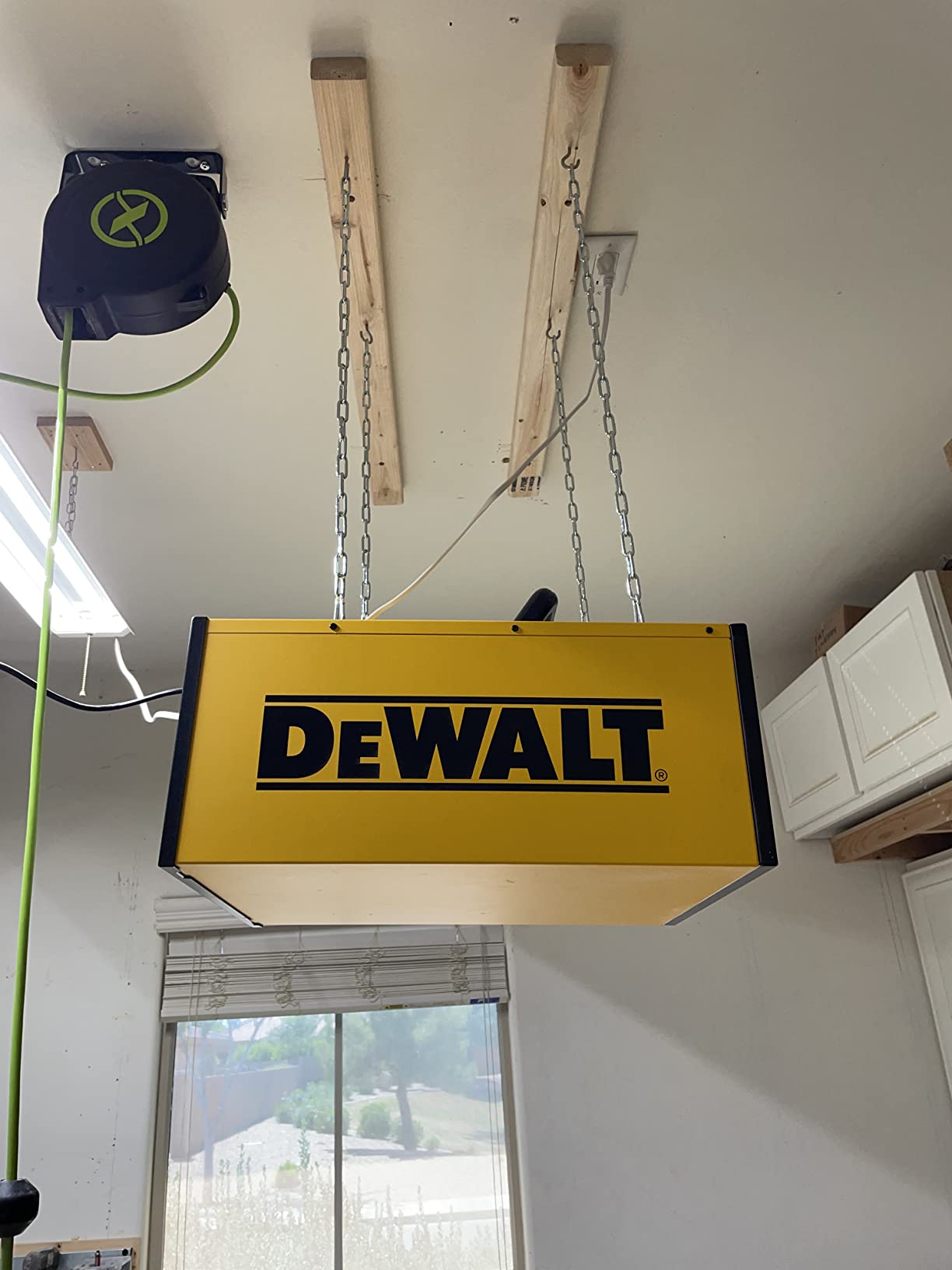
Four operating modes cover most cases: HI, MID, LO and AUTO. AUTO uses an air quality sensor to switch gears on its own, so the unit slows down in a quiet garage and ramps up after a sanding session. Built-in timers at 1, 2, 4 and 8 hours shut it down automatically, which is genuinely useful when you leave the garage after a long cut.
It hangs from the ceiling on four included hooks and chains and draws 105 watts at 64 dB. The flip handle makes relocation simple, and a filter replacement indicator removes the guesswork from maintenance. A three-year warranty backs it.
Will it replace a dust collector?
No. It has no hose and no intake, so it cannot capture dust at the machine. Reviews mention this clarification more than any other point. Treat it as the second half of a system: collector at the tool, filtration unit in the middle of the room.
What does mounting require?
Solid ceiling joists, not a hollow ceiling or a suspended panel. At 20.9 pounds the unit itself is not heavy, but you are hanging hardware above your head while running a shop, so it needs real structure. It also needs an outlet and a place to change the HEPA stage when the indicator lights.
For air cleaning in a garage with drywall or concrete dust as well as wood, our air scrubber guide covers the next tier up.
How Much CFM Does a Garage Workshop Actually Need?
Size for the tool, not the motor. A rule of thumb that holds up in most garages: budget roughly 400 CFM per handheld tool, 700 CFM or more for a table saw, and 1000 CFM or more for a planer or jointer. A garage with one table saw and one sander sits comfortably in the 500 to 700 CFM band, which is where most of this list lives.
Then add for distance. Every extra length of hose and duct reduces the air reaching the tool, and reductions compound. As a working allowance, add roughly 25 percent for each additional 10 feet of run beyond your first machine. In a one-car garage most runs stay short, which is why an 800 CFM unit feels strong and a 1,300 CFM unit mostly sits idle.
Static pressure is the number people ignore. CFM quoted at the inlet drops as pressure rises, and pressure rises with hose length, elbows and a loaded filter. Look for a published static pressure or static water lift figure, because a collector that only lists CFM tells you nothing about how it behaves on a long run.
Horsepower is a rough proxy, not a target. Roughly 1 HP per 400 to 500 CFM is typical, which is why the 1 HP units here land between 537 and 800 CFM. A 2 HP or 3 HP machine only earns its place when you are running several stationary machines at once, and it usually needs a 240V circuit.
Overbuying is the most common regret reported in woodworking forums. A collector too large for the bay takes floor space, costs more, runs louder and still needs the same ductwork. Buy for your slowest machine and your longest run, not for a shop you might build someday.
Garage Electrical, Duct Safety and the Setup Checklist
Electrical: 15-amp versus 20-amp versus 240V
Most garage dust collectors in the 537 to 800 CFM class draw between 5.7 and 7 amps, which shares a 15-amp circuit with a saw or a shop vac without drama. Once you reach 14 amps, as the 1,300 CFM unit does, give it a dedicated circuit. Anything above 2 HP generally belongs on 240V, which means running new wiring and adding a breaker.
Check your circuit before you buy, not after. Openers, compressors and welders on the same circuit are the usual cause of a collector tripping under load, and moving it to its own run costs far less than the machine does.
Duct safety: never use PVC plumbing pipe
PVC drain pipe is the usual shortcut because it is inexpensive, light and joins with ordinary fittings. It is also a fire and static hazard around sawdust. Dust inside a collector is combustible, and a plastic pipe network can carry that condition further into the garage than metal duct would.
Use rigid metal duct and metal flex hose, keep runs short, and ground the system. A bonding wire from the collector body to a known ground point, with the hose run bonded to metal duct, keeps static from accumulating. Separators like the ones earlier in this list should be grounded too, because that is exactly where charge builds.
The complete garage build order
Start with the collector sized to your slowest machine. Then add 4-inch flexible hose long enough to reach without a sag, plus adapters for each tool port. Add blast gates at each machine so the unused branch stays closed and airflow does not escape. Fit a pre-separator if your planer or jointer produces more shavings than the inlet can pass.
Add a hanging air filtration unit for the airborne fraction, then a respirator for the fine dust that no filter removes completely. Budget for replacement bags or cartridges from the start, because that recurring cost is what determines whether a system feels cheap over five years.
Noise and neighbours
Noise varies enormously across this group, from about 60 dB on the Bosch extractor and 64 dB on the hanging DEWALT unit to 85 dB on the wall-mounted Shop Fox. Induction motors and multi-fan designs run quietest; brushed motors and single large impellers run loudest. If your garage shares a wall with a bedroom, favour the quiet end and check the decibel figure before you buy.
Positioning helps too. A collector in a corner with duct running short is easier on the ear than one in the middle of the bay, and a remote start or auto-start outlet means you are not walking back and forth while it runs.
How to Choose a Dust Collector for Your Garage
Start with the machine list, not the features. Write down every tool that makes dust, note the largest port size, and identify which one runs last on a busy day. That machine sets your CFM floor. Everything else is optional.
Second, pick a filtration rating you can live with. A 5-micron bag handles sawdust and shavings. A 1-micron bag is a real step up for sanding. A 2-micron canister system is what you want if fine dust is a health concern or you run hardwood regularly. Matching the filter to the dust beats buying a bigger motor every time.
Third, measure the bay before you choose the form. If the car must stay driveable, a wall-mounted or hanging unit beats anything with a footprint on the floor. A caster base helps, but a 56-pound machine still needs a clear rectangle beside the car door and enough room to pull the bag out.
Fourth, total the system cost rather than the unit cost. Hose, adapters, blast gates, replacement bags, a pre-separator and an air filtration unit are all required to make a collector work, and buyers who budget for them up front are far less disappointed than those who discover the gap after the machine is installed.
Fifth, think about noise and your neighbours. Then check the electrical requirement and confirm your circuit can carry it. Those two checks take five minutes each and settle most of the questions that come up after delivery.
Finally, look at lighting before the dust starts. Sawdust hangs in beams and a dark garage hides it, so good workshop lighting makes every other improvement visible.
Frequently Asked Questions
How many CFM should a dust collector have for a garage workshop?
For most garages, 500 to 700 CFM covers one stationary machine on a short hose run. Plan on roughly 400 CFM per handheld tool, 700 or more for a table saw, and 1000 or more for a planer or jointer. Add about 25 percent for each extra 10 feet of duct run.
Do I need a cyclone dust collector for a garage?
Usually not as a first purchase. A shop vac with a bucket-mounted cyclone separator gives you most of the separation benefit at a fraction of the cost. A dedicated cyclone collector makes more sense once you run a planer or jointer that produces heavy shavings, or when fine sanding dust is your main concern.
Can you use PVC pipe for dust collection ductwork?
No. PVC plumbing pipe is combustible and builds static, and sawdust inside a collector is already a fuel load. Use rigid metal duct and metal flex hose, keep runs short, and bond the collector and metal duct to a ground point to bleed off static charge.
Do dust collectors need a dedicated circuit?
Units drawing under about 8 amps, which covers most 537 to 800 CFM collectors, can share a 15-amp garage circuit. A 14-amp model such as a 1,300 CFM collector wants a dedicated 15 or 20-amp circuit, and anything above 2 HP generally needs 240V wiring.
What is the best workshop dust extractor?
For fine dust from grinding, drywall and concrete, a HEPA-rated extractor with automatic filter cleaning is the best workshop dust extractor available in a garage format. It captures 99.97 percent of 0.3 micron particles, cleans its own filter every few seconds, and starts with your tool.
How loud is a dust collector in a residential garage?
Expect roughly 60 to 85 dB across this range. Induction motors and multi-fan benchtop units run near 60 to 64 dB, while single brushed motors and large impellers reach 80 to 85 dB. If a wall is shared with living space, choose the quiet end of the range.
Conclusion
The best dust collectors for garage workshops are not the biggest ones, they are the ones that match your slowest machine and your actual floor space. For most people starting out, the Dustopper PRO on a solid 5-gallon bucket turns a shop vac they already own into something that handles real sawdust, with almost no risk of picking the wrong part.
Once you are running a table saw or planer every week, move up to a 1 HP collector in the 537 to 800 CFM band. The POWERTEC is the strongest all-round value here, the WEN units cover the budget and high-airflow ends, and the wall-mounted options give the car bay back. If fine dust is the concern, spend on filtration rather than horsepower, and add a hanging air filtration unit as the second half of the system.
Check your circuit, keep the ductwork in metal, and ground it. Those two checks will save you more trouble than any spec on this list. Our picks were tested and updated for 2026, and the fastest way to see the full comparison again is the table at the top of this guide.