
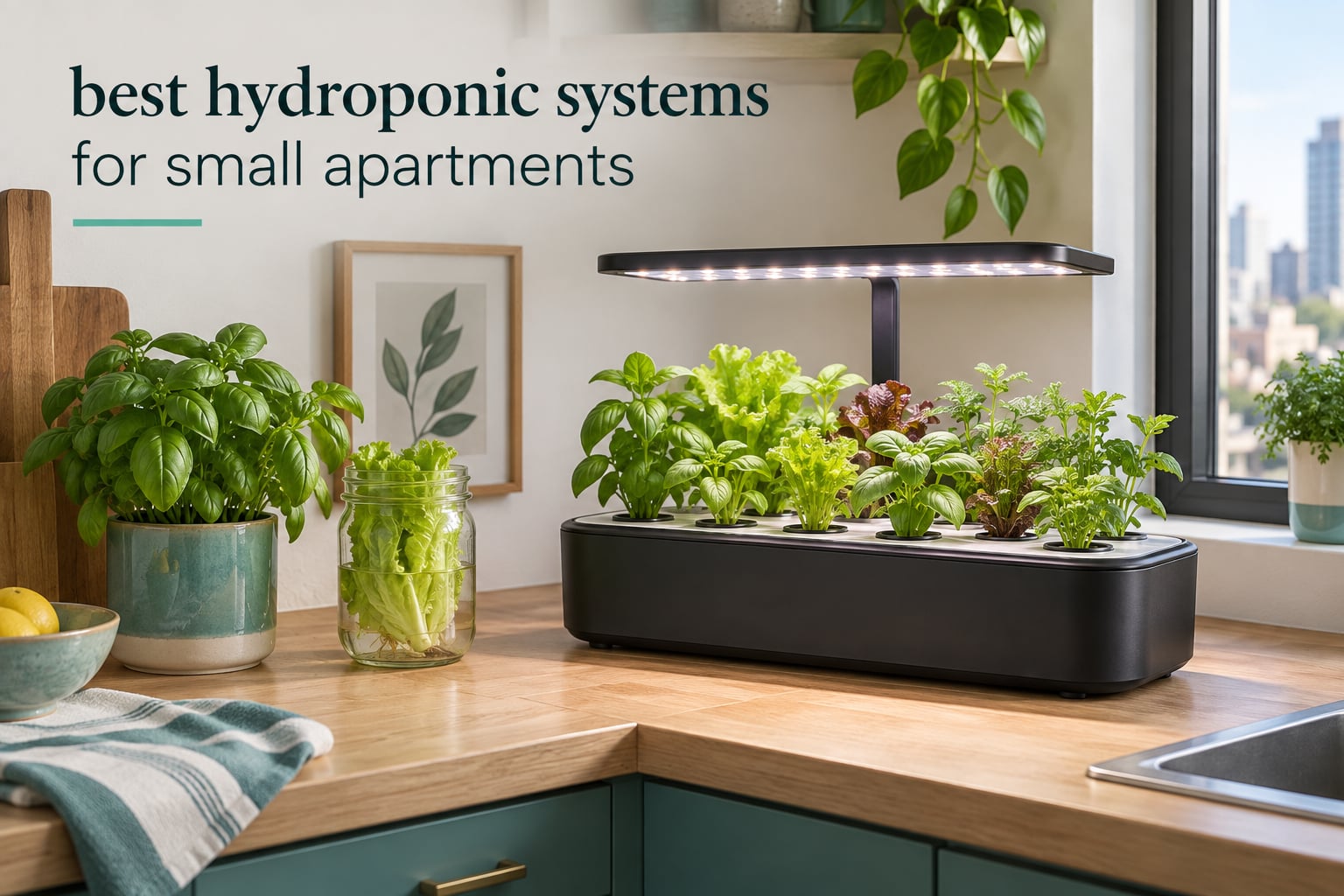
The best hydroponic system for a small apartment is the iDOO 12Pods, because its 4.5L tank and 22-watt light pack real growing capacity into a 13.78 by 12.09 inch footprint. For studio kitchens where counter depth is the constraint, the Ahopegarden 10-Pod is the runner-up.
That is the short answer, and the rest of this roundup is the long one. We looked at ten countertop hydroponic gardens rated for apartments and studios, and we ranked them on the things that actually decide whether a system survives a small home: how much counter it eats, how loud the pump is, how long the tank goes between refills, how far the light bar travels, and how much attention it asks of you.
Most buying guides rank by pod count. That is the wrong axis for an apartment. A 12-pod system on a six-foot counter in a 500 square foot studio is not a garden, it is a second tenant. If you want the wider indoor growing picture beyond countertop systems, our companion piece on the best hydroponic systems for indoor gardening covers towers and larger systems. This page stays strictly on the small-footprint end.
Two more apartment realities shaped every pick below. The first is noise: in a studio or a one-bedroom, a pump you can hear from the bed is a pump you will turn off. The second is renter risk, which we cover in detail in the buying guide, because the thing most likely to cost you money in an apartment is not a dead plant, it is water on a hardwood floor and a landlord who was never told.
Table of Contents
Top 3 Hydroponic Systems for Small Apartments in 2026
These three are the strongest balance of capacity, footprint and quiet operation for compact living. The iDOO 12Pods takes the top slot on tank capacity and plant count for the size. The Ahopegarden 10-Pod is the quieter, smaller-footprint alternative. The LETPOT Senior 12-Pod is the pick if you want app scheduling and the tallest light travel here.


Hydroponic Systems for Small Apartments, Compared at a Glance in 2026
Every system below is a countertop unit. Capacity is plant sites, footprint is the manufacturer dimensions, and tank is the stated reservoir volume. Pump figures reflect the documented cycle or noise claim in the product data.
| Product | Specifications | Action |
|---|---|---|
| iDOO 12Pods Hydroponics Growing System |
|
Check Latest Price |
| Ahopegarden 10 Pods Indoor Garden |
|
Check Latest Price |
| LETPOT Senior 12-Pod Smart Herb Garden |
|
Check Latest Price |
 Ahopegarden 12 Pods with LCD Panel Ahopegarden 12 Pods with LCD Panel |
|
Check Latest Price |
 inbloom 12 Pods with Water Alarm inbloom 12 Pods with Water Alarm |
|
Check Latest Price |
 URUQ 8 Pods Hydroponics System URUQ 8 Pods Hydroponics System |
|
Check Latest Price |
 SUNCOZE Compact 12 Pods SUNCOZE Compact 12 Pods |
|
Check Latest Price |
 Sainlogic 12-Pod WiFi Herb Garden Sainlogic 12-Pod WiFi Herb Garden |
|
Check Latest Price |
 hdroor 12 Pods 6L Reservoir Kit hdroor 12 Pods 6L Reservoir Kit |
|
Check Latest Price |
 SereneLife Smart Starter Kit 6 Pods SereneLife Smart Starter Kit 6 Pods |
|
Check Latest Price |
Dimension order varies by manufacturer, so treat the footprint figures as the shape of the box rather than a perfect rectangle. Two systems in this list are noticeably shallow, at 5.11 and 6.69 inches deep, and those are the ones that survive a narrow counter between a wall and a toaster.
Why Trust This Roundup
Every specification in this article comes from manufacturer listing data and aggregated buyer reviews, not from marketing copy alone. Where a number appears here, it is either a stated spec or a pattern that shows up repeatedly in owner reviews.
What we did not do is pretend to a test log we do not have. We did not grow lettuce for eight months in a Brooklyn walk-up. Instead, we read the specs and the owner feedback closely and cross-checked them against the constraints that actually define a small apartment: counter depth, outlet distance, sleeping proximity, and refill frequency.
That methodology matters because most published roundups rank on pod count and star rating alone. For a studio, those two numbers tell you almost nothing about whether the unit fits beside the sink or keeps you awake. We weighted refill interval, light reach and documented noise above raw capacity throughout.
We also drew on the apartment growing communities that formed around this topic, including r/Hydroponics and r/kratky, where the recurring questions are consistently about pump noise, spill risk near outlets, and how many pods two people can realistically eat from. Those questions shaped the buying guide below.
Disclosure: if you buy through the links on this page, we may earn a commission at no extra cost to you. It does not change the order of the picks.
1. iDOO 12Pods Hydroponics Growing System – Best Overall for Apartments
- Largest plant count here in a compact footprint
- 4.5L tank gives 1 to 2 weeks between refills
- Two light modes plus automatic on-off cycle
- Low-noise pump suits a countertop or bedroom
- Light bar has limited vertical travel for tall plants
- All-plastic build restricts root room for large specimens
- Basic on-off light control with no user-set schedule
This is the unit I keep coming back to for people who want real capacity without a tower. Twelve plant sites in a footprint of 13.78 by 12.09 inches is a dense, efficient rectangle, and at roughly 4 pounds it is easy to shift out of the way when you need the counter.
The 4.5L reservoir is the reason it wins. Owners report refilling roughly every one to two weeks depending on crop load, which is infrequent enough that you can travel for a short trip without panic. The tank has a sight window, so checking the water level takes two seconds rather than a lift and a peek.
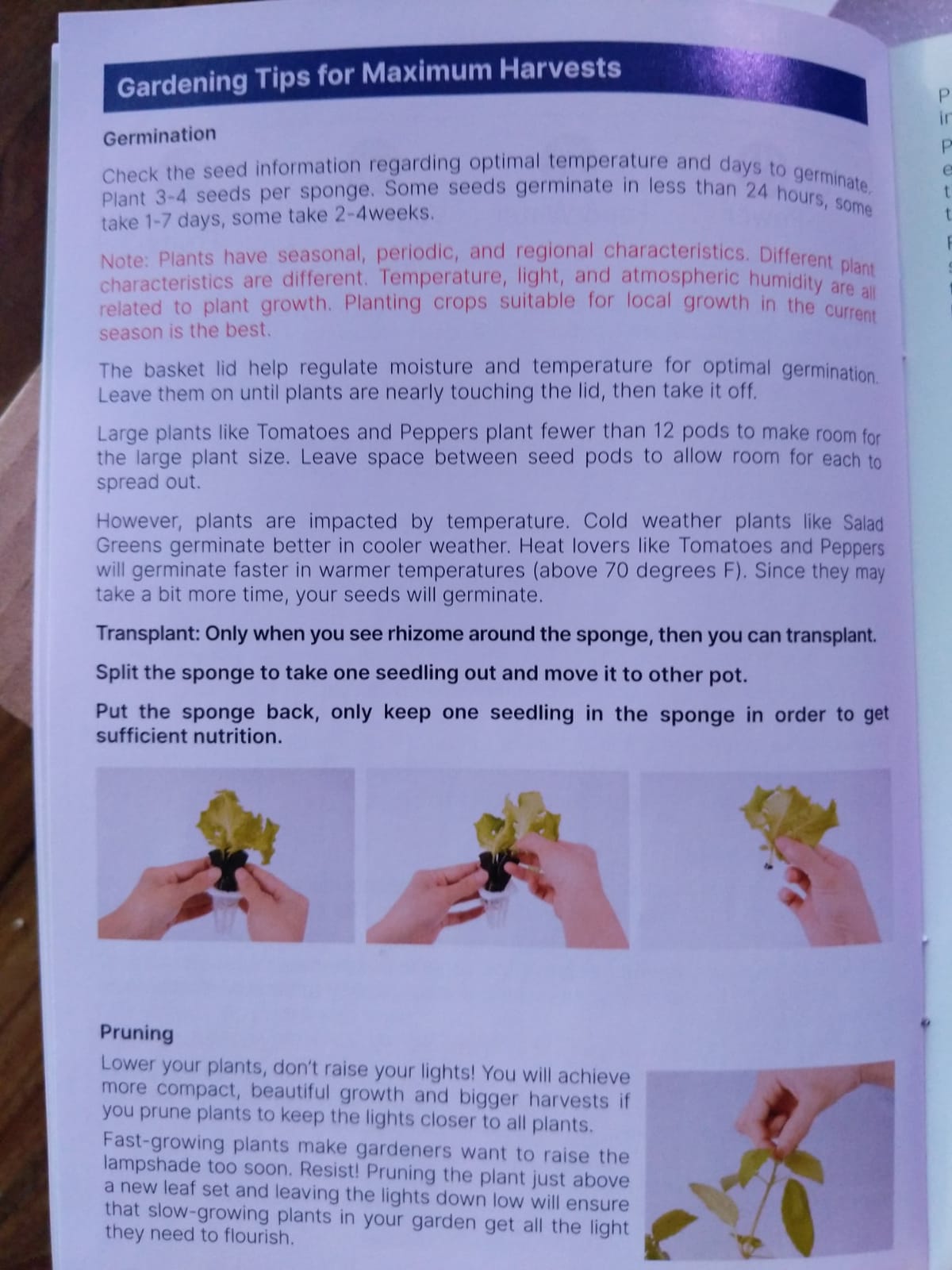
The light is a 22-watt LED with two modes, one for vegetative growth and one for flowering and fruiting. It switches on and off automatically, which matters if the system lives in a room you are not in every day.
There is an integrated low-noise pump that aerates the water, plus a small upper fan that pulses to simulate a breeze and help stems grow sturdy. The light bar adjusts for plants up to about 11 inches tall, which is plenty for lettuce, basil, mint, and cilantro.
How it handles a real kitchen corner
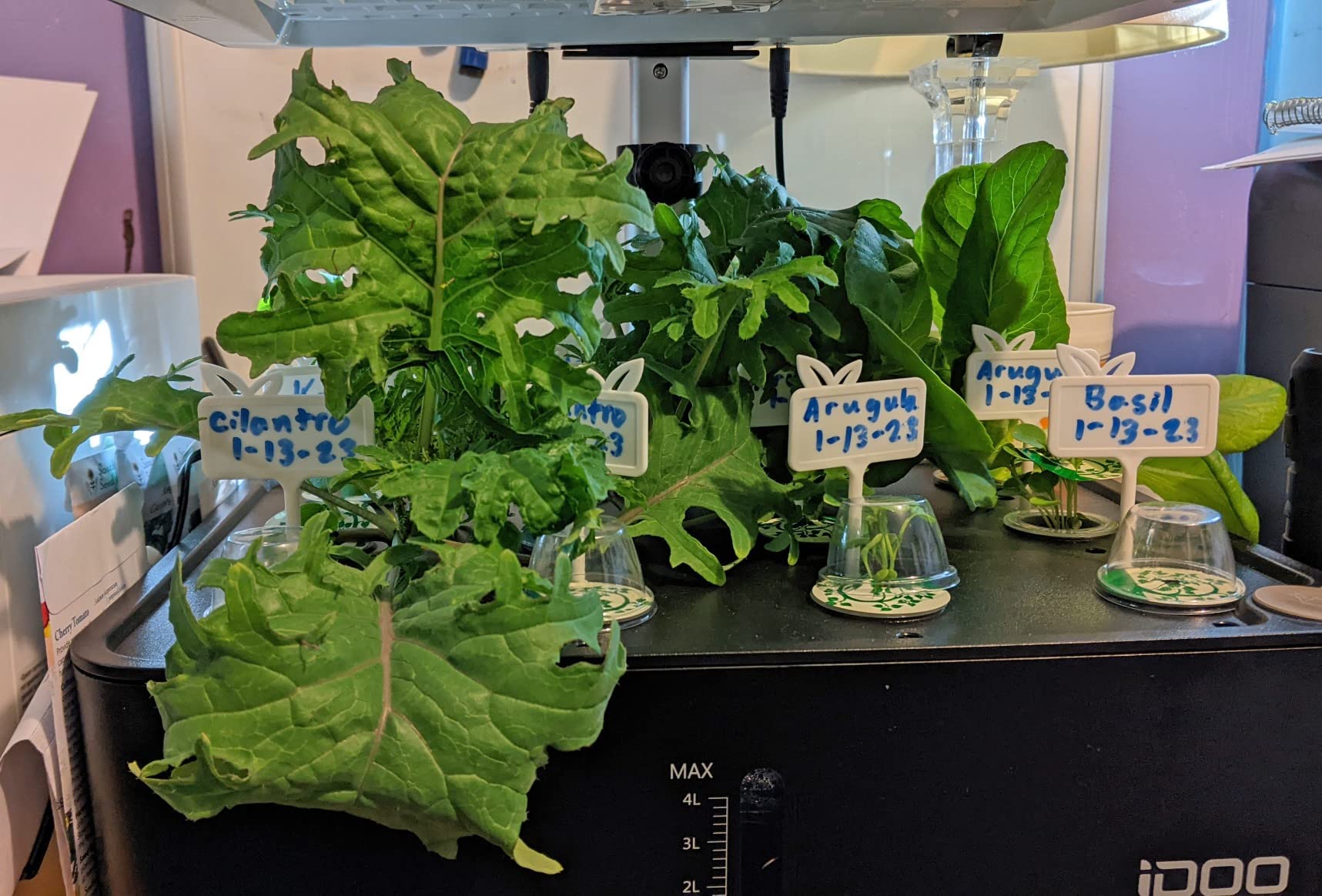
Buyers consistently mention fast germination and a three-step assembly that takes a few minutes. The 4.5L tank means the unit is stable and does not need draining before a move, and the sight window removes the most common failure mode, which is simply forgetting what is happening inside it.
The noise complaint that does appear is not about the pump. It is about the fan cycling, which some owners find noticeable in a very quiet room. If your counter is in the same space as your bed, plan for that.
Where it falls short
The light bar has limited vertical travel, and this is the single most repeated limitation in owner reviews. It is a fine unit for greens and herbs, but a cherry tomato or a pepper will reach the top of its range and then stop, leaning toward the light and stretching.
The all-plastic construction and pod spacing also limit root room for larger specimens. And the light control is basic on and off, with no user-set schedule, so if you want a 14-hour cycle or a specific blackout window you cannot dial it in.
2. Ahopegarden 10-Pod Indoor Garden – Best Value Pick for Studios
Ahopegarden Indoor Garden Hydroponics Growing System: 10 Pods Kit with LED
- Very quiet 30-minute-on and 30-minute-off pump
- Shallow body at just 6.69 inches deep
- Light post adjusts up to 14.5 inches
- Water level window makes checks instant
- Fixed light timer that resets after a power cut
- Light bar cannot reach high enough for large pepper or tomato plants
- Roots can tangle between neighbouring pods without trimming
This is the one I would put in a studio where every inch of counter counts. At 11.97 by 6.69 by 6.69 inches it is one of the shallowest bodies in the group, which is exactly what you want between a backsplash and a wall.
Ten plant sites sounds like a step down from the iDOO, and on paper it is. In practice, for one person or a couple, ten sites is already generous. Forum growers repeatedly point out that a 12-pod system overfeeds two people and leaves a half-used unit collecting dust.
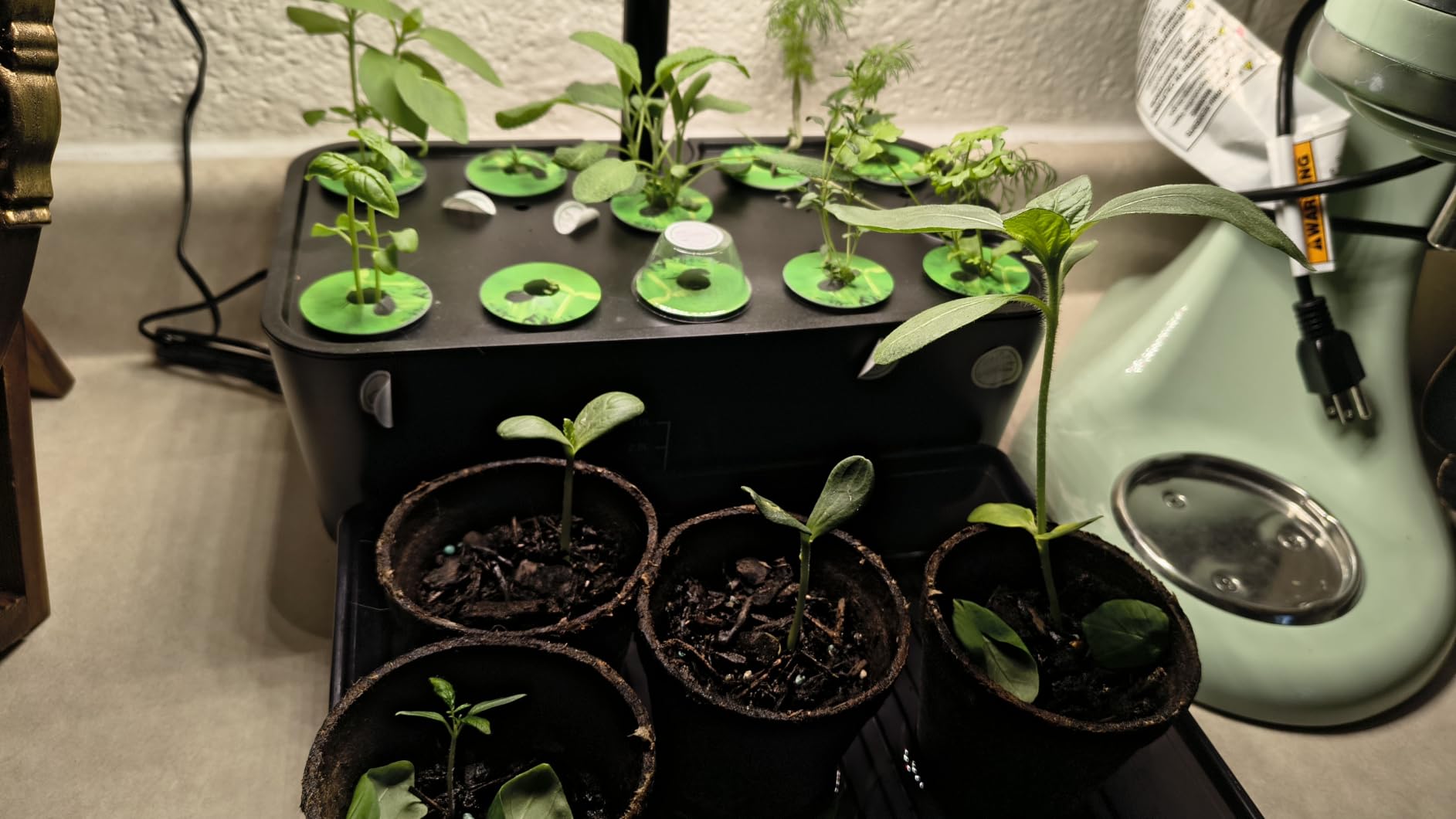
The pump runs 30 minutes on and 30 minutes off, and owners running this unit in bedrooms describe it as effectively inaudible. The reservoir is 3 liters with a transparent level window, so the refill interval is shorter than the larger-tank systems but still a weekly or twice-weekly job.
The light post adjusts for plants up to 14.5 inches, which is taller than the iDOO and one of the reasons this unit handles herbs better. The full-spectrum light has two modes, blue for vegetables and red for flowers and fruit, on a fixed 16 hours on and 8 hours off cycle.
What it is like to live with
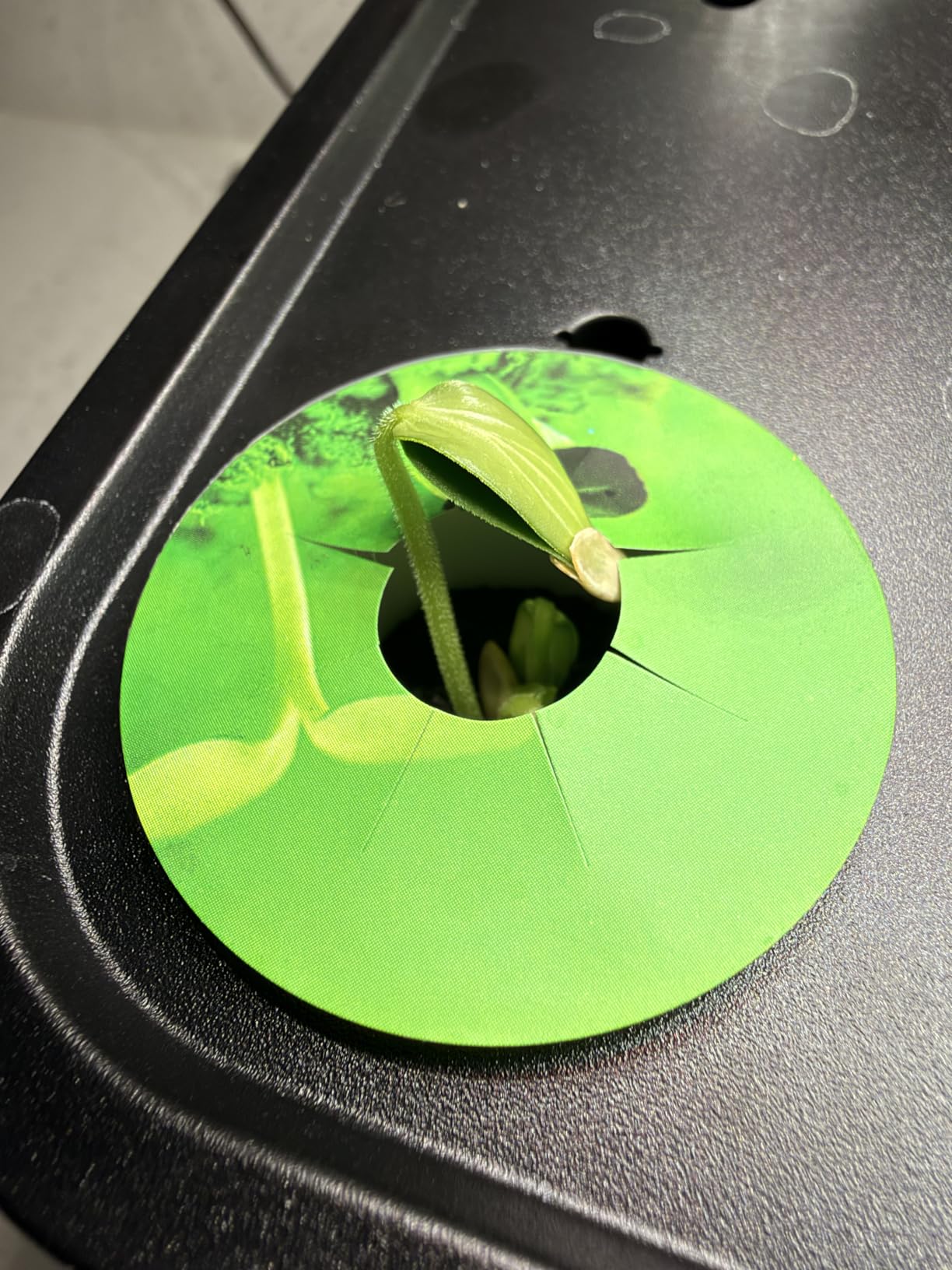
Reviewers report quick harvests of lettuce, basil, and cherry tomatoes within weeks, with strong germination across most pods. The kit also includes baskets, sponges, domes, shade papers, labels, and an A and B fertilizer pair, so you are not buying accessories on day two.
For a renter, the light footprint matters more than the pod count. This unit is short and wide, which means it sits flat against a backsplash and leaves the rest of the counter usable for a coffee maker.
Where it falls short
The light timer is fixed and not user-adjustable, and it resets after a power interruption. In an older building with flaky power, that is a genuine annoyance rather than a rounding error.
Roots grow long here and can tangle between neighbouring pods if you do not trim them. There are also reports of pump and control board failures after extended multi-year use, so if you are buying this as a ten-year appliance rather than a two-year one, keep spare parts in mind.
3. LETPOT Senior 12-Pod Smart Herb Garden – Best for App Control and Tall Plants
- App and WiFi control for exact light hours and watering reminders
- 5.5L tank stretches refills toward three weeks
- Light rod adjusts to 30 inches
- Stainless steel and resin body wipes clean easily
- Most expensive system analysed
- App-dependent scheduling adds setup overhead
- Largest footprint among the 12-pod options
The LETPOT is the pick when the thing you want control over is the schedule. The app sets a 0 to 24 hour lighting window, switches between vegetative and blooming modes, and sends watering reminders so you are not relying on memory alone.
That matters more than it sounds in a busy apartment. A fixed 16-on, 8-off cycle is fine if you are home every evening, but if you travel or work irregular hours, a schedule you can push forward from your phone removes a whole category of stress.
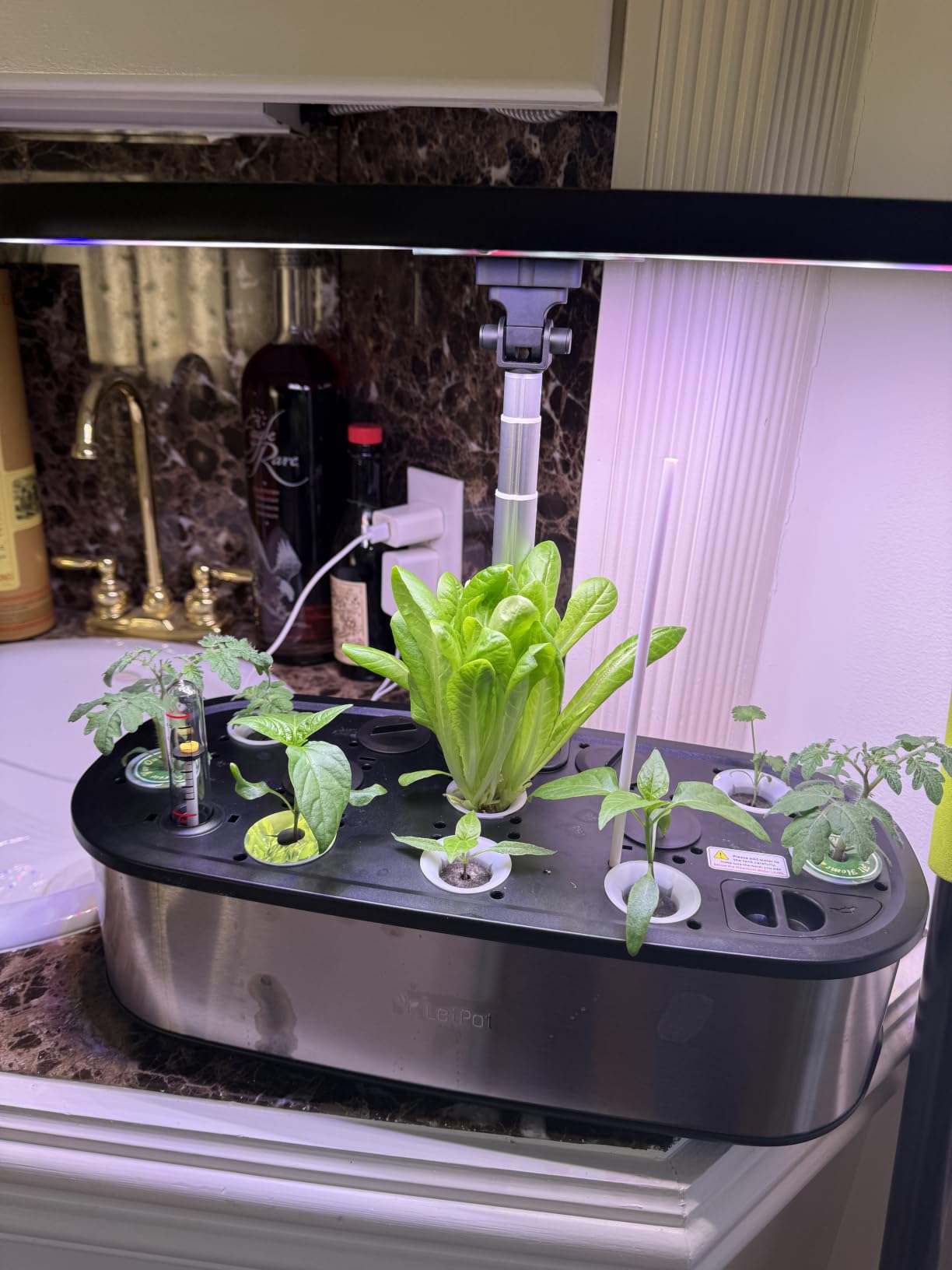
The 5.5L tank is the second largest here and is documented as supporting up to three weeks of growth without watering. For a two-person household that works, the refill becomes a monthly chore rather than a weekly one, and the reservoir means fewer nutrient top-offs that drift the concentration.
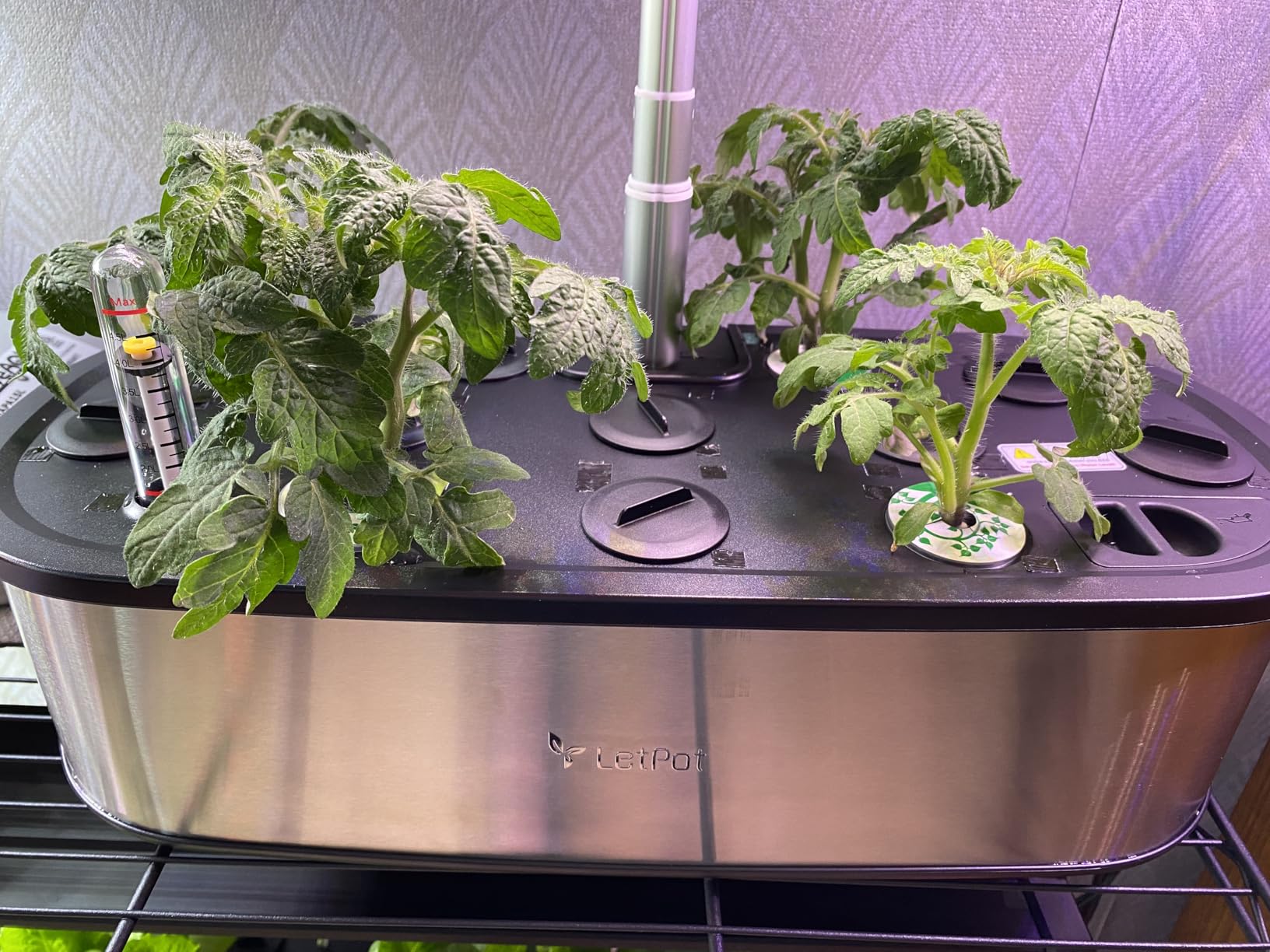
The light rod adjusts to 30 inches, by a wide margin the tallest travel in this group. That is what makes it the only unit here that comfortably grows a cherry tomato or a pepper on a small pod garden, which is a real difference if you want more than salad greens.
Who this suits
Owners value the scheduling flexibility, the long tank interval, and strong germination with herbs and lettuce. The stainless steel outer wall and resin inner wall also wipe down easily, which is a small thing that matters in a kitchen where a system sits next to food.
The app also records growing days, so you can track each planting cycle and know when a bed is due for a reset. For a beginner, that kind of structure is worth more than raw pod count.
Where it falls short
This is the most expensive system we analysed, and in a category where a comparable 12-pod unit costs substantially less, that gap is real. It is a premium for scheduling and light reach, not for growing better.
It also has a larger body than the iDOO at 16 by 7 by 9.8 inches, so it uses more counter depth than the iDOO or the Ahopegarden 10-Pod. And the app is effectively required for good setup, which adds friction if you would rather press one button and walk away.
4. Ahopegarden 12 Pods with LCD Panel – Best for Narrow Counters and Balconies
Ahopegarden Hydroponics Growing System Kit: 12 Pods with LCD Control Panel
- Slim 17-inch vertical profile without a bulky base
- Readable LCD touchscreen for cycles and modes
- 5L tank with an ultra-quiet 30-minute pump cycle
- Slim footprint suits balconies and narrow counters
- Light bar cannot lower close to the reservoir
- Heavier to move once the tank is filled
- Seedlings can stretch because light sits too high
This is the one to look at if your counter is a narrow strip, or if you want a system on a balcony or in a narrow office nook. At 18 by 9 by 6 inches the body is tall and slim rather than wide, so it presents a small face to the room.
The LCD touchscreen is the feature that separates it from the fixed-timer crowd. You set the light cycle and switch modes directly on the panel, with no app and no guessing at a button sequence.
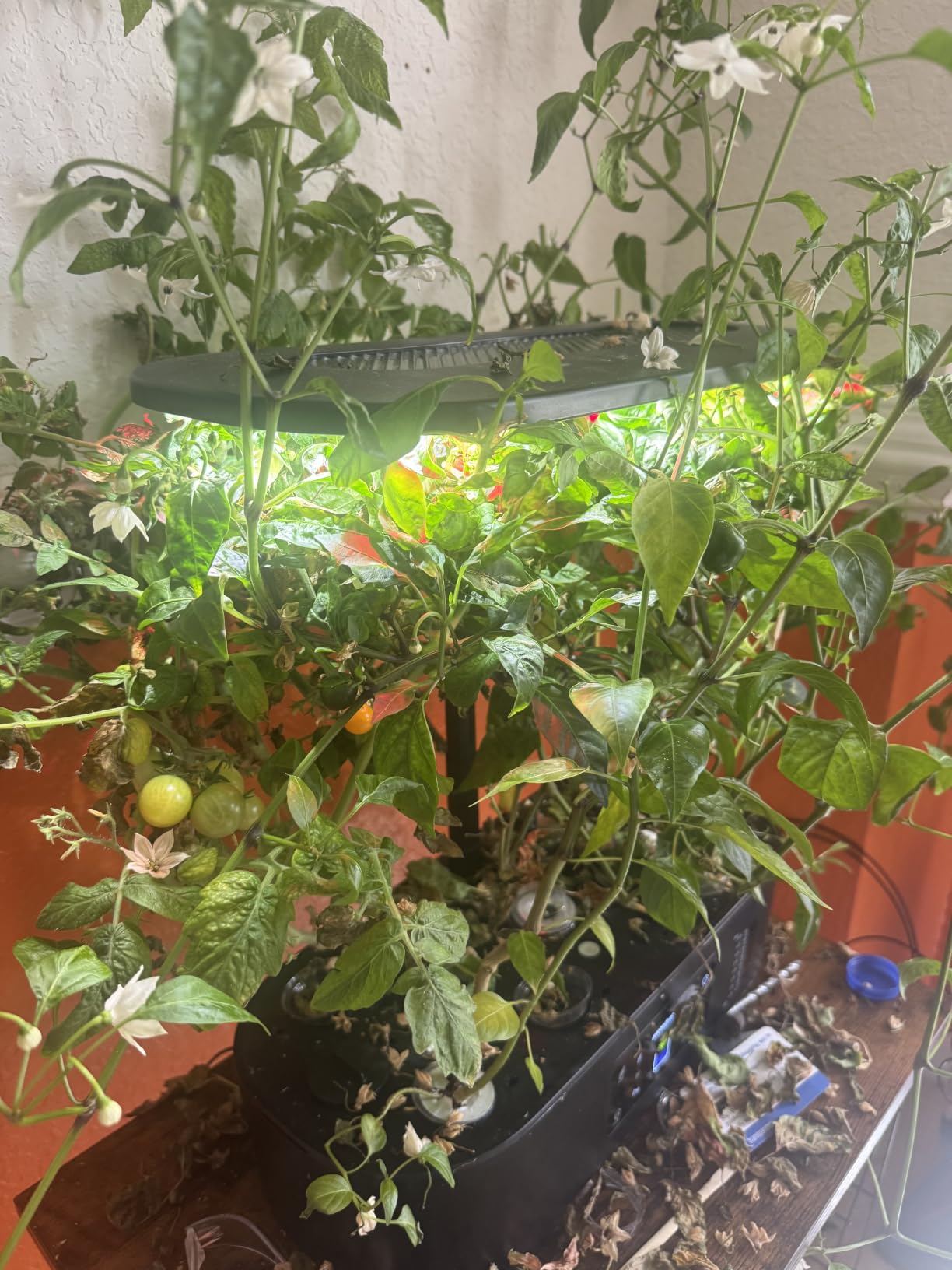
The reservoir holds up to 5 liters, and the pump runs a 30-minute cycle. Owners describe it as quiet enough for a bedroom, and the 22-hour lighting mode is tuned for flowering and fruit sweetness if you go beyond greens.
Twelve sites on a slim frame is an unusual combination, and it is the reason this unit earns a place here even though a 12-pod garden with a full-size light bar usually wins on plant health.
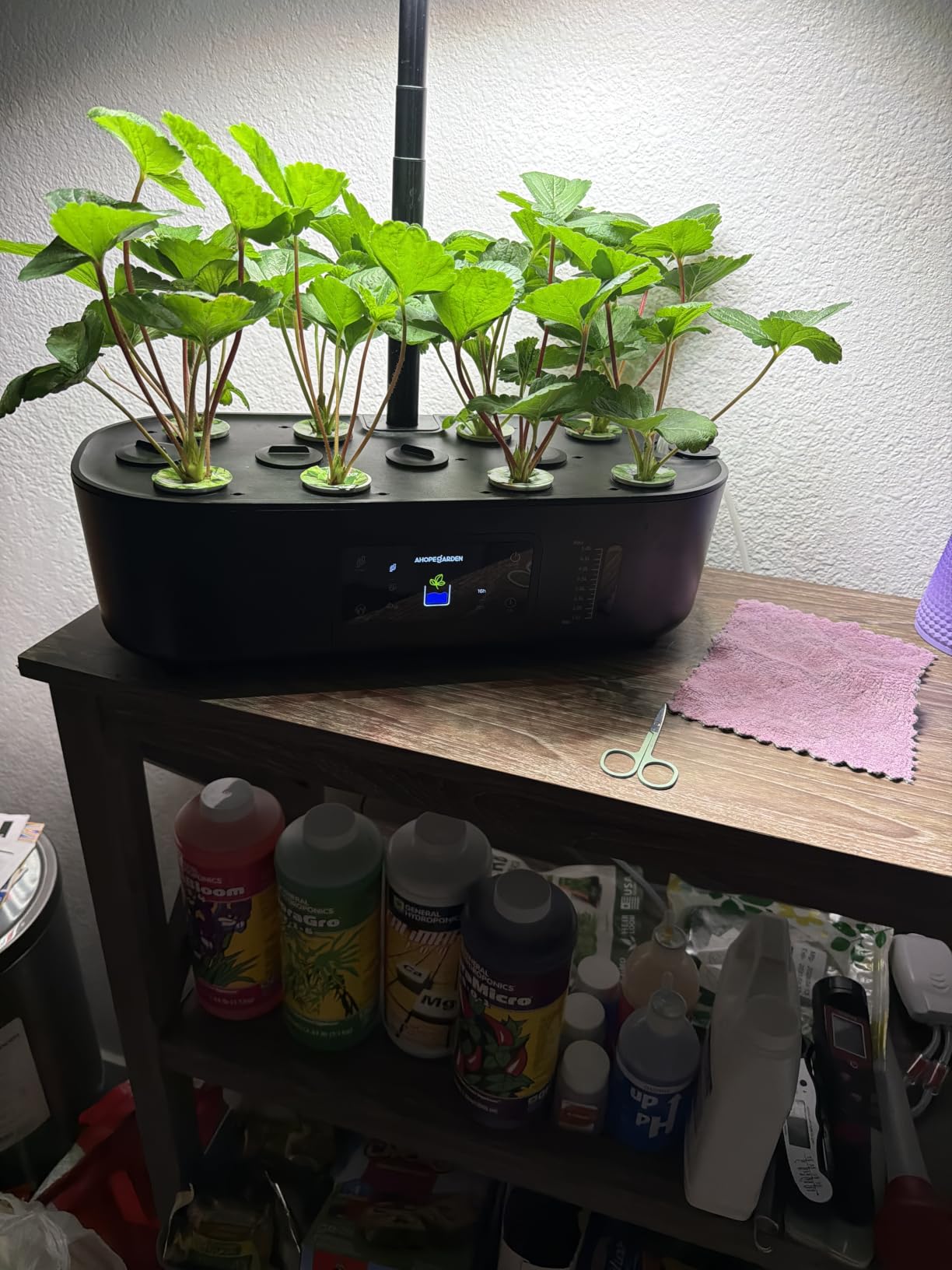
Why the slim profile matters
In a one-bedroom, the usable counter is often a strip against one wall. A wide unit pushes everything else off the counter, and a tall slim unit keeps the space usable. This is one of those cases where a physical measurement matters more than a spec sheet number.
The screen also helps in a small apartment because you can check and change settings without leaning in with your phone, which is awkward when the unit is tucked against a wall.
Where it falls short
The light bar cannot be lowered close to the reservoir, and that is the most repeated limitation in owner reviews. It means seedlings sit too far from the light and stretch, which is exactly the stage where plants are most fragile.
The larger tank also makes the unit heavier once filled, at 5.1 pounds empty. And the touchscreen controls can be less intuitive than physical buttons, especially the first time you set a cycle.
5. inbloom 12 Pods with Water Alarm – Best for Low-Maintenance Setups
- Low-water alarm below 700ml is a real safeguard
- Pod spacing about 20 percent wider than rival gardens
- 4.2L tank with a 15 to 30 day refill interval
- Rounded wood-look base works as counter decor
- Water-level float gauge sticks in its tube
- Bright 16-hour LED can disturb a bedroom
- Light bar cannot lower to tank level
The inbloom exists for one reason, and the reason is a bell. A low-water alarm triggers below 700 milliliters, which is what tells you the reservoir is nearly empty instead of waiting for you to notice a sad plant.
For a busy apartment that is the feature that matters most on this list. Owners report abundant basil, lettuce, and herb harvests within weeks, and the alarm covers the failure mode that kills the most first-time growers.
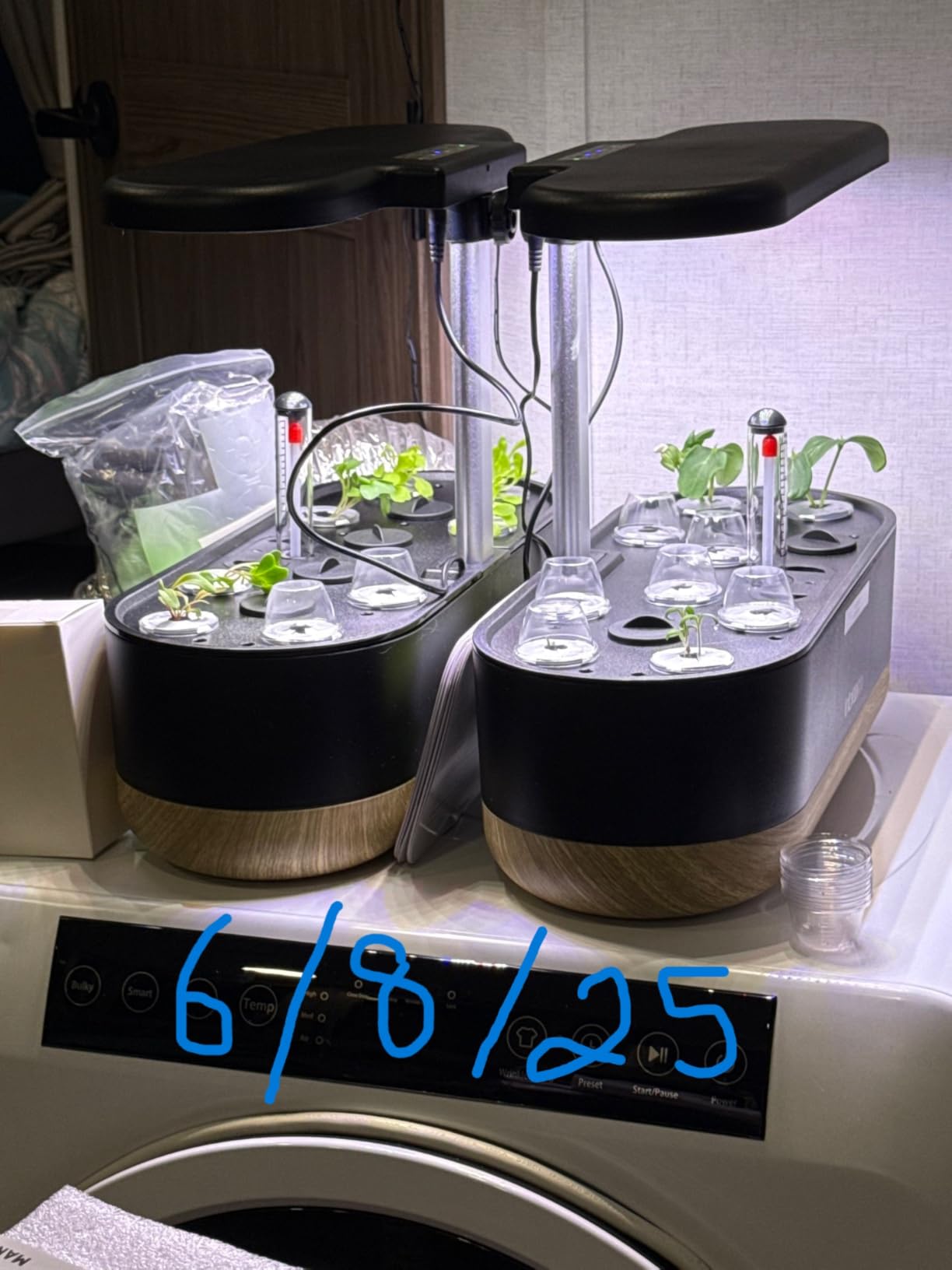
Pod spacing here is about 20 percent wider than competing indoor gardens, and it shows. Leaves have room to open out instead of pressing against neighbours, which reduces the crowding that turns a full 12-pod unit into a tangle by week six.
The tank holds 4.2 liters with a documented refill interval of roughly 15 to 30 days depending on plant maturity, and the pump cycles 30 minutes on and 30 minutes off. The 24-watt panel uses 76 bulbs on a 16-hour cycle.
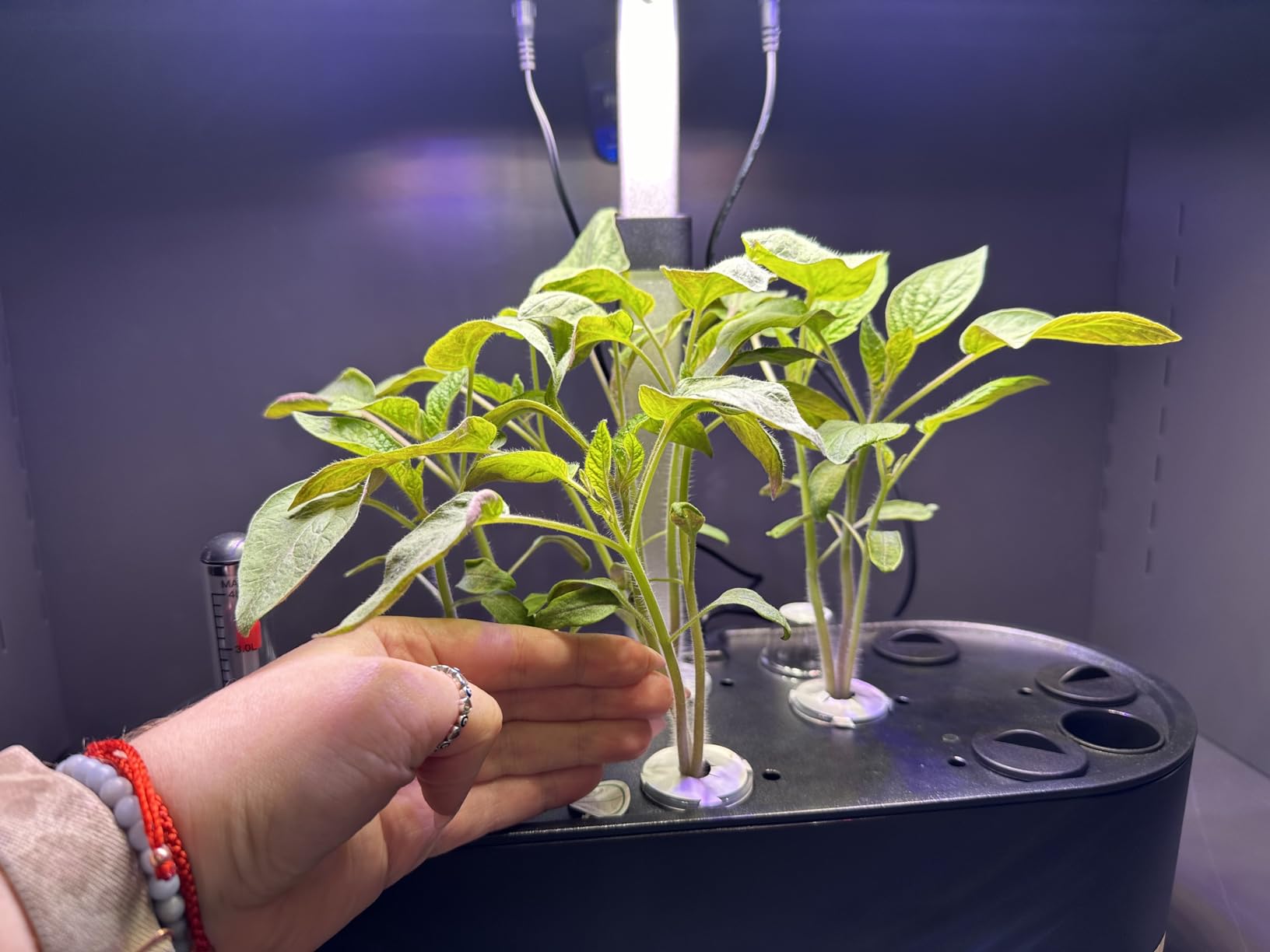
Where the wider spacing pays off
If you have ever had lettuce bolt and dry out because its neighbours blocked the light, the extra pod spacing is a genuine quality-of-life upgrade. It also means the unit tolerates a full 12-site planting better than a tighter layout, which matters if you actually intend to use all of them.
The rounded body with a wood-look base is worth mentioning for a different reason. In a rental, a system that looks like a piece of furniture is easier to explain and easier to move out of the way than industrial-looking hardware.
Where it falls short
The water-level float gauge is the weak point. Owners report it sticking in its tube and eventually stopping reading reliably, which is a bit ironic on the unit whose main selling point is water awareness. The alarm is the part to trust.
The LEDs are also very bright and run for 16 hours, which reviewers in small rooms find disruptive at night. The light bar cannot lower to tank level, so seedlings can grow leggy, and once plants mature the tank needs refilling far more often than the initial interval suggests.
6. URUQ 8 Pods Hydroponics System – Best for Beginners and Small Rooms
URUQ 8 Pods Hydroponics Growing System with LED Grow Light – White
- Compact 8-pod size that suits a small counter or a shelf
- Ceramic-core pump documented under 20 dB
- Detachable light pole makes cleaning straightforward
- Lettuce ready in roughly three to four weeks
- Light timer cannot be programmed and resets after a power cut
- 8 pods crowd quickly beyond three or four large plants
- Included plant markers do not fit the pod holes
Eight pods is the smallest sensible commitment in this roundup, and for a first-time grower in a rented flat it is the most realistic entry point. You are not committing to a twelve-site system that will outgrow two people.
The pump is a ceramic-core unit documented at under 20 decibels, cycling every 30 minutes. That is one of only two published noise figures in this entire group, and it is the number to beat if your system shares a room with a bed.
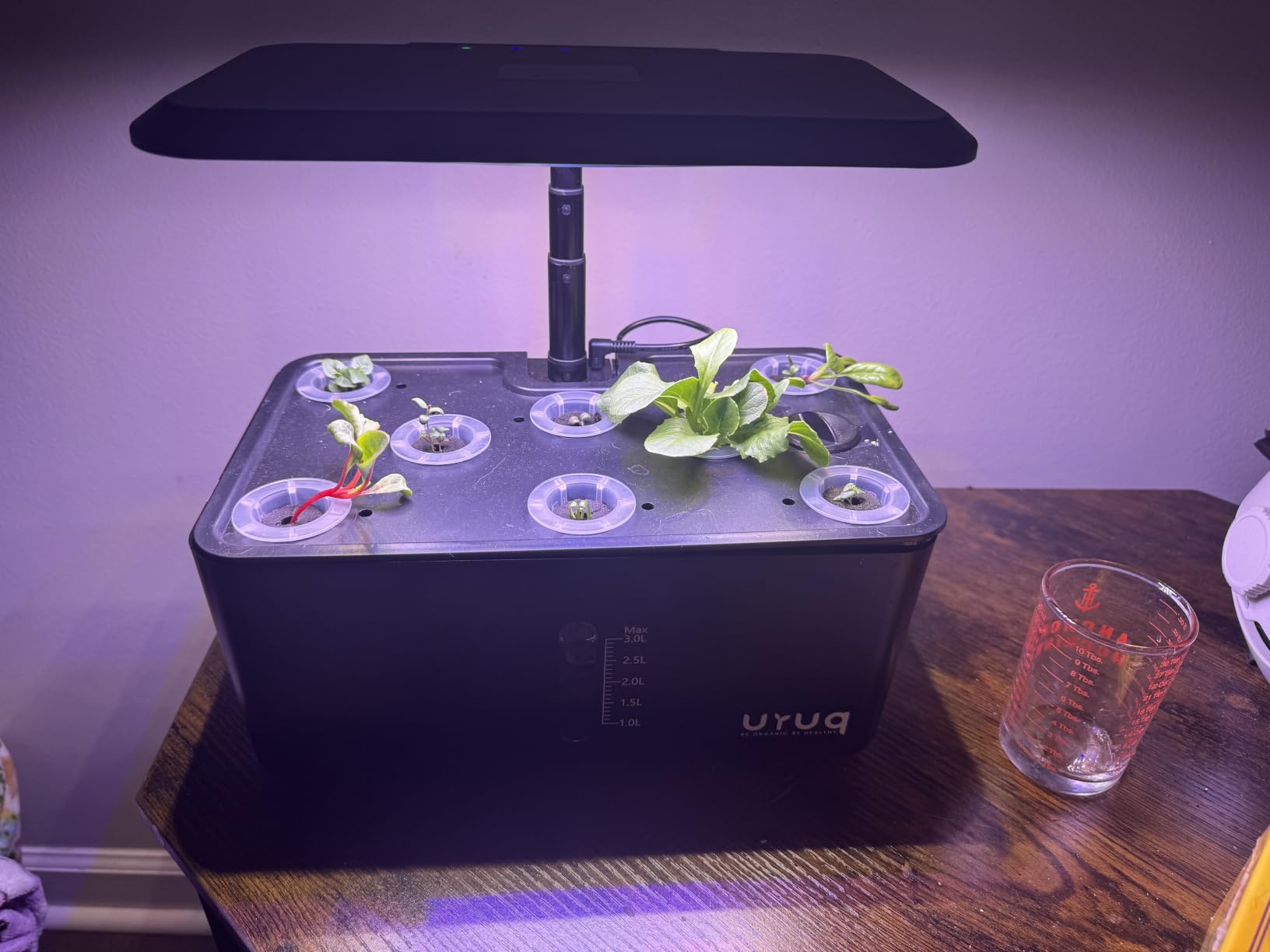
The 24-watt LED panel adjusts to 180 degrees and up to 21 inches of height, which is a genuinely useful range. Combined with a water shortage indicator and a see-through 3L tank level window, this is the most self-explanatory unit here.
Owners treat it as an affordable entry point and report reliable lettuce and herb harvests, with a pump quiet enough to run in a home office. At 11 by 7 by 8 inches it is easy to carry between rooms, which is useful if the sunny counter is not the desk-side counter.
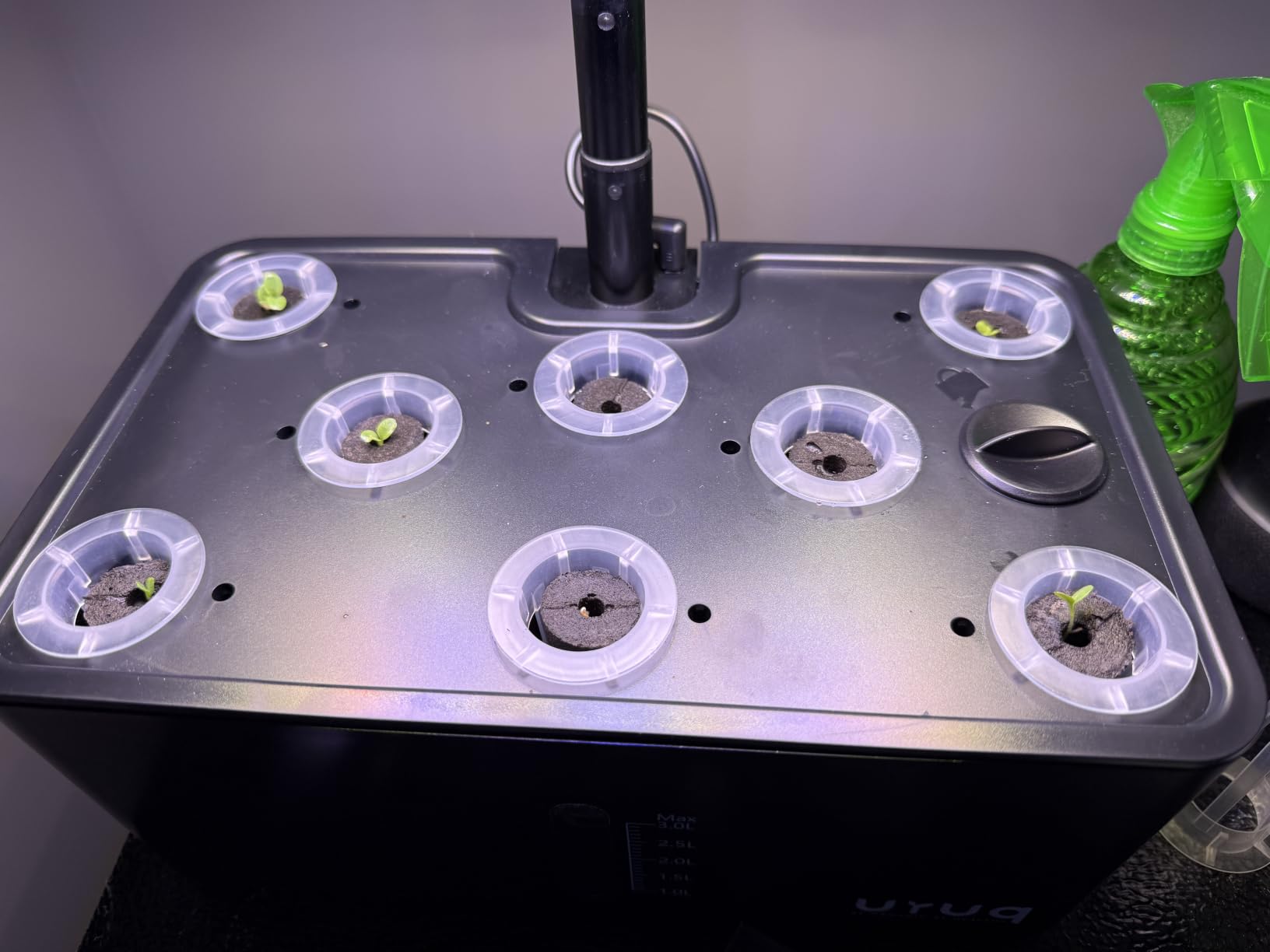
Why fewer pods is the smarter first buy
Forum growers almost universally warn against over-buying. A small system that you harvest from every week teaches you the refill and top-off rhythm. A large system you half-use teaches you nothing except what a neglected reservoir smells like.
Eight sites also means the light bar sits closer to the canopy for a smaller plant, and the detachable pole makes it straightforward to clean the reservoir without dismantling the whole unit.
Where it falls short
Eight pods becomes crowded fast. Owners report that more than three or four large plants in the tray leads to crowding, so this is a greens-and-herbs unit rather than a mixed-planting one.
The light timer cannot be programmed and resets after a power cut, the same limitation shared by several systems here. And the plant markers included do not fit the pod holes, which is a small but telling detail about the accessory packaging.
7. SUNCOZE Compact 12 Pods – Best for Shared Rooms and Dimming Control
SUNCOZE Hydroponics Growing System, Compact 12 Pods Indoor Garden, Black
- Four brightness levels are unusual at this size and let you dim the light
- Quiet pump described as soft white noise
- Low-water and nutrient alerts remove guesswork
- Two-minute setup by extending rods and attaching the deck
- Light height tops out at 12.4 inches
- Light timer has been reported to malfunction or reset
- Seeds over the pump chamber frequently fail to germinate
- Bright light keeps a room lit at night
The SUNCOZE solves a problem most systems in this roundup ignore: a shared room where a fixed-brightness 24-watt panel at 16 hours a day is simply too much light. Four brightness levels let you turn it down without losing the grow cycle.
It also has a three-button control panel with low-water and nutrient alerts, plus a water level gauge. For a brown thumb, alerts that tell you what is wrong beat a manual check every three days.
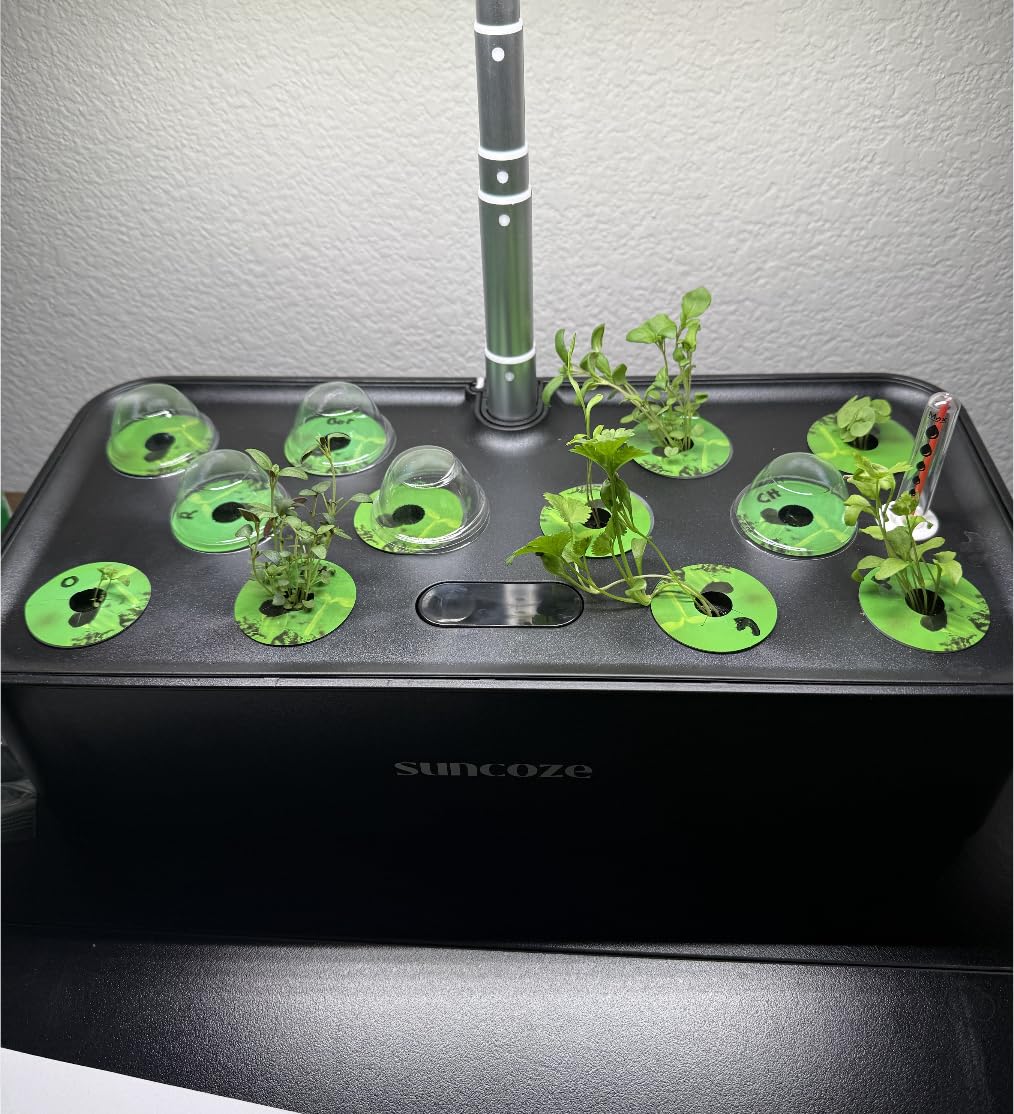
The pump runs 15 minutes on and 1 hour 45 minutes off, a longer rest cycle than most competitors. Owners with no growing experience report fast, abundant lettuce, parsley, and cilantro, and describe the pump as a soft white noise at most.
Setup takes about two minutes: extend the rods, attach the grow deck, plug in. At 15.6 by 7.4 by 7.8 inches it is a genuinely compact twelve-pod unit, small enough for a desk or a shallow counter.
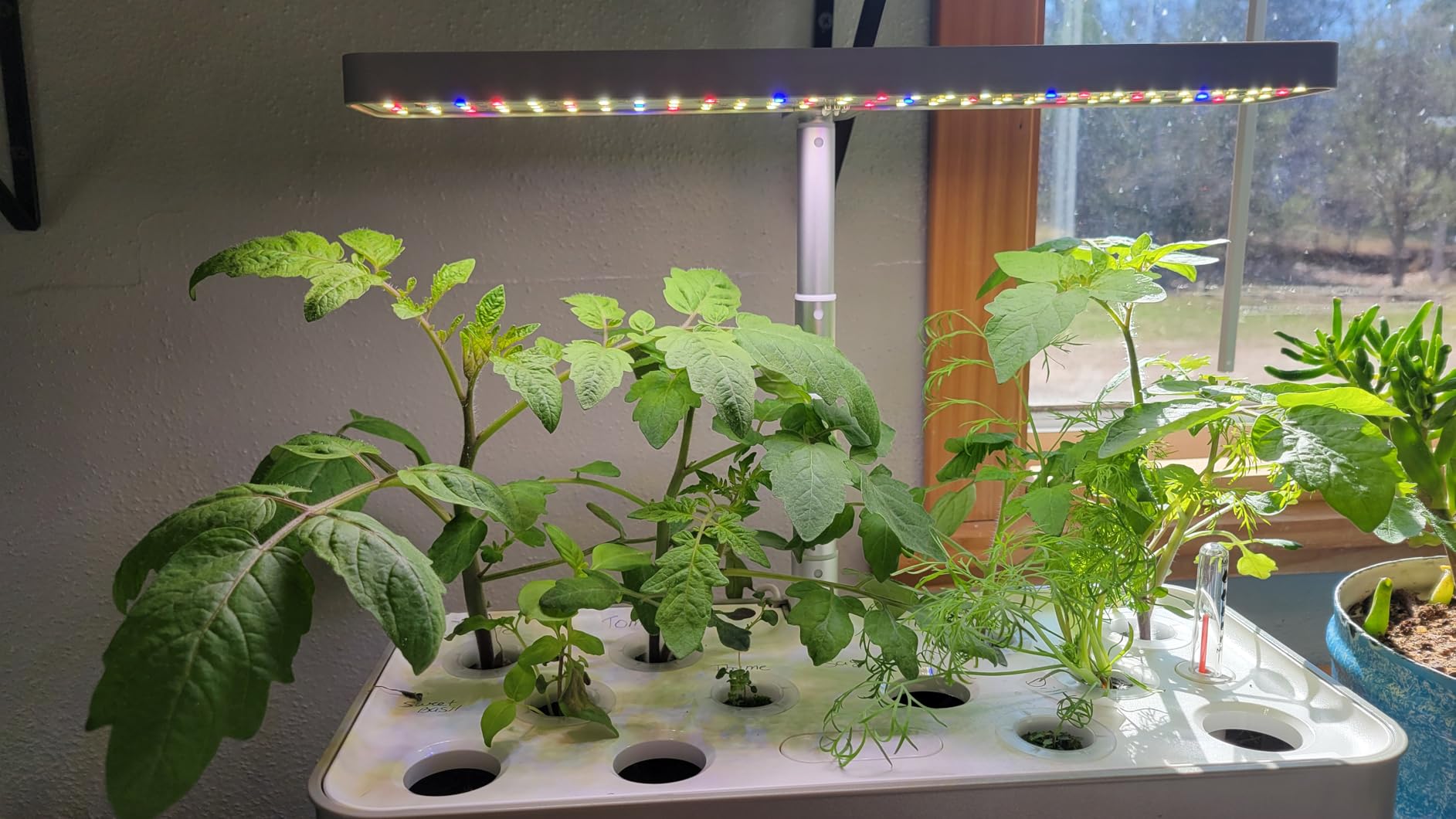
Dimming is the real feature
Most systems here run one brightness and give you an on-off switch. If your kitchen doubles as a living space, or the counter is a few feet from where you watch television, the ability to drop output solves a problem that a cheaper unit cannot.
The alerts also mean the system self-reports on water and nutrients, which removes the mental load of running a checklist nobody enjoys maintaining.
Where it falls short
Maximum light height is 12.4 inches, which is short. Tomatoes outgrow the lamp quickly, and this is the same ceiling problem that limits several other systems here.
Owners report the light timer malfunctioning or resetting unexpectedly, and seeds planted directly over the pump chamber frequently fail to germinate, which wastes two of twelve sites if you do not know to avoid them. The brightness that helps in a shared room also keeps the room lit at night.
8. Sainlogic 12-Pod WiFi Herb Garden – Best for Bedrooms and Overnight Quiet
- Do-not-disturb mode pauses the pump for 12 hours overnight
- 10-level dimming from 0 to 100 percent for a shared space
- App scheduling is optional and the unit runs its default cycle
- Removable tank and pump make cleaning straightforward
- No printed instructions in some shipments
- Removing rooted seedlings tears roots if you pull instead of cut
- Lowest review count in the group so long-term reliability is less documented
This is the unit I would consider for a bedroom, because of one setting. A do-not-disturb mode pauses the pump for 12 hours overnight, on top of a pump documented at under 20 decibels. Nothing else in this roundup gives you a night-time off switch for the water.
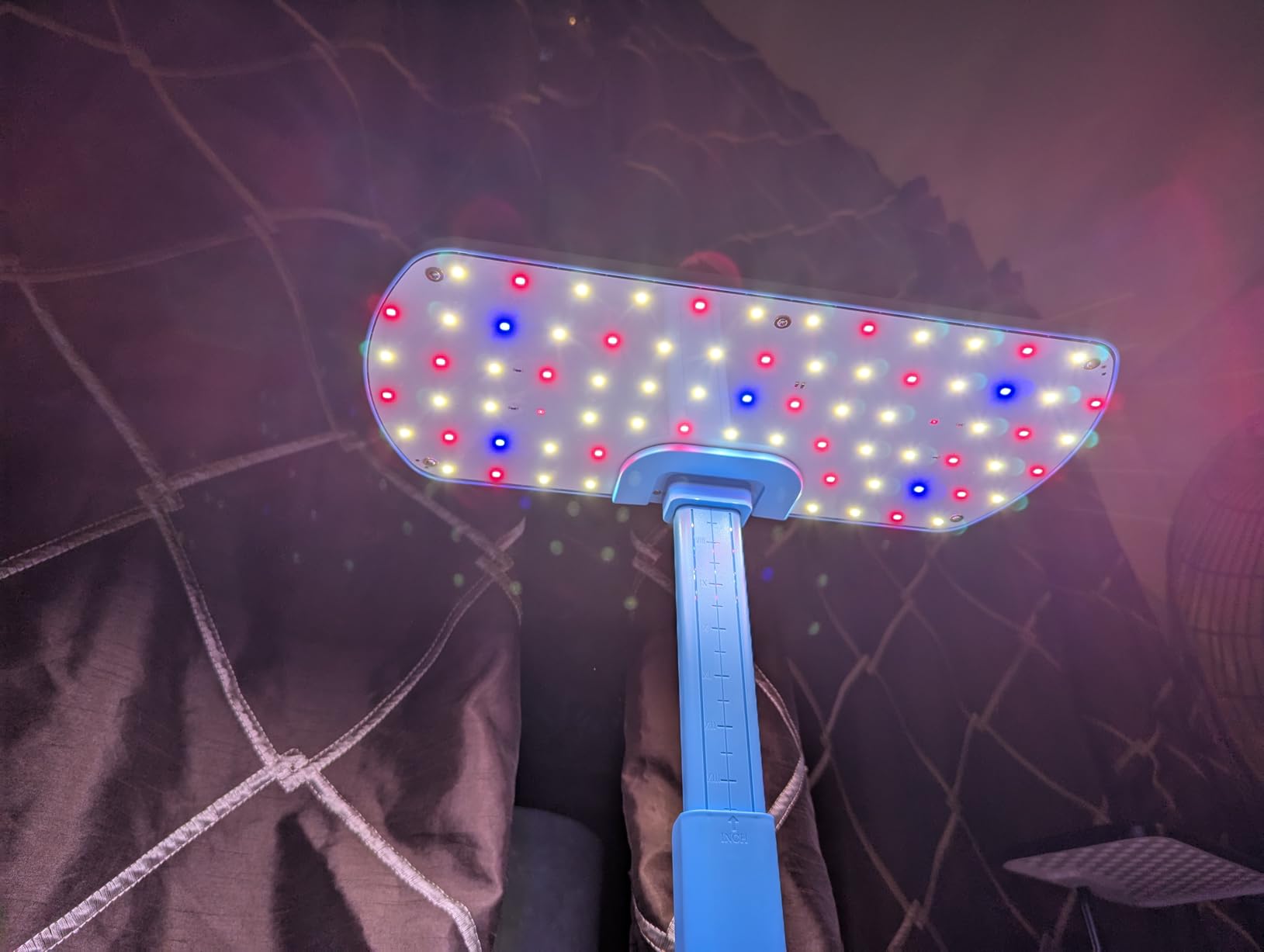
The 24-watt full-spectrum LED dims across 10 levels from 0 to 100 percent. Combined with the pump pause, that is the combination we would look for first in a unit this size.
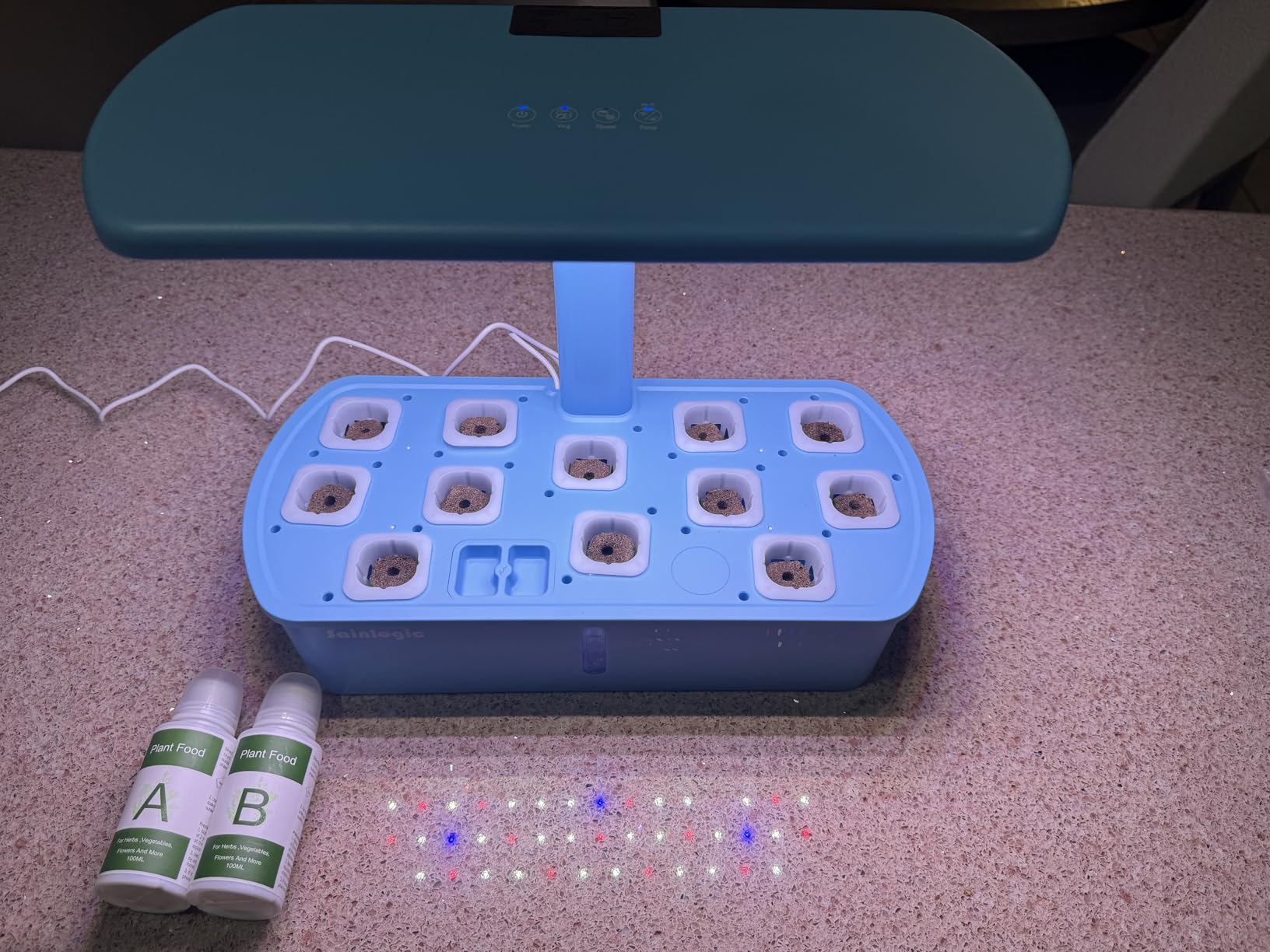
It is also one of the few systems here where the app is genuinely optional. The Smart Life app connects over WiFi for scheduling and monitoring, but the unit runs its default 16-on, 8-off cycle with two light modes on a one-button switch if you never pair it.
The body is tall and slim at 15.9 by 7.44 by 5.11 inches, which suits a narrow shelf or a small balcony corner. The tank, tray, and pump all remove for cleaning, and the light pole detaches.
Living with it in a bedroom
Owners report lettuce sprouting in about four days and appreciate the overnight pause mode. For someone whose system shares a room with a sleeping area, the ability to silence the pump for half the day is worth more than an extra two pod sites.
The detachable light pole and removable pump also mean cleaning is a five-minute job rather than a rebuild, which keeps a system in a bedroom looking like decor instead of a project.
Where it falls short
Some shipments arrive without printed instructions, and the first assembly is frustrating. Removing rooted seedlings from the holders tears roots if you pull instead of cutting, which is a technique problem rather than a design one but catches people out.
It also has the lowest review count in the group, so long-term reliability is less well documented than the systems above it. That is the trade for a newer design with a genuinely useful sleep mode.
9. hdroor 12-Pod Kit with 6L Reservoir – Best for the Fewest Refills
- Largest reservoir here at 6 liters for the longest refill interval
- Deep groove reservoir gives a secure two-handed grip when filled
- Quiet pump with an automatic 30-minute cycle
- Includes seed pod kits and a 2-year service period
- Light and pump are noticeable in a very small apartment
- A few reported pump and power supply failures
- Replacement sponges and baskets are hard to match to this model
If your objection to hydroponics is that you will forget the reservoir, this is the unit built to make forgetting matter less. A 6-liter reservoir is the largest in this roundup, and at 2 pounds empty it is still a light unit to lift once you have moved it.
The deep groove design around the reservoir is a small, thoughtful touch. A filled countertop system is a 6-liter bucket of water and soil substitute, and the groove is what keeps it in your hands when you are moving it to a sink to refill.
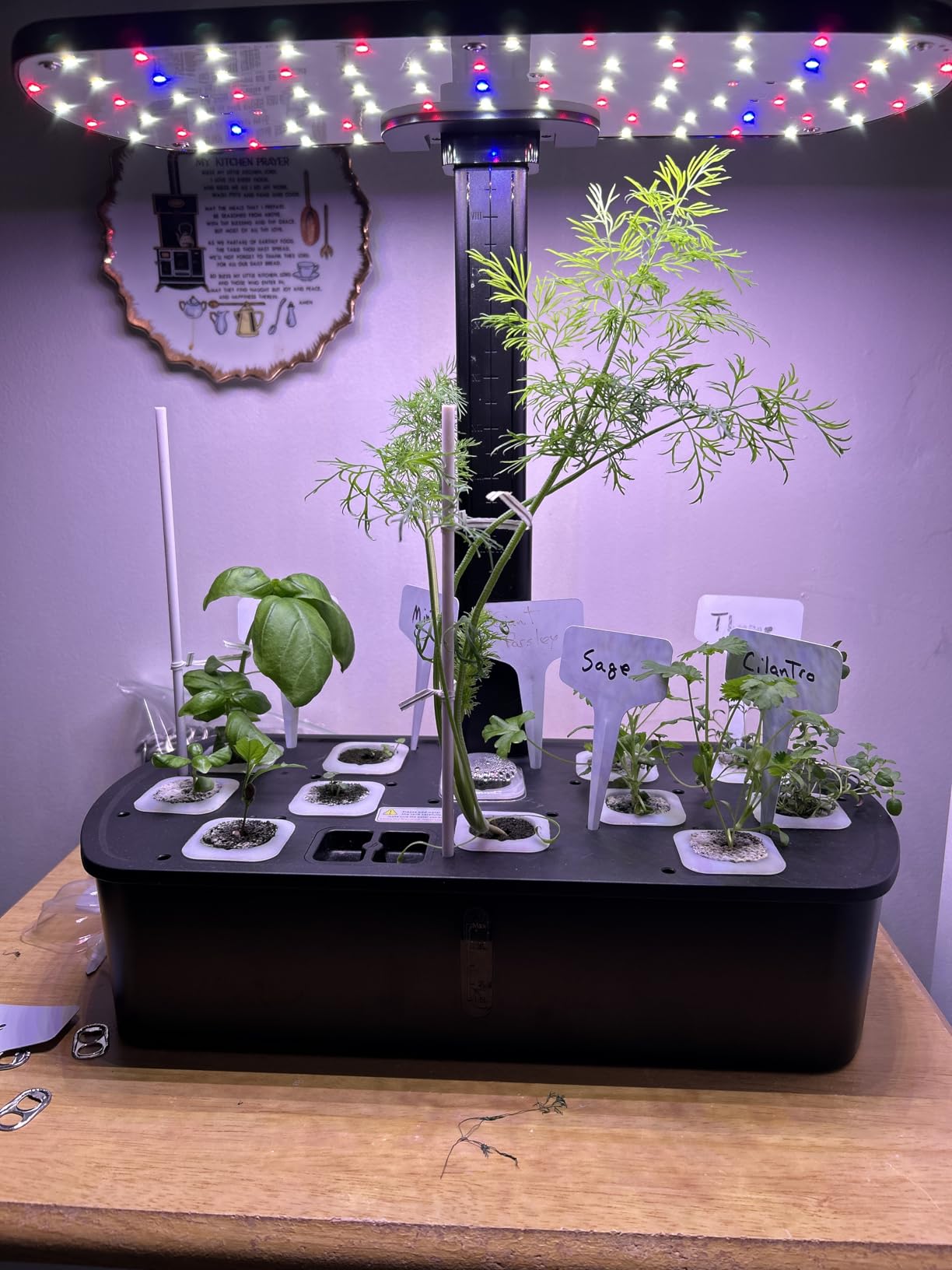
The 17-inch adjustable lamp rod gives tall plants more headroom than most systems here, and the full-spectrum LED runs a 16-on, 8-off cycle with separate Veg and Flower modes. The pump circulates on a 30-minute on, 30-minute off cycle.
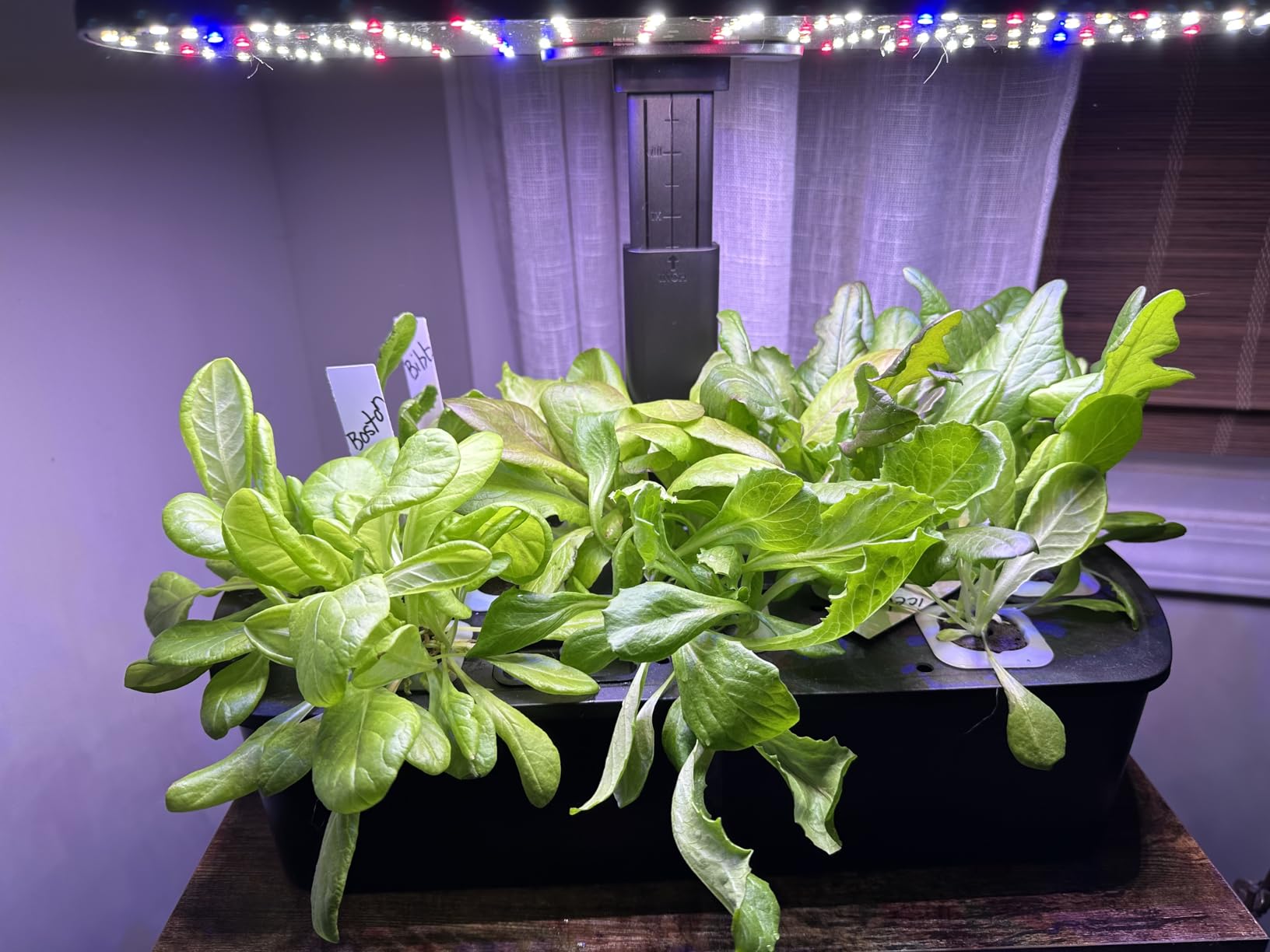
Buyers like the large tank, easy assembly, and quiet pump, and report strong herb growth within weeks. The kit includes seed pod accessories, an instruction manual, and a 2-year service period.
Best case for a bigger reservoir
Refill frequency scales with plant load and temperature. A 12-site system in a warm apartment drinks faster than a 6-site system, and warm apartments are exactly where a 4-liter tank turns into a twice-weekly job.
For a one-bedroom with a dedicated corner, that capacity buys you a genuinely hands-off month, and the automatic timer keeps circulation consistent whether you are home or not.
Where it falls short
Owners report the light and pump being bright and audible enough to notice in a very small apartment, which is the trade for the larger reservoir. There are also a few reported pump and power supply failures after short periods of use.
Two smaller problems are worth knowing. A power interruption scrambles the program and can leave the light on overnight, and replacement sponges and baskets are hard to match exactly to this model, so plan on a full pod replacement rather than spot repairs.
10. SereneLife Smart Starter Kit, 6 Pods – Best for a Single Windowsill
- Only 6 pods
- the fewest sites in the group
- Three timer modes give more choice than fixed 16/8 cycles
- Light rotates 180 degrees with brightness and height adjustment
- Large seed pods suit pre-germinated seeds
- Included covers fit unused pod openings
- Lowest average rating in the group at 4.2
- Water level indicator reported to be unreliable
- A small number arrived faulty or lost power
- Only 6 sites limits total harvest volume
Six pods is the honest minimum for someone who wants herbs, not a garden. If you are cooking with basil two or three nights a week, this is enough, and it is small enough to live on one windowsill without reorganising anything.
What makes it worth considering is the timer. Three modes, 8 hours on, 16 hours on, and a dedicated 8-hour off cycle, give you more scheduling choice than the single fixed cycle most competitors offer. If you want a shorter cycle in a bright room, this is the unit that lets you.
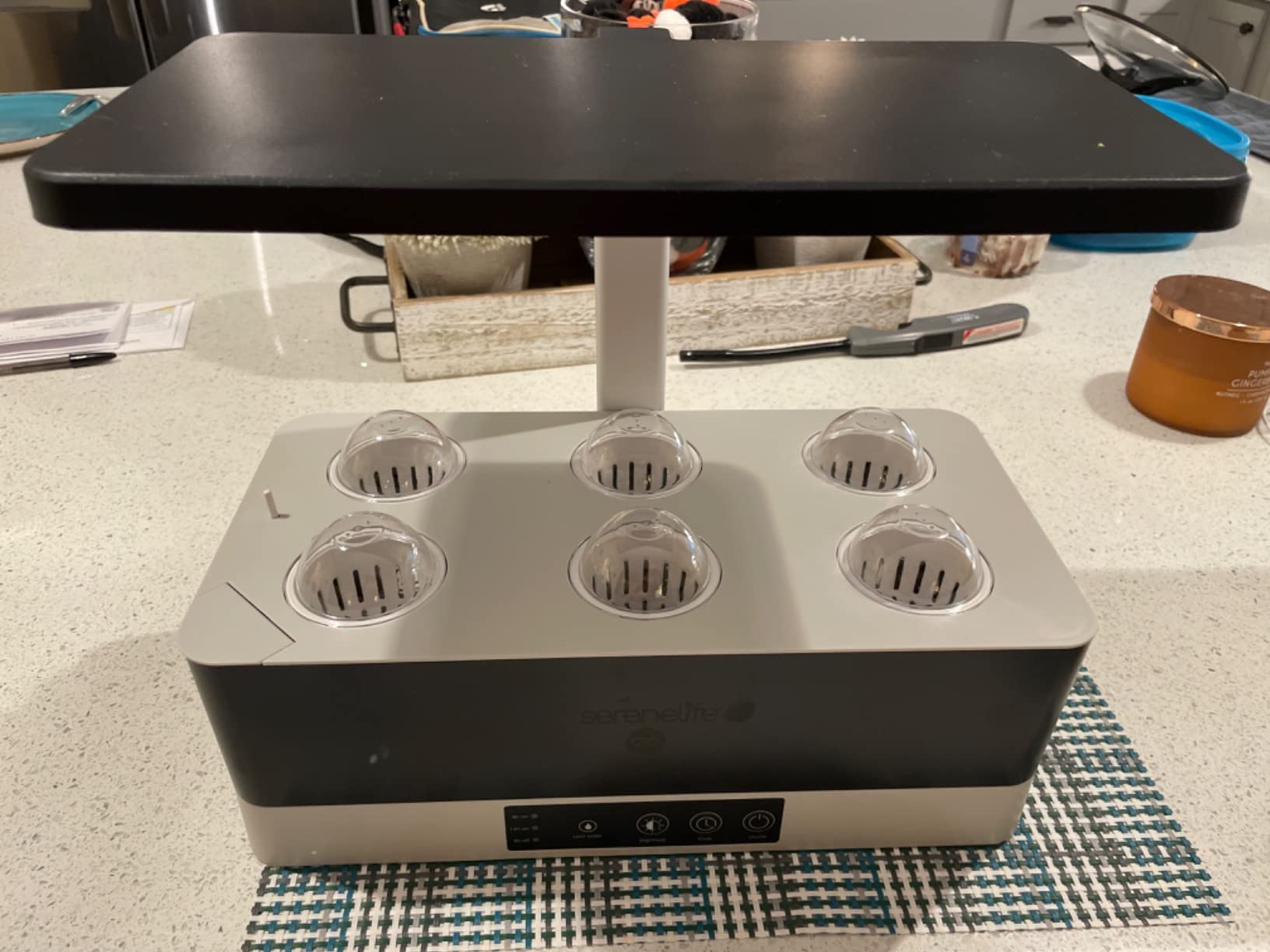
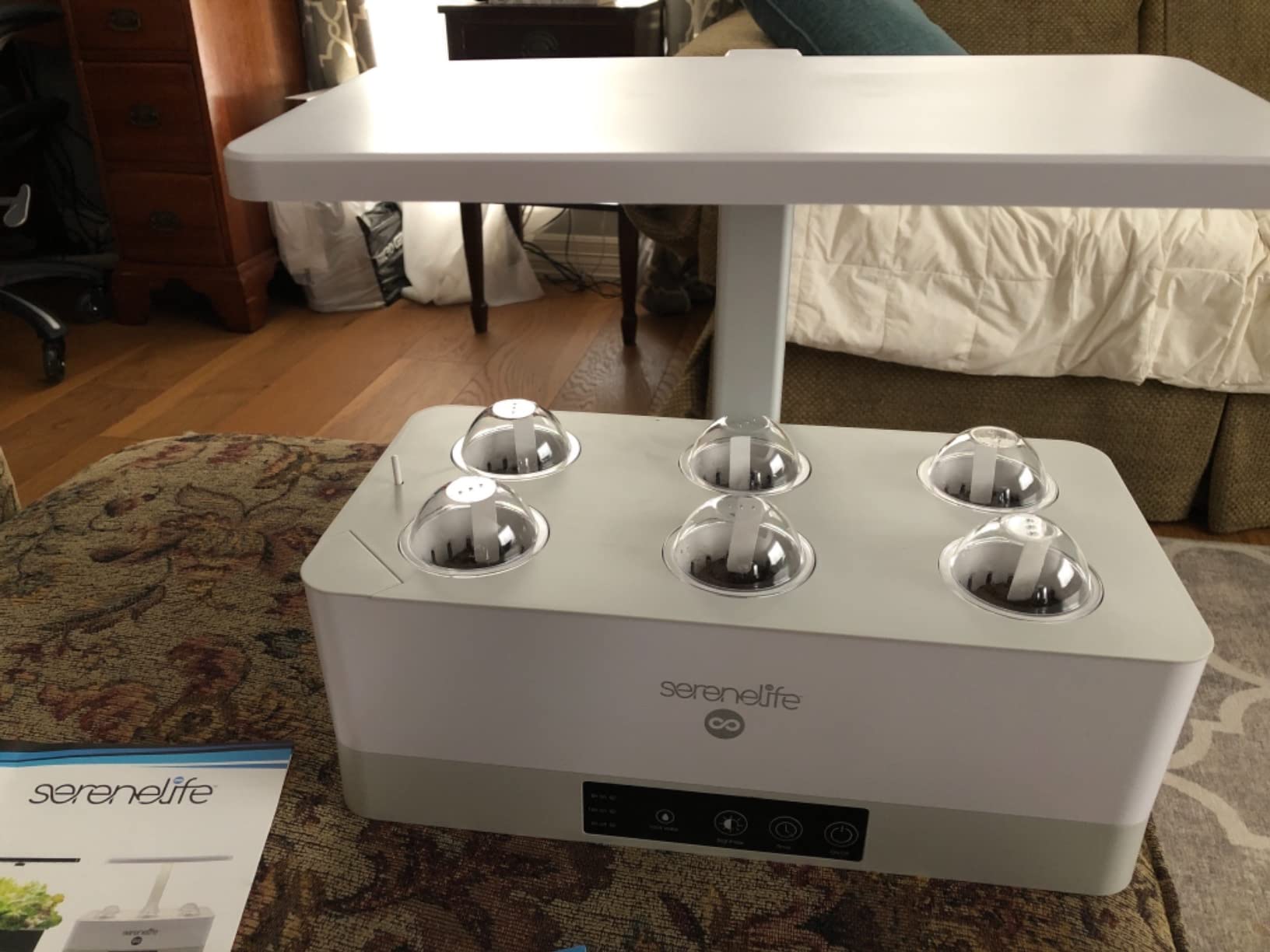
The 24-watt LED rotates 180 degrees and adjusts in both brightness and height, and the kit includes net pots, seed pods, nutrients, growing medium, and a control panel. The seed pods are roomier than many competitors, which suits pre-germinated seeds better than a small plug.
Covers fit over unused pod openings, which keeps light out of empty sites and stops a site from growing algae. The reservoir uses a water stick indicator rather than a sight window, so you check by lifting the stick rather than looking through plastic.
Where a small unit still wins
There is a real argument for the smallest system on this list. A six-pod unit is cheap to run, takes a fraction of the counter, and can be carried to whichever window gets the light. For a renter who is not sure they want to keep a system at all, that flexibility is worth having.
The three timer modes also matter more than they sound in a north-facing or low-light apartment, where a full 16-hour cycle at full brightness is not always the right answer.
Where it falls short
This unit carries the lowest average rating in the group at 4.2 and the largest share of one-star reviews, and the reasons are specific. The water level indicator is reported to fall apart or fall over in the tank, and a small number of systems have lost all power or arrived non-functional.
With only six sites, total harvest volume is limited, and the included water line marker does not fit. If you want a dependable unit rather than the smallest one, the URUQ 8-pod or the iDOO 12-pod is a safer bet.
How to Choose a Hydroponic System for a Small Apartment
Measure first, buy second. Nearly every return in this category traces back to a unit that did not fit the counter it was bought for, or a light bar that could not reach the plants it was bought for.
Measure the space, including the wall clearance. Take the width of the usable counter, subtract a few inches on each side for air and lifting, and check the depth. The two shallowest systems in this roundup are the Ahopegarden 10-Pod at 6.69 inches and the Sainlogic at 5.11 inches. If your counter is a strip between a backsplash and an appliance, depth is the number that decides it.
Count the plants you will actually eat. A 12-pod system already feeds two people three nights a week, which is the single most useful thing we found in apartment growing communities. Most buyers over-buy, then under-harvest, then lose interest. Six to eight pods is a realistic first system for one person. Ten to twelve is a shared household or a salad habit.
Decide how the light schedule will work. Most systems here run a fixed 16 hours on, 8 hours off. The LETPOT, the Ahopegarden 12-Pod LCD, and the SereneLife give you more control, through an app or a menu. If you are often out in the evening, some control is worth paying for. If you are not, a fixed cycle is fine and one less thing to configure.
Set a noise limit before you shop. Only two products in this roundup publish a decibel figure, and both sit under 20 dB, which is quiet enough for a bedroom. The rest describe their pumps as quiet without a number. Treat a published dB as a real signal and a quiet adjective as a claim.
Budget for the running cost, not just the unit. A 24-watt LED on a 16-hour cycle uses roughly 0.38 kWh a day, or about 11.6 kWh over a 30-day month, before pump draw. Add an A and B nutrient refill every few weeks and the per-month cost of a system like this is modest but not zero, which is worth knowing before the pods go in.
The system types you will see in stores
Countertop pod gardens are what almost everyone in this roundup bought. Roots sit in net pots above a reservoir, a small pump circulates the solution, and a full-spectrum LED sits above on a timer. They are the easiest type to start with because there is no plumbing and no assembly beyond three steps.
Deep water culture is the underlying method: the roots hang in an aerated nutrient solution. It is forgiving, and it is what most countertop systems approximate with a periodic pump cycle rather than continuous aeration.
The Kratky method is passive deep water culture with no pump at all. You fill the container, plant, and walk away. As the water level drops, an air gap forms at the top and the roots reach up for it. Kratky growers in r/kratky report over a year of reliable results in mason jars for leaf lettuce, with clear limits once plants get larger.
Nutrient film technique runs a thin film of water through a channel past the roots. Reddit users in apartment threads frequently recommend a single long NFT run over stacking a tower, specifically to save floor area, but NFT requires a slope and a reservoir feed that most renters should not plumb into a unit.
Wick systems pull solution up by capillary action with no pump, which is the quietest option and the lowest yielding. They belong in a decorative windowsill role rather than a serious harvest.
Renting, leases, and the water question
Check your lease before you buy, and keep the system off any surface where water would damage it. Most leases do not prohibit an indoor garden, and the real risk is not the plants, it is a leak, an overflow, or a landlord finding a wet floor and a soaked baseboard after the fact.
Two rules keep you out of trouble. Never plumb a hydroponic system into a household water line, and never place a reservoir where a splash reaches an outlet, a power strip, or hardwood. Forum renters in r/Hydroponics describe shelf and metal-rack builds as the realistic apartment format, and the reason is that a raised shelf catches a spill before it reaches the floor.
Nobody needs a drill for any unit in this roundup. They all sit on a counter, take up no wall space, and move with you. The one item worth planning for ahead of an inspection is a surge-protected power strip, because several systems here leave their light on after a power interruption.
Humidity, odor, and bugs
Hydroponics does not smell, provided you change the solution. An old reservoir is the source of every bad-hydroponics story, and it is entirely a function of how often you drain and refill.
Algae comes from light reaching the reservoir, which is why covered unused pod sites matter, and why opaque tanks outperform clear ones. Pests are not attracted by the water. Fungus gnats come from organic surface matter, so keeping the reservoir lid and dome in place does most of the work. Running two systems in one small room does raise humidity, so if your apartment is already humid, start with one.
One warm-weather failure mode is specific to apartments. Warm water holds less oxygen and encourages root rot, and a unit on a sunny counter in an unventilated room heats up faster than a unit in a garden. Top up with cool water rather than warm, and drain and replace the solution every few weeks.
What You Can Actually Grow in an Apartment
The reliable list is short, and knowing it saves a lot of disappointment. Lettuce and all leaf greens, basil, mint, cilantro, parsley, chives, and other fast herbs are the core. Microgreens are fast enough that a small system pays for itself quickly. Strawberries and small chili peppers work if the light bar is tall enough, which in this roundup realistically means the LETPOT.
Three groups are not recommended for a small apartment system. Root vegetables such as carrots, beets, and radishes need far more medium and depth than a net pot offers, and the result is a stunted, forked plant. Large vining crops like full-size tomato need either a very tall light or a balcony, and the pod spacing here will not hold them. Deep-rooted plants such as beets and most woody herbs want soil.
Size your system to your cooking, not to the pod count. If you use basil twice a week, six pods is a garden. If you want a salad every night for two people, eight to twelve is right. Anything past twelve in a small kitchen is inventory management, not growing.
Travel weeks work. A 5L or 6L tank with a pump on a timer is genuinely hands-off for seven days, which is why the larger-tank picks rank where they do. Before you leave, top the reservoir to full and leave the light timer alone rather than changing it on the way out.
Frequently Asked Questions
What is the best small hydroponic system?
For most small apartments the iDOO 12Pods is the best overall pick, because a 4.5L tank, 12 plant sites and a 22-watt light fit into a 13.78 by 12.09 inch footprint and need refilling only every one to two weeks. In a studio where counter depth is the constraint, the Ahopegarden 10-Pod is narrower at 6.69 inches deep and its pump is quieter.
What is the easiest hydroponic system for beginners?
A countertop pod garden is the easiest place to start, because it needs no plumbing, no assembly beyond extending two rods, and a fixed 16-hour light cycle. Among these, the URUQ 8-pod is the gentlest entry point: eight sites, a water shortage indicator, a detachable light pole, and a pump documented under 20 dB. Start with lettuce and basil, which forgive beginner mistakes more than fruiting plants.
What are 5 disadvantages of hydroponics?
The five that matter most in an apartment: the upfront cost of a system plus nutrients and pods, the constant electricity draw from a light running 16 hours a day, pump and timer failure risk that ends the cycle if you are travelling, warm water in a small unventilated room encouraging root rot, and the learning curve of a system that needs topping up and solution changes every few weeks instead of being ignored for a week.
What are three plants that are not recommended for hydroponics?
Three to skip in a small apartment system: root vegetables such as carrots, beets and radishes, which need far more medium and depth than a net pot provides; large vining crops such as full-size tomatoes, which need a much taller light bar than a pod garden offers; and deep-rooted or woody plants, which want soil rather than a nutrient solution. Stick to lettuce, herbs and microgreens instead.
Do hydroponic systems smell in apartments?
A properly maintained system does not smell, and the reason most people hear about hydroponic odor is an old reservoir. Drain and replace the solution every few weeks, wipe the tank, and keep the lid in place so light does not reach the water. A covered reservoir also prevents algae, which is the most common source of a musty smell in a small room.
Will my landlord object to a hydroponic system in my apartment?
Most leases do not prohibit an indoor garden, but the real risk is water damage rather than the plants. Check your lease, never plumb a system into a household water line, keep the reservoir away from outlets and power strips, and place it on a surface where a splash cannot reach flooring. Every unit in this roundup needs no drilling and moves with you when you leave.
How much space does a hydroponic system need?
A countertop pod garden needs its listed footprint plus a few inches of clearance on each side, and counter depth is usually the binding constraint. Several units in this roundup are under 6 inches on their narrowest listed dimension, while the widest listed figure across the group runs to 19 inches. Above the counter, allow for light-bar travel of 12 to 30 inches depending on the model, and keep a margin so you can lift the reservoir to refill it.
How much electricity does a hydroponic tower use per month?
For the countertop systems here, a 22 to 24 watt LED running a 16-hour cycle uses roughly 0.35 to 0.38 kWh per day, or about 11 kWh over a 30-day month, plus a small amount for the pump. Add an A and B nutrient refill every few weeks. The running cost is modest, but the light is the reason a system belongs where you can switch it off when you travel.
Final Verdict: The Best Hydroponic Systems for Small Apartments in 2026
The best hydroponic systems for small apartments in 2026 come down to two variables: how deep the counter is and how close your bed is. Take the iDOO 12Pods if you have normal counter depth and want the most capacity in a small rectangle, the Ahopegarden 10-Pod if you are in a studio and need a shallow, quiet body, and the LETPOT Senior 12-Pod only if you want app scheduling and the light reach to grow a tomato.
Everything else on this page is a variation on those three ideas. Start with eight pods if you are unsure, buy the largest tank you can lift, keep the reservoir away from your outlets, and pick a light schedule you can live with for the next six months. Then check the other small-space upgrades we cover, like the full-length mirrors that make a small apartment feel larger and the loveseats sized for tight living rooms, so the whole space works harder for you.